The parterre stretches in perfect geometric symmetry, clipped hedges forming patterns that have remained unchanged since the early 19th century. Muskau Park, straddling the border between Germany and Poland, is the largest English-style landscape garden in Central Europe, a masterpiece of landscape architecture created by Prince Hermann von Pückler-Muskau. The park covers over 700 hectares, blending open meadows, woodland, and winding waterways into a composition that appears natural but is entirely designed. The neo-renaissance castle at the park’s heart anchors the design, its reflection shimmering in the lake.
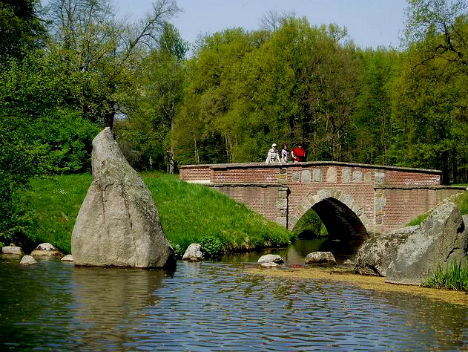
If you plan to visit Germany or Poland, you should reserve at least a moment to see one of the most beautiful parks in Europe – Muskau Park (Muskauer Park in German or Park Mużakowski in Polish). Walking through this picturesque piece of nature can help you to forget about everyday stress and worries. The park stretches along both banks of the Neisse River, with the border between the two countries running through its heart. This unique cross-border location makes it one of the most accessible UNESCO World heritage sites in Europe, reachable from Berlin in under two hours by car and from Wrocław in just over ninety minutes.
Photo licensed under the Creative Commons, created by Udo Schröter
In This Article
The History and Design Philosophy of Muskau Park
Muskau Park is located on the border between Poland and Germany, along the Neisse River. It covers an area of over eight hundred hectares, thus it is one of the largest and certainly the most famous English parks in both countries. The park includes also two magnificent castles – An Old Castle, dating back to the 13th century and two centuries younger New Castle. Right here, beside those two castles, was Muskau Park founded in 1815. The founder was Prince Hermann Ludwig Heinrich von Pückler-Muskau, whose name is probably not missing in any publication of the garden architecture. He was an excellent artist in landscape gardening and wrote also several great publications about a harmony between a nature and human activity. In 1834 he summarized his ideas and findings into the publication, which meant a complete breakthrough in this area. Unfortunately, not all plans could be implemented. The cost of construction of the park and extensive reconstructions of the adjacent castles greatly exceeded the architect’s investment options. In 1845 Pückler was forced to sell the park and the adjacent estate, and the new owner engaged the famous landscape architect Eduard Petzold to complete the works. Petzold, a student of Pückler, faithfully carried forward the original vision while adding his own touches to the landscape.
Photo licensed under the Creative Commons, created by Udo Schröter
World War II Damage and Post-War Restoration
Muskauer Park was seriously damaged during World War II. Both castles and surrounding structures, including bridges, were destroyed by bombing. In addition, the park was in 1945 divided into two parts, which made its reconstruction very complicated. More than two thirds of the area fell to Poland and the rest to Germany. The closer cooperation between those two parts started in the 1990s of the last century, while the reconstruction work is still being done. Today, the Polish and German park authorities work together on conservation projects, applying for joint funding and coordinating restoration efforts across the border. The reconstruction has been painstaking, with gardeners using historical plans and paintings to restore the original planting schemes and sight lines that Pückler designed. Not only the life-work of Hermann von Pückler, but also the way how Muskau Park was created, greatly influenced the development of landscape architecture in Europe and America. This is why the park was in 2004 inscribed on the UNESCO World heritage List.
Exploring the Park and the Castle
Muskau Park, designed by Prince Hermann von Pückler-Muskau between 1815 and 1845, covers 700 hectares straddling the Neisse River border between Germany and Poland. The park features English-style landscaping with winding paths, artificial lakes, and carefully framed vistas. The New Castle, rebuilt after WWII damage, houses a museum of landscape architecture and a restaurant. A footbridge crosses the river into the Polish section of the park, where the Old Castle houses a conference centre. Entry to the park is free. The best months are May through September when the rhododendrons and azaleas bloom. The town of Bad Muskau offers accommodation from 60 euros per night. The park is now open for visitors every day from 10 to 18 hours, winter months excluded. The admission is free. For those who want a deeper experience, guided tours in both German and Polish are available by advance booking, and cycling routes connect the park to nearby towns on both sides of the border.
Have you ever explored a landscape garden designed to look perfectly natural? 🌿
Explore all our Germany travel guides, from Berlin buzz to Bavaria castles.
Explore More
If you enjoyed this article, you might also like:
