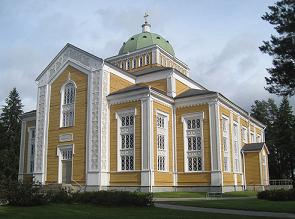
The church sits in a small town 85 km northwest of Savonlinna, surrounded by birch forest and lake country. From the outside it looks like a traditional Finnish wooden church, white with an ocher cross. Then you see the scale. The spire reaches 37 metres. The nave is 27 metres high inside. The building can hold 5,000 people in a municipality that has fewer than 5,000 residents. Kerimaki Church is the largest wooden church in the world, built in 1847, and the story of how it got that way is the most Finnish story you have ever heard.
In This Article
The Miscommunication Theory and the Real Story
The popular legend says that the architect, Anders Granstedt, drew the plans in inches and the builder, Juhana Salonen, read them as feet, resulting in a church 2.54 times larger than intended. The truth is less colourful and more practical. The parish of Kerimaki had 12,000 members in the 1840s. The pastor, Johan Fredrik Bjork, believed that half the congregation should fit inside the church for major services. The building was designed deliberately to that scale from the start. Granstedt submitted plans for a church seating 3,000 with room for 2,000 standing. The Russian authorities, who controlled Finland at the time, approved the dimensions in 1845. Construction took two years and cost 60,000 Finnish marks.
The Interior: How You Heat a Church the Size of a Football Field
The nave is 27 metres high and the floor area covers 1,400 square metres. Originally, eight stoves were installed to heat the space. Even with all eight burning, the temperature rarely rose above 10 degrees Celsius in winter. Four stoves remain today, converted to oil heating in the 1950s and then to electric in the 1980s. The winter chapel, a smaller space seating 300, was built alongside the main church to allow services to continue in the cold months. The altar painting, “Christ on the Cross” by Berndt Godenhjelm from 1855, is the focal point. The altar is framed by two columns carved to resemble marble. The pulpit, decorated with paintings of the four evangelists, is reached by a spiral staircase.
Summer Services and the Church Boat Tradition
The main church holds services only in summer, from June to August. The liturgy follows the traditional Finnish Lutheran form and the singing, unaccompanied, fills the vast wooden space with an acoustic that was designed for voice alone. The church boat tradition, the kirkkovene, was how parishioners from remote lake-side villages reached Sunday services. A single kirkkovene carried up to 60 people, rowed by the men of the village while the women and children sat in the stern. The boats were up to 15 metres long. The tradition died out in the early 20th century when roads replaced lake routes. A restored kirkkovene is displayed on the church grounds.
What would a 27-metre-high wooden ceiling sound like with 5,000 people singing a hymn inside it?
Explore all our Finland travel guides, from Helsinki design to Lapland wilderness.
Explore More
If you enjoyed this article, you might also like:
