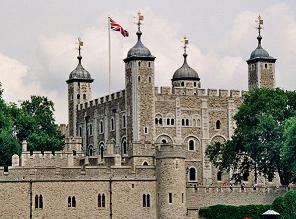
Nine hundred years of history is a long time for a building to stay relevant. The Tower of London has managed it by being everything at once: a fortress, a prison, a palace, a mint, a zoo, an armoury, and a tourist attraction. The White Tower, the central keep, was built by William the Conqueror in 1078. Since then, the site has grown to 12 acres enclosed by two curtain walls and a moat that no longer holds water. Here is what sits inside those walls.
\\n\\n
In This Article
The Crown Jewels: 23,578 Gems Under Guard
\\n
The Jewel House, a purpose-built underground vault completed in 1994, holds the Crown Jewels. The collection includes the Imperial State Crown, made in 1937 for George VI and reset for Queen Elizabeth II in 1953. The crown contains 2,868 diamonds, 17 sapphires, 11 emeralds, 269 pearls, and 4 rubies. The Star of Africa diamond, the largest colourless cut diamond in the world at 530 carats, sits in the Sovereign’s Sceptre. The Crown Jewels have been housed at the Tower since 1303, when the previous treasury at Westminster Abbey was robbed. The entire collection is valued at roughly 3 billion pounds. The moving walkway carries visitors past the display cases at a steady pace. You have roughly 90 seconds in front of the main crowns.
\\n\\n
The Prisoners: Who Went In and Who Came Out
\\n
The Tower’s first recorded prisoner was Ranulf Flambard, the Bishop of Durham, in 1100. He escaped by climbing down a rope smuggled in a wine barrel. Anne Boleyn, the second wife of Henry VIII, was held in the Queen’s House in 1536 before her execution on Tower Green. The scaffold was removed after the execution of Lord Lovat in 1747, the last person beheaded in Britain. Guy Fawkes was tortured in the Queen’s House in 1605 after the Gunpowder Plot. Rudolf Hess, Hitler’s deputy, was imprisoned in the Tower for four days in 1941. In total, the Tower held over 8,000 prisoners between 1100 and 1952, when the last prisoners, the Kray twins, were held for a short period.
\\n\\n
The Ravens: The Birds That Hold the Kingdom
\\n
The Tower has maintained a resident population of six ravens since the reign of Charles II, who was told that the kingdom would fall if the ravens left. The ravens on duty are named Jubilee, Harris, Dunlop, Rocky, Poppy, and Rex. Each bird has a clipped flight feather on one wing to prevent it from flying away. The Ravenmaster, a Yeoman Warder appointed to the role, feeds them 170 grams of raw meat per day, supplemented with blood-soaked biscuits. The ravens have an average lifespan of 25 years in captivity. The oldest recorded Tower raven lived to 44.
\\n\\n
If you could go back to witness one event at the Tower of London, which year and what scene would you choose?
\\n
Explore all our United Kingdom travel guides, from London landmarks to the Scottish Highlands.
Explore More
If you enjoyed this article, you might also like:
- A Weekend in Cool Brighton – United Kingdom
- South Bank – a significant arts and entertainment district of London | United Kingdom – United Kingdom
- Siccar Point rocky promontory in Scotland, United Kingdom – United Kingdom
