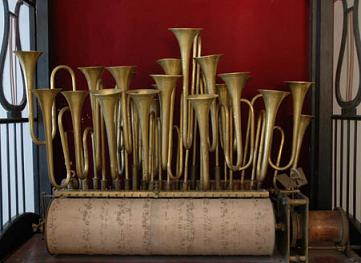
The first sound you hear is a piano note hanging in the air. It drifts from somewhere deep inside the building, layered over the hum of voices and footsteps on wooden floors. At the Museum of Music in Prague, every exhibit invites you to listen. Antique violins rest in glass cases while their digital ghosts play melodies through hidden speakers. You can press a button and hear how a harpsichord sounded in a 17th century ballroom. Children run their fingers along interactive walls that produce chimes and drones. The museum occupies a former Baroque church, so even the silence has a cathedral quality to it.
In This Article
The Building and the Collections
The Czech Museum of Music, part of the National Museum in Prague, occupies a former Baroque church of St. Mary Magdalene in the Mala Strana district, a 15-minute walk from Prague Castle. The building was constructed in the 17th century as a church and monastery for the Discalced Augustinians. It retains its original vaulted ceilings, frescoes, and ornate stucco work, which create an atmosphere unlike any other museum in the city. After a comprehensive restoration completed in 2014, the interior combines Baroque grandeur with modern museum design. Glass display cases sit beneath painted cupolas, and interactive terminals are tucked into alcoves that were once confessionals. The museum holds over 700,000 items, including musical instruments, manuscripts, printed scores, and archival recordings. The permanent exhibition is spread across 1,200 square metres on three floors and is organised thematically, covering the history of Czech music from medieval times to the 20th century. Among the most treasured pieces on display are a violin by Antonio Stradivari built in 1693, one of only 650 surviving Stradivarius instruments in the world. There is also a clavichord owned by Wolfgang Amadeus Mozart, which he played during his visits to Prague in 1787. The personal scores of Bedrich Smetana and Antonin Dvorak are displayed in a climate-controlled case, including Smetana’s autograph score of “Ma vlast” (My Homeland), the cycle of symphonic poems that includes the famous Vltava River movement.
Interactive Exhibits and the Concert Programme
What sets the Museum of Music apart from traditional instrument collections is its emphasis on sound and interactivity. Every display case includes audio stations where visitors can hear the instruments being played, often with period-appropriate recordings. The interactive zone on the first floor allows visitors to try replicas of historical instruments including a harpsichord, a clavichord, and a small pipe organ. Visitors wear headphones so the sound is clear without disturbing other guests in the museum. There is also a touch screen that demonstrates how musical notation evolved over the centuries, allowing users to compare a Mozart manuscript with a Smetana score side by side. The museum hosts a regular programme of concerts in the former church nave, taking full advantage of the spectacular acoustics of the Baroque hall. The vaulted ceiling and stone walls create a natural reverb that enriches every note. String quartets, chamber orchestras, and solo piano recitals are held on most Friday and Saturday evenings, with ticket prices ranging from 10 to 20 euros. The programme changes monthly and features both established Czech musicians and emerging international performers. Many visitors plan their museum visit to coincide with an evening concert, as the combination of the daytime exhibition and an evening performance creates a complete musical experience that can easily fill an entire day.
Visitor Information and Nearby Attractions
The Czech Museum of Music is located at Karmelitska 2/4, Prague 1, in the Mala Strana district. It is open Tuesday through Sunday from 10:00 to 18:00, with last admission at 17:15. The museum is closed on Mondays. Entry costs 8 euros for adults, 4 euros for students and seniors, and a family ticket covering two adults and up to three children costs 16 euros. Photography is permitted without flash or tripod. The museum is fully wheelchair accessible, with a lift connecting all three floors. Audio guides are available in Czech, English, German, Russian, and French. The nearest public transport stops are Malostranske namesti, served by trams 12, 15, 20, and 22, and Malostranska metro station on line A. The museum cafe on the ground floor serves coffee, tea, and light snacks in a pleasant setting beneath the Baroque vaulted ceiling. For those who want to explore further, the nearby Lennon Wall, a colourful tribute to John Lennon and a symbol of peaceful protest during the Communist era, is a 5-minute walk away. Charles Bridge and Prague Castle are both within a 10-minute walk, making it easy to combine the museum with a tour of the city’s most famous landmarks.
What instrument would you most want to hear played inside a Baroque church turned museum? 🎵
Explore all our Czech Republic travel guides, from Prague spires to Moravian wine country.
Explore More
If you enjoyed this article, you might also like:
