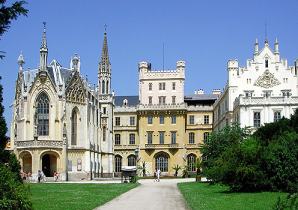
A fairy tale castle reflected in still water, its white walls and ornate spires rising above manicured gardens. The Lednice Valtice Cultural Landscape is one of the largest artificial landscapes in Europe, a sprawling estate that the House of Liechtenstein shaped over centuries. The scent of clipped hedges and blooming roses drifts through formal gardens. A Gothic style minaret rises unexpectedly from the trees, a romantic folly built for the pleasure of looking out over the estate.
Lednice-Valtice Area, sometimes called the “Pearl of South Moravia”, is a region in south-east of Czech Republic, close to Slovak and Austrian borders. This region, covering an area of almost 300 km2, was ruled by the dukes of the Liechtenstein family between the 17th and 20th centuries. The dukes built many towns, villages and castles in the area and created such a big and romantic park.
Most of the buildings in Lednice-Valtice Area were designed by the famous architect Johann Bernhard Fischer von Erlach in the Baroque style. These intermingled with the existing castles of Lednice and Valtice which are in the Classical and Neo-Gothic styles. The result is one of the largest artificial landscapes in Europe. Johann Bernhard Fischer von Erlach also designed many of the buildings in Salzburg, Austria, which is another UNESCO World heritage city.
The Lednice-Valtice Cultural Landscape was inscribed as a UNESCO World heritage Site in 1996.
The Lednice-Valtice Area is the home of a romantic chateau, a picturesque village and in particular a jewel of landscape architecture of unprecedented proportions. The notional milestone at the beginning of the long period of development of this whole area is the end of the 14th century, when the Liechtenstein family obtained a share of the land.
Best option for visiting this landscape is using the bicycle.
View Lednice-Valtice Cultural Landscape – one of the largest artificial landscapes in Europe Czech Republic in a larger map
Castle Interiors and the Valtice Chateau
The interiors of Lednice Castle are a showcase of 19th-century aristocratic taste, with rooms decorated in Gothic Revival, Neo-Renaissance, and Neo-Baroque styles reflecting the Liechtenstein family’s evolving preferences. The highlight is the grand staircase, a sweeping spiral of carved wood and wrought iron that rises through three floors illuminated by a stained glass window depicting scenes from the legend of the Grail. The library contains over 20,000 volumes, including illuminated medieval manuscripts, early print Bibles, and botanical folios with hand-coloured engravings. The Moorish-style smoking room, with its intricate geometric plasterwork and hanging lanterns, reflects the 19th-century fascination with Oriental design. Guided tours of the castle interior last approximately one hour and cost 8 euros for adults.
Five kilometres south of Lednice lies the Valtice Chateau, the other jewel of the estate. Valtice served as the Liechtensteins’ primary summer residence, and its Baroque facade and richly decorated state apartments rival the grandeur of Lednice. The chateau’s Marble Hall, with its ceiling fresco depicting the apotheosis of the Liechtenstein dynasty, is one of the finest Baroque interiors in the Czech Republic. The chateau also houses a wine museum, located in the vaulted cellars that once stored the estate’s wine production, providing an introduction to the Moravian wine region. A combined ticket for both castles costs 15 euros and is valid for two days.
The Moravian Wine Region
The Lednice-Valtice estate sits within the Moravia wine region, which produces 95 percent of the Czech Republic’s wine. The warm, sunny slopes and limestone-rich soils around the estate create ideal conditions for white grape varieties, particularly Müller-Thurgau, Riesling, and Grüner Veltliner, as well as the aromatic Pálava variety developed locally. The wine trail connecting Lednice and Valtice passes through vineyards and past wine cellars where many producers offer tastings. The annual Wine Festival of Valtice, held in September, gathers over 100 local winemakers in the chateau courtyard and is the largest wine event in the Czech Republic. Wine tastings at the individual cellars cost approximately 5 to 10 euros for a flight of five to seven wines. Many cellars also sell bottles directly, with prices ranging from 5 euros for table wines to 25 euros for premium reserve selections. The Moravian wine region is a hidden gem compared to its Austrian and German neighbours, and combining castle visits with wine tasting makes for an exceptionally rewarding day.
Would you climb the minaret for a view over the estate? 🏰
Explore all our Czech Republic travel guides, from Prague spires to Moravian wine country.
Explore More
If you enjoyed this article, you might also like:
- Jindřichův Hradec – unique Gothic and Renaissance town in Czech republic – Czech Republic
- Top 15 sights to see in Prague – Czech Republic – Czech Republic
- Aquapark Babylon – biggest water fun in the Czech Republic – Czech Republic
