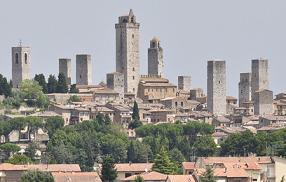
Fourteen stone towers cut a jagged silhouette against the Tuscan sky, their medieval pinnacles rising like fingers reaching for heaven. From the ramparts of Rocca di Montestaffoli, vineyards stretch in every direction, geometric rows of Sangiovese vines fading into a golden haze. The cobbled Via San Giovanni climbs past stone houses that lean inward, their facades untouched since the 13th century. Inside the Collegiata, frescoes blaze in ultramarine and ochre, telling stories of saints and sinners to visitors who step out of the bright sun into the cool hush of incense and old stone. San Gimignano is a vertical vision, frozen in time.
San Gimignano, the city of the beautiful towers, is a small walled medieval hill town located in north-central Italy in the province of Siena, Tuscany. The town lies 56 km south of Florence and 38 km north-west of Siena. It was founded as a small village in the 4th century BC, as the first Etruscan settlement named Velathri. San Gimignano is famous for its medieval architecture, especially its towers, which may be seen from several kilometres outside the town, and is also known for the white wine, Vernaccia di San Gimignano.
In 1990 the historic center of San Gimignano has been included in UNESCO World heritage Sites. It is a good one-day travel tip for those visiting Pisa, Firenze and Siena.
The Iconic Towers of San Gimignano
The towers of San Gimignano are the defining feature of this Tuscan hill town and the reason it is often called the “Medieval Manhattan.” Originally, 72 towers pierced the skyline, built between the 12th and 13th centuries by the town’s wealthy aristocratic families as symbols of power and prestige. The tallest tower still standing is the Torre del Podestà, also known as the Torre Rognosa, which reaches 51 metres and dominates the Piazza del Duomo. A close second is the Torre degli Ardinghelli, a twin tower that stands slightly shorter at 47 metres. The competition among families to build the tallest tower was so fierce that the city government eventually passed laws capping the height of new towers to prevent instability and maintain a degree of social order.
Today, 14 towers remain, and several are open to the public. Climbing the Torre Grossa, the tallest tower accessible to visitors at 54 metres, rewards those who brave the steep wooden staircase with a breathtaking 360-degree view of the Val d’Elsa valley, the surrounding vineyards, and the distant skyline of Siena on clear days. The towers serve as a vertical timeline of San Gimignano’s history: the tallest and most ornate were built during the city’s golden age in the 13th century, when its position on the Via Francigena pilgrimage route made it a prosperous trading centre. After the Black Death of 1348 devastated the population and the city came under Florentine control, no new towers were built, and many of the original 72 were gradually dismantled or reduced in height. The surviving towers are now protected as part of the UNESCO World heritage site and have become the most photographed landmark in Tuscany after Florence’s Duomo.
Wine and Local Specialities of San Gimignano
San Gimignano is as famous for its wine as it is for its towers. The surrounding hills are covered with vineyards producing Vernaccia di San Gimignano, one of Italy’s most prestigious white wines and the first Italian wine to receive DOCG status in 1993. Vernaccia is a crisp, mineral-driven white wine with notes of green apple, pear, and almond, perfectly suited to the local cuisine. The wine’s history stretches back to the 13th century, when it was praised by Dante Alighieri in the Divine Comedy and served to popes and princes across Europe. Today, over 200 producers in the area cultivate Vernaccia on the region’s distinctive limestone-rich soils, and most welcome visitors for tastings. The local wine shop, La Buca delle Fate on Via San Giovanni, offers tastings of more than 50 local Vernaccia labels and can ship bottles home.
The culinary traditions of San Gimignano extend well beyond wine. The region produces some of Tuscany’s finest olive oil, pressed from the local Frantoio and Leccino olives that thrive on the sun-baked hillsides. Saffron, grown in the area since the Middle Ages, is used in local risottos and pasta dishes, giving them a distinctive golden colour and earthy flavour. The town’s bakeries produce a traditional saffron and pine nut biscuit called brutti ma buoni (ugly but good), while the gelateria Dondoli on Piazza della Cisterna has won multiple international gelato championships. For a true taste of the region, try the pici cacio e pepe, a hand-rolled pasta with pecorino cheese and black pepper, paired with a glass of chilled Vernaccia on a terrace overlooking the Tuscan hills.

My partner and I visited San Gimignano for our road trip adventure and it was absolutely magical. Everything felt perfect — the setting, the food, the pace. We still talk about it years later.