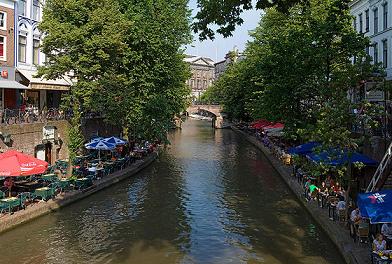
Water laps gently against the brick walls of Oudegracht, the oldest canal in Utrecht, as houseboats and tour boats drift past centuries-old wharf cellars. Unlike any other canal in the Netherlands, this medieval waterway is lined with unique double-level quays, where the lower docks once served as storage for merchants trading along the Rhine. Today those cellar spaces house cozy cafes and boutiques, their terraces spilling onto the water edge.
Oudegracht (The Old Canal) is a historic canal that flows through the center of the city of Utrecht in the Netherlands. It is one of the most famous and most beautiful canals in the country. It is easily accessible on foot from the central station in Utrecht.
Oudegracht begins in the south-eastern part of the city where are joining together the rivers Kromme Rijn and Vaartse Rijn, and where begins the original moat of the fortified town. Oudegracht then continues to the center of Utrecht. Part of Oudegracht follows the original course of the river Rhine, but it is not certain which part of it is.
View Oudegracht – one of the most famous and most beautiful canals in the Netherlands in a larger map
The northern part of Oudegracht is probably older, it dates back to around the 10th century and connects the River Rhine with the River Vecht. The construction of the southern part began in 1122, but then the river level dropped due to the completion of the new dam in Wijk bij Duurstede. Exposed shores were then used to protect the city from flooding. Since 1275 the water level is stable.
Oudegracht form a vibrant center of Utrecht. It is alive on both sides. Here you can sit on numerous outdoor terraces and enjoy the unique atmosphere of the place, watching the ships and boats or take a walk around the water where you can find a quiet picturesque places in the shade of aged trees. Also such a night lit Oudegracht belongs to a very romantic experience.
You can explore the beauty of Oudegracht for hours from its banks, bridges or from the water. There are organized cruises and gondola cruises, or you can rent canoes or paddle boats.
View Oudegracht – one of the most famous and most beautiful canals in the Netherlands in a larger map
The Dom Tower: Climbing Utrecht’s Iconic Spire
Rising 112 metres above the city, the Dom Tower is the tallest church tower in the Netherlands and the undisputed symbol of Utrecht. The tower was built between 1321 and 1382 as part of the Cathedral of Saint Martin, but a devastating storm in 1674 destroyed the nave and separated the tower from the cathedral, leaving the gap that still exists today. Climbing the 465 spiral steps to the top is a rite of passage for any visitor to Utrecht. The narrow staircase winds past the tower’s medieval bells, including the Salvator bell that weighs over 8,000 kilograms and rings only on special occasions.
There are several rewarding stops along the climb. At the first gallery, 30 metres up, you step out onto a viewing platform that offers close-up views of the tower’s Gothic tracery and flying buttresses. A small exhibition room at the second level displays the original medieval crane used to hoist building materials during construction. At the third gallery, 70 metres high, the carillon of 50 bells is visible through glass panels. The final climb to the fourth gallery at 95 metres opens onto a panoramic view that stretches across Utrecht’s medieval skyline to the Utrechtse Heuvelrug hills on clear days. The domkerk, the cathedral that now stands separately from its tower, is worth visiting for its 13th-century crypt, Gothic vaulted ceiling, and the tomb of Bishop Guy of Avesnes. The tower tour takes about 45 minutes and should be booked in advance during summer months to secure a time slot.
Utrecht’s Museum Quarter and Canalside Life
Utrecht offers cultural attractions that extend well beyond its famous canal. The Museum Quarter, located in the eastern part of the city centre, centres on the Centraal Museum, the oldest municipal museum in the Netherlands, founded in 1838. The museum’s collection covers Utrecht’s history from Roman times to the present day, with highlights including the original 17th-century ship buried beneath the canal, a collection of Utrecht Caravaggisti paintings, and the Rietveld Schröder House, a UNESCO World heritage site that is one of the defining buildings of the De Stijl movement. The house, designed by Gerrit Rietveld in 1924, is located a short walk from the main museum building and can be visited with a combined ticket. Tours of the house are limited to small groups, so advance booking is essential.
The wharf cellars of Oudegracht deserve their own exploration beyond simply dining in them. These unique double-level quays, built from the 12th century onward, were originally used for unloading cargo directly from barges into merchant storage. The water level in the canal was raised in the 19th century, permanently flooding the lower quays, which were then converted into the cafes and restaurants that define Utrecht’s social life today. The best way to experience them is to walk along the lower quay on the eastern side of Oudegracht between the Zandbrug and the Stadhuisbrug, where the terraces are sunniest in the afternoon. For a different perspective, rent a pedal boat or take a canal cruise, which passes beneath the low bridges and offers views of the cellars from the water. The werfkelder experience is unique to Utrecht and is one of the reasons the city feels so different from Amsterdam, more intimate and more connected to the water that flows through its historic heart.
Can a canal define the character of a city? 🚤
Explore all our Netherlands travel guides, from Amsterdam canals to tulip fields.
Explore More
If you enjoyed this article, you might also like:
- Discovering Amsterdam: An Area Guide – Netherlands
- Best Day Trips From Amsterdam | The Netherlands – Netherlands
- Amsterdam for Foodies: See the City with a new Perspective – Netherlands
