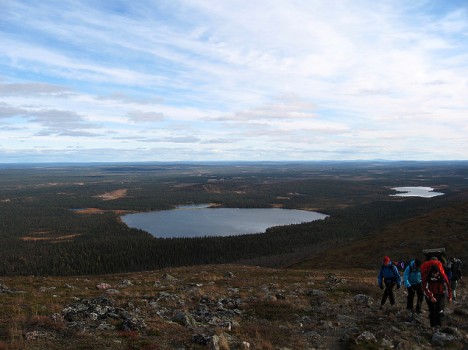
Lapland stretches endlessly under a vast northern sky, and Pallas-Yllästunturi National Park sits at its heart. This is not a park of sharp peaks but of rounded fells, ancient mountains worn smooth by glaciers over millions of years. Birch forests give way to pine, then to open tundra where reindeer graze and golden eagles circle. In winter the snow settles deep and the northern lights dance overhead. In summer the midnight sun paints the landscape in soft amber light for weeks on end. The hiking trails run for hundreds of kilometres between wilderness huts where you can sleep to the sound of wind and running water.
Pallas-Yllästunturi National Park is located in Finland, in the northern part of country, in western Lapland, near the town of Enontekiö. It is the third largest national park in Finland with a total area of 1,020 square kilometres.
Photo licensed under the Creative Commons, created by Victor Sounds
Pallas-Yllästunturi National Park was founded in 2005 by combining Pallas-Ounastunturi National Park and Ylläs-Aakenus Nature Reserve. It consists of peat bogs, which are surrounded by forests. It is an untouched corner of our planet and is breathtaking to see it with the northern lights (aurora). The local countryside is really beautiful. Pallas-Yllästunturi National Park is also very popular in winter, there are ideal conditions for cross-country skiing. The highest peak in the park is Taivaskero, which reaches an altitude of 807 metres above sea level. Pallas-Yllästunturi National Park is crossed with a series of marked hiking trails with a total length of 350 km. They are suitable both for hiking or cross-country skiing. There are several log huts in the area of the park, where you can rest or even stay for a night. However staying here is not free. The park is home to reindeer.
Photo licensed under the Creative Commons, created by Victor Sounds
The Pallas-Ylläs Hiking Route and Trail Network
The crown jewel of the park is the 55-kilometre Pallas-Ylläs hiking route, a well-signed trail that connects the Pallas and Ylläs fell centres and takes three to five days to complete. The path follows the crest of the fells for much of its length, offering continuous panoramic views over the boreal forest. Overnight huts, some with wood-heated saunas, are spaced roughly a day walk apart and operate on a first-come, first-served basis. The trail is at its most spectacular in late September when the autumn colours known as ruska transform the birch leaves into a blaze of yellow and orange. The midnight sun in June provides nearly 24 hours of daylight for hiking. For a shorter day hike, the 6-kilometre Pallas Fell Nature Trail climbs gently through ancient spruce forest to the summit of Pallas fell. Interpretive signs explain the unique geology of the fells, which are remnants of a mountain range eroded by glaciers over millions of years. Another popular route is the Lommoltunturi loop, a 12-kilometre trail that circles a fell with open bogs on one side and dense pine forest on the other. In winter, the same trails become cross-country skiing routes, and the park maintains over 300 kilometres of groomed ski tracks. The Ylläs fell centre also offers downhill skiing with 63 slopes, the largest ski resort in Finland, with the season extending from late October to early May.
Wildlife, Northern Lights and Practical Tips
Already mentioned Pallas-Ounastunturi National Park was the first national park in Finland, founded already in 1938. The park was established to protect unique parts of forestless highland areas, which stretch through the forests of Lapland. Finnish national parks are golden treasures of Finland and are waiting for each tourist with open arms. The vast taiga forest and open fell heaths of Pallas-Yllästunturi support a remarkable range of Arctic wildlife. Reindeer are the most commonly seen large mammal; the semi-domesticated herds of the Sami herders roam freely across the park. Brown bears are present but are shy and rarely seen by day hikers; their tracks and claw marks on birch trunks are a more common sign. The elusive wolverine has a small but stable population in the Pallas area. The park is also home to moose, red foxes, mountain hares, and the Siberian flying squirrel, a nocturnal glider that nests in old aspen trees. Birdwatchers rate Pallas-Yllästunturi among the best sites in Finland for Arctic species. The great grey owl, with its piercing yellow eyes and silent flight, nests in the old-growth spruce forests. The Siberian jay, a fearless blue-and-grey corvid, often approaches hikers in search of food. On the open fells, the dotterel, the long-tailed skua, and the golden plover breed in the short summer months. The park is also one of the best places in Finland to see the northern lights; the dark skies above the Pallas fell are far from any significant light pollution. The best viewing season runs from late August through March, with peak activity around the equinoxes. Many of the park lodges offer aurora wake-up calls for guests who want to witness this spectacular natural phenomenon without staying up all night.
View Pallas-Yllästunturi National Park – the third largest national park in Finland in a larger map
Would you rather see the northern lights or the midnight sun? 🌌
Explore all our Finland travel guides, from Helsinki design to Lapland wilderness.
Explore More
If you enjoyed this article, you might also like:
