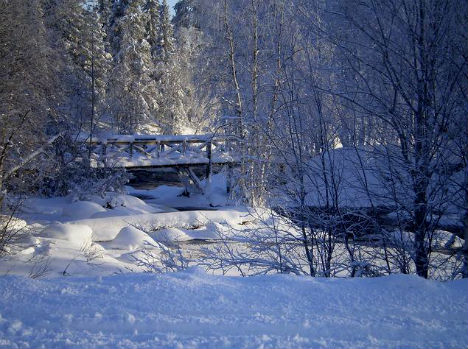
The snow in Finnish Lapland does not just fall. It settles in layers that accumulate through the long winter until the landscape is buried in a metre of soft white powder. The sun barely rises above the horizon between December and January, casting a constant blue twilight over the frozen lakes and snow-laden pine forests. This is the realm of the Northern Lights, of reindeer herds moving silently through the trees, of wood-fired saunas and holes cut into the ice for swimming. Finland in winter is a country transformed into something elemental, a place where cold becomes a physical presence and the darkness is filled with its own light.
If you’re looking to make the kids’ Christmas extra special and as magical as they could possibly imagine, you probably can’t beat a trip to a winter wonderland in Finland. There, amidst the snow and ice, it’s so much easier to believe in Father Christmas.
Photo licensed under the Creative Commons, created by Heather Sunderland
There are a huge range of tour operators offering winter wonderland holidays in Finland. Go onto different travel review sites to see which hotel and tour operator gets the best recommendations before booking your magical family holiday.
The Finnish hotels are usually set in perfect backdrops of frozen fairy tale forests, adding to the wonder of it all for you and your children. There are lots of activities that you can combine with your holiday. And of course, there’s the chance to meet Father Christmas and his elves.
If you’re not sure what to pack, then think of it in the same way as you would prepare for a ski holiday. Don’t forget – you can be too cold, but it’s going to be difficult to get too hot. If you do get too hot, you can always take layers off – better to carry an extra jacket than be wishing you hadn’t travelled so light. As well as having great ski outfits, make sure you’ve don’t forget to pack essentials like thermal underwear.
It’s not just about meeting Father Christmas; you’ll have the chance to do things like take a ride on a skidoo, go on a sled pulled by Huskies or ride a reindeer. Just don’t forget to have your thermal gloves with you at all times when you go outside. It’s probably worth taking a spare pair for the kids, as they’re the most likely to lose them as they’ll be so breathlessly excited.
Holidays like these don’t come cheap, but the memories will last a lifetime.
In This Article
The Northern Lights and Arctic Night
The aurora borealis, the Northern Lights, are visible in Finnish Lapland from late August to early April, with peak activity between October and March. The best viewing locations are away from any artificial light, typically a 15 to 30-minute drive from the towns of Rovaniemi, Ivalo, Kilpisjarvi, or Saariselka. The optimal time of night is between 9pm and 2am, when the sky is darkest and the geomagnetic activity is strongest. The Finnish Meteorological Institute produces a daily aurora forecast showing the probability of visible activity. A KP index of 3 or higher typically produces displays visible from the ground. The auroras appear as green curtains, arcs, and spirals that move across the sky, with occasional red, purple, and blue colours appearing during intense storms. The display is caused by charged particles from the solar wind interacting with the Earth magnetic field at altitudes of 100 to 400 kilometres. Several companies offer aurora hunting tours in heated vehicles, with a guide who monitors the forecasts and drives to areas with clear skies and high activity. These tours cost between 70 and 150 euros per person and typically last three to four hours. For independent viewing, glass igloos at resorts like Kakslauttanen and the Arctic TreeHouse Hotel offer the chance to watch the sky from a heated bed. The polar night, kaamos, occurs north of the Arctic Circle between late November and mid-January, when the sun does not rise above the horizon at all. During this period, the sky turns a deep blue for a few hours around midday, creating a unique twilight landscape that photographers prize.
Winter Activities in Finnish Lapland
The range of winter activities in Finnish Lapland is extraordinary. Huskysafaris take you behind a team of 4 to 6 dogs across frozen rivers and through forest trails, with the guide controlling the speed and direction. A two-hour husky ride costs approximately 130 euros and includes a visit to the kennel. Reindeer sleigh rides offer a quieter, more contemplative experience, with the saami herder guiding the reindeer through the snowy landscape while telling stories about the traditional way of life. A 30-minute reindeer ride costs about 60 euros. Snowmobiling is the fastest way to cover ground, with guided tours lasting from two hours to full-day expeditions reaching the Swedish or Norwegian borders. A two-hour snowmobile tour costs approximately 120 euros and includes thermal overalls, boots, gloves, and a helmet. Ice fishing involves drilling a hole through the lake ice, which typically reaches 50 to 80 centimetres in depth, and fishing for Arctic char and perch using a short rod. The catch is often cooked over a fire on the ice. Cross-country skiing trails crisscross the entire region, with over 1,000 kilometres of maintained tracks in the Saariselka area alone. The Levi ski resort in Kittila offers downhill skiing with 43 slopes and 27 lifts, the largest ski resort in Finland. A day pass costs 49 euros. Snowshoeing provides access to areas where other vehicles cannot go, allowing you to walk through deep powder snow in complete silence. The day ends with a traditional Finnish sauna at 80 to 100 degrees Celsius, followed by a roll in the snow or a dip in a hole cut in the ice, an experience that locals claim is essential for the circulation.
Planning Your Winter Trip to Finnish Lapland
The best time for a winter trip to Finnish Lapland is between December and March, when snow cover is guaranteed and the Northern Lights are most active. December offers the Christmas atmosphere and the chance to visit Santa Claus Village in Rovaniemi, which officially marks the Arctic Circle at 66 degrees 33 minutes north latitude. January and February are the coldest months, with temperatures dropping to minus 30 degrees Celsius in the north. March offers longer daylight hours and slightly warmer temperatures while still retaining full snow cover. Rovaniemi, the capital of Lapland, is the main gateway, with direct flights from London, Paris, Amsterdam, and Helsinki taking three hours from most European capitals. The flight time from Helsinki to Rovaniemi is one hour 15 minutes. Overnight trains from Helsinki to Rovaniemi take eight hours and offer sleeper compartments with private bathrooms. Pack thermal underwear, a mid-layer fleece, a waterproof outer shell, insulated boots rated to minus 30 degrees Celsius, a warm hat, gloves, and a scarf. Most activity providers supply thermal overalls, boots, and gloves for outdoor excursions, so you do not need to buy specialist equipment. Accommodation ranges from the glass igloos of Kakslauttanen at 500 euros per night to budget cabins at 100 euros per night. The Inari-Saariselka region, 250 kilometres north of Rovaniemi, offers the most reliable Northern Lights viewing and the least light pollution. The region is also home to the Siida Museum, which presents the culture and history of the Sami people through exhibits and outdoor displays covering 7,000 years of habitation in the region.
Would you brave the Arctic winter for a chance to see the Northern Lights? Or does summer in Finland sound more appealing?
Explore all our Finland travel guides, from Helsinki design to Lapland wilderness.
Explore More
If you enjoyed this article, you might also like:
