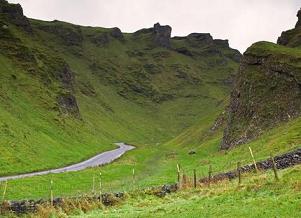
Gritstone edges cut sharp lines across the sky above England’s oldest national park. The Peak District covers 1400 square kilometres of moorland, limestone dales, and heather-clad slopes. Walking paths crisscross the landscape in a network of trails. The heather blooms purple across the moors in late summer. Millstones abandoned in the grass tell stories of a vanished industry. Villages built from local stone nestle in the valleys, their pubs serving ales brewed down the road. The park sits at the heart of England, easily reached from Manchester, Sheffield, and other northern cities. Despite its name, the terrain offers gentle rolling hills alongside steeper scrambles. This is where generations of Britons first discovered the joy of a long country walk.
Peak District National Park is the oldest national park in United Kingdom, located in the middle of England, less than 35 km southeast of Manchester.
Peak District National Park was designated in 1951 and consists of two distinct types of landscape. The first type is located in the southern part of the park, called the White Peak, and is characterized by undulating limestone terrain. In the northern part – Dark Peak there are the wild moors and heaths.
In This Article
The White Peak and Dark Peak Landscapes
The Peak District is divided into two distinct geological regions that offer completely different walking experiences. The White Peak in the south is characterised by limestone plateaus carved into deep valleys known as dales. This area is greener and more pastoral, with drystone walls crisscrossing the fields and wildflowers carpeting the valley floors in spring. Dovedale is the most famous of these limestone dales, a narrow valley with steep wooded cliffs and the iconic stepping stones that cross the River Dove. The area is ideal for family walks, romantic riverside strolls, and fishing along well-maintained banks. The Dark Peak in the north presents a wilder landscape of millstone grit moorland, peat bogs, and rocky escarpments. This is where you will find the famous gritstone edges such as Stanage Edge and Kinder Scout, which attract climbers and hikers seeking more challenging terrain. The heather moors turn a spectacular shade of purple in late August and September, attracting photographers from across the country. Abandoned millstones scattered across the moors are reminders of the quarrying industry that once thrived here, providing grinding stones for flour mills throughout England.
Historical Attractions and Visitor Highlights
The Peak District is rich in historical sites that span thousands of years of human habitation. Arbor Low, often called the Stonehenge of the North, is a Neolithic henge monument consisting of 46 recumbent limestone slabs arranged in a circle surrounded by a ditch and bank. Dating from around 2000 BC, this mysterious site offers a quieter alternative to its more famous counterpart in Wiltshire. Peveril Castle, built by the Normans in the 11th century, overlooks the village of Castleton from its dramatic hilltop position, with the ruins offering spectacular views of the Hope Valley. The spa town of Buxton, with its elegant Georgian crescents and the magnificent Opera House known as the Theatre in the Hills, serves as one of the main gateways to the park. The village of Cromford claims historical importance as the home of the world’s first water-powered cotton mill, built by Sir Richard Arkwright in 1771 and now a UNESCO World heritage site. For a unique experience, the Crich Tramway Village offers rides on vintage trams from around the world, running along a mile-long track through the Derbyshire countryside.
Walking Routes and Practical Tips
The Pennine Way, Britain’s first long-distance national trail, begins in the Peak District village of Edale and stretches 412 kilometres north to the Scottish border. The first section from Edale to Kinder Scout is one of the most popular day walks in the park, ascending through dramatic moorland to the Kinder plateau. Hathersage offers panoramic views of the northern moorland and is a good starting point for exploring the Dark Peak. Thor’s Cave and Treak Cliff Cavern are popular underground attractions, with Thor’s Cave being a natural karst cave visible from the valley floor and Treak Cliff Cavern offering guided tours through its mineral-rich passages. The park is easily accessible from Manchester, Sheffield, Derby, and Stoke-on-Trent, with train services stopping at Edale, Hope, and Buxton. The Hope Valley railway line connecting Sheffield and Manchester is one of the most scenic rail journeys in England. Walkers should carry waterproof clothing and a map even on fine days, as the mountain weather can change rapidly, particularly on the exposed moorland of the Dark Peak.
What is your favourite national park for a weekend hiking trip? 🥾
Explore all our United Kingdom travel guides, from London landmarks to the Scottish Highlands.
Explore More
If you enjoyed this article, you might also like:
- South Bank – a significant arts and entertainment district of London | United Kingdom – United Kingdom
- Salisbury Cathedral with the tallest church spire in the United Kingdom – United Kingdom
- Buckingham Palace – one of the most prestigious and interesting sights of London | United Kingdom – United Kingdom
