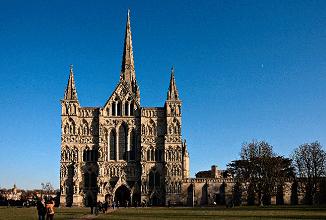
The spire of Salisbury Cathedral rises 123 metres above the Wiltshire plain. It is the tallest church spire in the United Kingdom and the fourth tallest in Europe. The cathedral was built in a single architectural period, Early English Gothic, between 1220 and 1258. Most English cathedrals are palimpsests of styles layered over centuries. Salisbury is a pure statement of what the 13th century wanted to say about God, stone, and light.
In This Article
The Spire: 6,500 Tonnes of Stone and Timber
The spire was added between 1310 and 1333, a second phase of construction after the main body of the cathedral was complete. The spire and tower weigh 6,500 tonnes, supported by four 2.5-metre-thick pillars that have bent visibly under the weight. The lean of the cathedral’s east end is 25 inches from vertical, a result of the spire’s weight settling into the foundations. The foundation depth is only 1.5 metres, remarkably shallow for a building of this mass. The scaffolding used for the 2026 conservation project is the largest freestanding scaffold in Europe, wrapping the entire spire.
The Magna Carta: The Best Preserved Copy
Salisbury Cathedral holds one of the four surviving original copies of Magna Carta from 1215. The document was brought to Salisbury by Elias of Dereham, who witnessed the sealing at Runnymede and later became a canon of Salisbury. The copy is the best preserved of the four, the ink still legible. It is displayed in the Chapter House, an octagonal room built between 1260 and 1280, with a central pillar carved from Purbeck marble. The Chapter House also has a 13th century frieze depicting scenes from the Old Testament, running around the walls at a height of 2.5 metres. Entry to the cathedral and the Chapter House is by donation, 12.50 pounds suggested for adults.
The Cloisters and the Close
The cloisters at Salisbury are the largest in England at 55 metres on each side. They were built between 1263 and 1270 and are lined with window tracery that changes colour as the sun moves across the sky. The Close, the green space surrounding the cathedral, covers 80 acres. It is the largest cathedral close in Britain. The houses around the close include Mompesson House (built 1701, National Trust, entry 6 pounds) and the Salisbury Museum, which holds the Salisbury Hoard, a collection of 535 bronze and iron objects dating from 1,000 BC, discovered in 1987. The museum entry is 8 pounds.
What is the one English cathedral you would return to on a quiet weekday with nothing but time, and what would you look at first?
Explore all our United Kingdom travel guides, from London landmarks to the Scottish Highlands.
Explore More
If you enjoyed this article, you might also like:
- Tower of London – Royal Palace, fortress, prison, place of execution, arsenal, Royal Mint, Royal Zoo and jewel house | United Kingdom – United Kingdom
- Lulworth Cove – beautiful natural attraction at Jurassic Coast, Dorset, England – United Kingdom
- Siccar Point rocky promontory in Scotland, United Kingdom – United Kingdom
