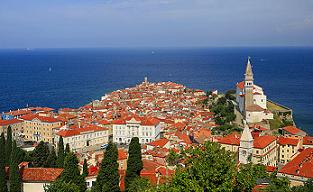
Piran is a 14th-century Venetian port town on the Slovenian coast, and it is the reason Slovenia has a coastline at all. The country’s Adriatic coast is only 46 km long, squeezed between Italy and Croatia, and Piran is its jewel. The town sits on a narrow peninsula that juts into the Gulf of Trieste. The architecture is Venetian Gothic: red roofs, narrow alleys, a main square that opens onto the sea. The population is about 4,000. The summer population is many times that. But Piran in October, when the crowds thin and the mistral wind clears the air, is a different town entirely.
In This Article
The Venetian Legacy on the Slovenian Coast
Piran’s history is deeply intertwined with the Venetian Republic, which ruled the town for over 500 years from the 13th to the 18th century. This Venetian influence is immediately visible in the architecture of Tartini Square, the town’s main piazza, which is paved with white stone and surrounded by Gothic and Venetian Gothic buildings. The square is named after the violinist and composer Giuseppe Tartini, who was born in Piran in 1692, and his bronze statue stands at the centre. The narrow streets of the old town, known as the calle, wind up the hillside in a pattern that has remained virtually unchanged since medieval times. At the top of the hill, the Church of Saint George, with its Venetian-style campanile modelled on the Campanile of Saint Mark’s in Venice, offers sweeping views across the red-tiled rooftops to the Adriatic Sea and the Gulf of Trieste.
Seaside Pleasures and Local Cuisine
Piran’s location on the Adriatic coast means that seafood features prominently in the local cuisine. The harbour area is lined with restaurants serving fresh fish, squid ink risotto, and the local speciality of scampi alla busara, prawns cooked in a tomato and wine sauce. The town has a small but clean beach at Punta, at the southern tip of the peninsula, where locals and visitors alike swim in the calm, clear waters. A longer seafront promenade stretches along the western side of the peninsula, perfect for an evening stroll as the sun sets over the sea. The town’s salt pans, the Sečovlje Salina Nature Park just south of Piran, have been in operation since Roman times and produce high-quality fleur de sel, which can be purchased from local shops. The salt pans are also an important habitat for migratory birds.
Practical Information and Nearby Excursions
Piran is a compact town best explored on foot, as cars are largely restricted in the historic centre. Parking is available in the Garazna hisa car park on the outskirts, from where a free shuttle bus runs into the town centre. The nearest major transport hub is Trieste in Italy, about 45 minutes to the north, or Ljubljana, the Slovenian capital, roughly 90 minutes away by car or bus. Piran can get very busy during the summer months, so visiting in late spring or early autumn offers a more relaxed experience with similar weather conditions. The neighbouring coastal towns of Portorož, Izola, and Koper are all easily reachable by bus or bicycle along the coastal path. The entire Slovenian coast is only 46 kilometres long, making it easy to explore in a single day.
Tartini Square and the Old Town
Tartini Square, named after the 18th-century violinist and composer Giuseppe Tartini who was born in Piran, is the heart of the town. The square was once an inner harbour, filled in during the 19th century to create a public space. The marble paving is laid in a fish-scale pattern that reflects the town’s maritime history. The statue of Tartini, cast in bronze in 1896, stands in the centre. The Venetian House, with its distinctive red facade and Gothic windows, dates from the 15th century and is the oldest building on the square. The narrow streets of the old town climb the hill behind the square, leading to the Church of Saint George at the summit. The church was built in 1344 and rebuilt in the 16th and 17th centuries. The bell tower, a copy of the campanile of St Mark’s in Venice, was completed in 1609. The view from the top covers the entire coastline from Trieste to the Istrian peninsula.
The Walls of Piran
The town walls, built between the 13th and 16th centuries, once encircled the entire peninsula. Three sections survive: the lower wall along the harbour, the upper wall above the old town, and the bastions at the highest point. The entrance to the walls costs €2 as of 2026. The walk along the upper wall, from the Bastion on the western side to the Church of Saint George, takes 20 minutes and passes through a small park with olive trees. The view of the town below, compressed within its peninsula, is the view that makes the climb worthwhile.
Eating and Drinking in Piran
Piran is a fishing town, and the seafood is the reason to eat here. The restaurant Pri Mari, on the harbour, has been serving grilled fish and seafood risotto since 1946. A meal with wine costs €30-45 per person. The ice cream at Cacao, on Tartini Square, is made daily and is better than most Italian gelato. The local wine is Malvazija, a white wine grown on the hills above the coast. The wine is dry, mineral, and pairs perfectly with the local seafood. The farmers’ market on the western edge of the old town sells fresh produce, olive oil, and salt from the nearby Sečovlje salt pans, which have been in operation since the 14th century.
Did Piran feel like a small piece of Venice that drifted south and found its own way, or is it something entirely its own?
Looking for more European travel inspiration? Check out our other guides and start planning your next European adventure!
Explore all our Slovenia travel guides, from Lake Bled to the Julian Alps.
Explore More
If you enjoyed this article, you might also like:
