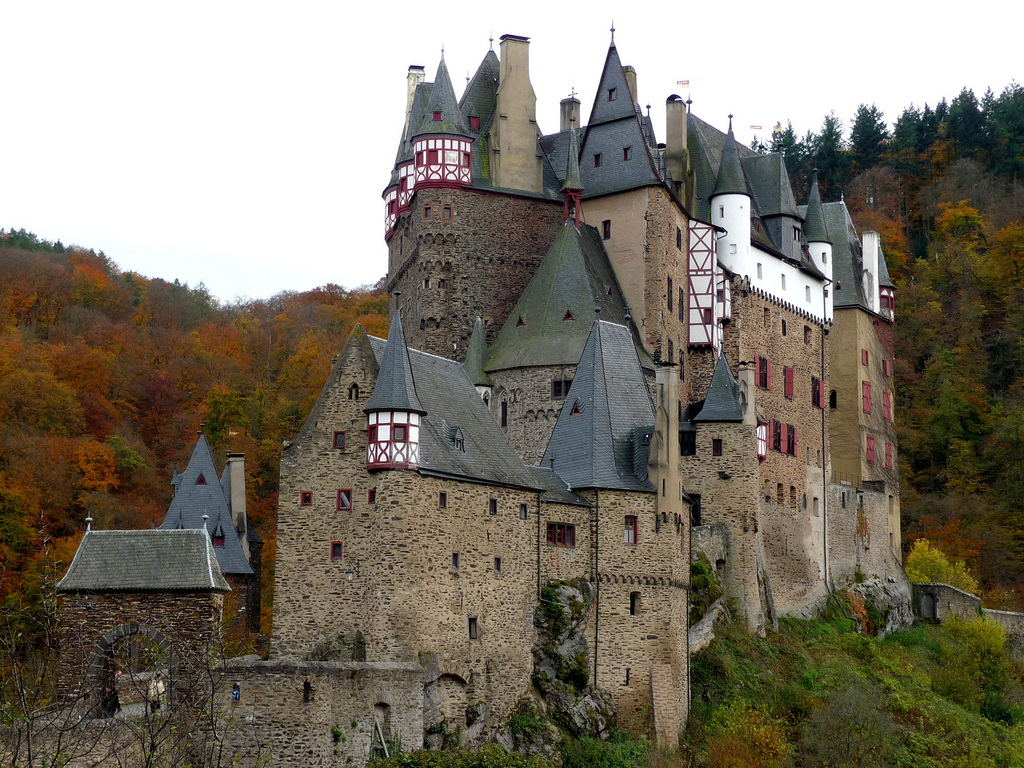
Eltz Castle is the only castle on the left bank of the Moselle that has never been destroyed or rebuilt. It survived the Thirty Years’ War, the French Revolution, and both World Wars without a single cannonball to its walls. The castle sits on a 70-metre rock spur above the Elzbach River, hidden in a forested valley that made it difficult to find and harder to attack. It has been owned by the same family, the Eltz or Eltz-Kempenich dynasty, for more than 850 years. The current owner, Count Karl zu Eltz, lives in the Kempenich wing with his family.
In This Article
eight Centuries of Unbroken Family heritage
One of the most remarkable things about Burg Eltz is that it has remained in the possession of the same family, the Eltz family, for over 850 years. The castle has never been conquered, destroyed, or significantly altered by war, allowing its medieval character to survive intact through the centuries. The earliest sections date from the 12th century, with subsequent wings added in the Gothic, Renaissance, and Baroque periods. Each of the three main branches of the Eltz family once occupied a separate section of the castle, creating a fascinating architectural patchwork of gables, turrets, and half-timbered facades rising from the forest floor. Unlike many German castles that were rebuilt in the 19th-century Romantic style, Burg Eltz retains its original medieval fabric, making it one of the few genuine medieval castles in the region.
Exploring the Castle Interior
A guided tour of Burg Eltz takes you through approximately ten rooms spread across the residential wings, each furnished with original pieces spanning several centuries. The Knights’ Hall, with its vaulted ceiling and suit of armour, evokes the castle’s defensive past, while the Rübenach Low Chamber features exquisite 15th-century wall paintings depicting scenes from chivalric romances. The treasury in the cellar houses an extraordinary collection of gold, silver, and enamel objects spanning 800 years of Eltz family history. One of the most striking rooms is the Elector’s Chamber, a richly panelled space with an intricately carved ceiling that demonstrates the wealth and taste of the castle’s occupants during the Renaissance. Photography is not permitted inside, but the audio guide provides excellent commentary on the history and significance of each room.
Visiting Burg Eltz: Trails, Tickets, and Tips
The castle is located in the Eltz Forest, near the town of Münstermaifeld in the Rhineland-Palatinate region. Visitors park in a designated lot about two kilometres away and either walk through the forest along a scenic trail, which takes about 30 minutes, or take a shuttle bus during the peak season. The footpath through the Eltz Forest is a highlight in itself, crossing a stream and passing through ancient woodland that opens dramatically to reveal the castle perched on a rocky spur. Admission costs around 12 euros for adults, with family tickets and combination passes available. The castle is open from late March through early November, with extended hours during July and August. The best time to visit is early morning or late afternoon, when the crowds are thinner and the light casts the castle in a golden glow against the dark forest backdrop.
The Architecture of the Castle
Eltz Castle is not a single building but a collection of eight distinct residential towers, each built by a different branch of the Eltz family between the 12th and 16th centuries. The highest tower, the Platteltz, rises 35 metres above the courtyard. The Rübenach house, built in 1472, is decorated with late Gothic vaulting and wall paintings. The Rodendorf house, built in 1504, contains the castle’s most impressive room: the Knight’s Hall, with a vaulted ceiling, a carved fireplace, and armorial shields of the families who have intermarried with the Eltz over the centuries. The Kempenich house, the most recent addition, was completed in 1604. The ensemble is asymmetrical, crowded on the rock, and entirely beautiful. No two windows are the same height. No facade aligns with another. The castle grew, organically and without a master plan, over 400 years of construction.
The Treasury
The Eltz Castle Treasury is one of the finest private collections of its kind in Germany. It contains more than 500 objects spanning five centuries, including gold and silver jewellery, ivory carvings, glassware, porcelain, and weapons. The highlight is the Burgenrätsel, a 17th-century mechanical puzzle box that opens to reveal a miniature castle interior. The treasury is housed in the vaulted cellars of the Rübenach house and forms the last section of the castle tour. The collection was assembled over generations and has never been dispersed. The total insured value is estimated at €20 million, but the family has no intention of selling.
Practical Information
Eltz Castle is open from April to November. The standard ticket costs €12 as of 2026, which includes the guided tour of the interior and access to the treasury. The tour lasts 35-40 minutes. The walk from the car park at the bottom of the valley takes 15 minutes through the forest. A shuttle bus runs from the car park for €2 each way. The castle can only be visited on a guided tour. Photography is not permitted inside. The café in the former stables serves coffee, cake, and Flammkuchen, the Alsatian flatbread. The road through the Elzbach Valley is narrow. Buses and campervans should park at the lower car park and take the shuttle.
Did the asymmetry of Eltz Castle: the towers at different angles, the windows at different heights: feel like an honest record of 800 years of family life, or did it feel like a story you could read in the stone?
Looking for more European travel inspiration? Check out our other guides and start planning your next European adventure!
Explore all our Germany travel guides, from Berlin buzz to Bavaria castles.
Explore More
If you enjoyed this article, you might also like:
