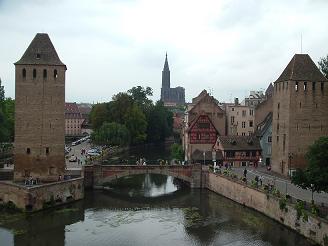
The Ill River wraps around the historic centre of Strasbourg, reflecting half-timbered houses that lean gracefully over the water. Petite France, with its tanners’ houses and flower-lined canals, feels frozen in a past century, yet the massive Gothic cathedral rises from the heart of the city as a reminder of its enduring importance. Strasbourg blends French elegance with German architectural influences across its streets and cuisine. European Parliament sits nearby, a modern counterpoint to the medieval lanes. At Christmastime, the city transforms into one of Europe’s most celebrated markets, with wooden stalls filling the squares with the scent of mulled wine and gingerbread.
Strasbourg is a beautiful historic city and a seat of several important European institutions. Although its name is known worldwide, the most people mistakenly think that it is located in Germany. Finally, sounds like the German name and German influence is also evident at first glance.
Strasbourg is the capital and the largest city of French Alsace. Its name means “City of Road” and it is, of course, justified. Strasbourg has a strategic position within Europe and has always been a kind of crossroads, of which often fought mainly Germans and French. Wrangling lasted for years, once the city belonged to the Germans for a while, then again to the French for a few years, and so it went again and again. Finally, France won the battle and such the city belong to France today. But as mentioned earlier the German influence is evident here, from the street names through the meals in local restaurants up to the typically “German” half-timbered houses. But Strasbourg residents do not feel any injustice, consider that the city took the better of both countries – at first glance is a picturesque like the rest of France, but neat and clean like it would be German city.
View Strasbourg – a beautiful historic city in France in a larger map
In the distant past Strasbourg used to be a free city of Holy Roman Empire. Being a crossroad of trade routes and also an important crossing over the river Rhine, the city grew very fast. However in the following centuries it was quite difficult, as written above. During the “German” times, the city was a home to some important people, such as Johann Gutenberg (Johannes Gensfleisch zur Laden zum Gutenberg), who was forced to leave Mainz in the 15th century. Right here then constructed one of his first printing machines. A few hundred years later, famous German poet Johann Wolfgang von Goethe lived and studied here.
Strasbourg has kept the great importance in France and all over Europe until today. It is home to the Council of Europe, the European Court of human Rights and also a place of regular meetings of European Parliament. In addition, the buildings of these institutions are among the major structures of modern architecture. But Strasbourg has a lot to offer also in terms of historical sights. Along the river Ill you can see a lot of houses with gables, which dates back to the 16th century. Following century left a few half-timbered burgher houses here.
There are also historic gems such as Gothic cathedral and Rohan castle. Therefore “Grande Ile” (Big Island) – which represents the historic center with cathedral, churches and palace has been inscribed on the UNESCO’s World heritage List already in 1988.
View Strasbourg – a beautiful historic city in France in a larger map
Strasbourg Cathedral and the historic Heart of Grande Ile
Strasbourg Cathedral, or Cathedrale Notre-Dame, dominates the city skyline with its single 142-metre spire, which was the tallest building in the Christian world when completed in 1439. The pink Vosges sandstone facade is covered in intricate Gothic carvings depicting biblical scenes and the Last Judgement rose window dates from the 14th century. Inside, the astronomical clock draws crowds at 12:30pm when the figures of Christ, the Apostles, and the Roman Emperor parade before the dial. The clock was built by Jean-Baptiste Schwilgue in 1843 and its mechanism is accurate enough to calculate the date of Easter for centuries ahead. Climbing the 332 steps to the viewing platform rewards you with a panoramic view across the tiled roofs of the old town to the Black Forest on the German side of the Rhine. The cathedral square, Place de la Cathedrale, is surrounded by half-timbered houses, including Maison Kammerzell from 1467, now a restaurant serving Alsatian specialties such as choucroute garnie and tarte flambee.
Petite France and the Alsatian Culinary Tradition
The Petite France quarter is the most photographed part of Strasbourg. Its narrow cobblestone lanes and half-timbered houses with steep roofs were once home to tanners, millers, and fishermen who worked along the canals. Covered bridges from the 13th century cross the river at the western edge of the district, and the Vauban Dam, built in 1690, controls the water level in the canals. Today the area is filled with winstubs, Alsatian taverns serving local wines in tall, narrow glasses called flutes d’Alsace. A typical meal includes baeckeoffe, a slow-cooked casserole of three meats and potatoes, or fleischschnacka, rolled pasta filled with meat and herbs. The Alsace wine route begins just south of Strasbourg, with the Grand Cru vineyards of the Vosges foothills producing Riesling, Gewurztraminer, and Pinot Gris. Strasbourg’s Christmas market, running from late November through December, is the oldest in France, dating to 1570, with over 300 chalets spread across 11 locations in the city centre.
Have you visited Strasbourg during the Christmas season, or would you like to? 🎄
Explore all our France travel guides, from Parisian boulevards to Provence lavender.
Explore More
If you enjoyed this article, you might also like:
