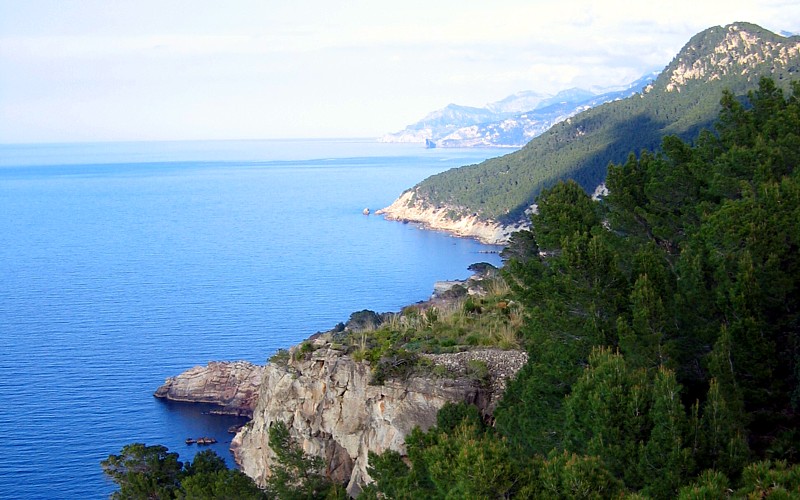
The largest of the Balearic Islands sits in the Mediterranean with a mountain range running down its western flank and beaches tracing its coastline. Majorca has been a sun-seeking destination for decades, and the island delivers reliably on its promise of warmth. Beyond the resort strips of Magaluf and Palma Nova, the Tramuntana mountains offer limestone peaks, hidden coves, and stone villages where life moves slowly. Palma’s cathedral rises directly above the sea, its rose window the largest of any Gothic cathedral in the world. Olive groves, almond blossoms in February, and clear water for swimming define the island beyond the tourist posters.
In This Article
Palma: Cathedral, Old Town, and Museums
Palma is the capital and cultural heart of Majorca. The Cathedral of Santa Maria of Palma, known as La Seu, dominates the waterfront with its magnificent Gothic facade. Construction began in 1229 after King James I of Aragon conquered the island from the Moors, and the building was not completed until 1601. The single nave rises 44 metres, making it one of the tallest Gothic naves in Europe. The rose window, called the Gothic Eye, measures 12 metres in diameter and is the largest of any Gothic cathedral in the world. At midday, sunlight streaming through the coloured glass creates a spectacular display of light on the opposite wall. The interior features a striking canopy over the high altar designed by Antoni Gaudi, added during a controversial restoration in the early 20th century. The cathedral is illuminated at night, creating a reflection that shimmers across the waters of the bay. A short walk inland is the Palau de l’Almudaina, the former Moorish citadel turned royal palace, which still serves as the official summer residence of the Spanish royal family. The old town, the Casco Antiguo, is a labyrinth of narrow streets lined with medieval stone buildings, hidden courtyards, and boutique shops. The Banys Arabs, dating from the 10th century, are the only surviving Moorish building in the city. Palma’s food market, the Mercat de l’Olivar, is one of the largest covered markets in Spain, with more than 300 stalls selling fresh fish, shellfish, meats, cheeses, olive oil, and local produce. The Es Baluard Museum of Modern and contemporary Art, built into the city’s 16th-century fortifications, displays works by Joan Miro, Pablo Picasso, and local Mallorcan artists.
Mountain Villages: Valldemossa, Deia, and Soller
The Serra de Tramuntana runs along Majorca’s northwest coast for 90 kilometres and was declared a UNESCO World heritage landscape in 2011, recognised for its thousand-year tradition of drystone terrace farming. Three villages hidden among the limestone peaks capture the soul of the island. Valldemossa, 17 kilometres north of Palma, is famous for the Real Cartuja, a 14th-century Carthusian monastery where Chopin and George Sand spent the winter of 1838. The monastery’s apothecary, library, and Chopin’s original piano are open to visitors. Deia, 10 kilometres further north, was home to the poet Robert Graves, author of “I, Claudius.” His house, now a museum, preserves his study, library, and personal belongings. The village’s cove, Cala Deia, is a pebble beach popular with locals for swimming and snorkelling. Soller sits in a fertile valley of orange and lemon orchards surrounded by steep mountainsides. Its main square, the Placa de la Constitucio, is dominated by a Modernist church and a row of cafes where locals gather for morning coffee. The vintage wooden tram from Soller to the Port de Soller has operated without interruption since 1913, running 4.7 kilometres through the citrus groves on narrow-gauge tracks. The journey takes 20 minutes and costs 8 euros return. The weekly Saturday market in Soller sells local honey, sobrassada (a cured sausage spread), and the valley’s famous oranges and lemons. The MA-10 road connecting these three villages is one of the most scenic drives in the Mediterranean, with hairpin turns that open onto panoramic views of the sea far below.
Hiking the Tramuntana, Beaches, and Where to Stay
The Tramuntana range has over 600 kilometres of hiking trails, many following ancient mule paths that have been used for centuries to transport goods between the coast and the interior. The most famous long-distance walk is the GR 221, which runs 28 kilometres from Port d’Andratx to Pollenca and takes 3 to 4 days to complete. Mountain refuges along the route offer beds and meals for 25 to 35 euros per night. For day hikers, the 4-hour loop from Deia to Cala Tuent descends through pine forest to a secluded cove where the water is crystal clear and the beach is rarely crowded. Another popular walk climbs to the Puig de Galatzo, the highest point of the Tramuntana at 1,027 metres, offering views that span the entire island on clear days. The best months for hiking are March through June and September through November. July and August are too hot for sustained walking on exposed sections of the mountains, so hikers should start early in the morning and carry at least two litres of water per person. For those who prefer beach clubs and swimming, the coves of Cala Varques, Cala Mondrago, and Cala S’Almunia offer turquoise water and fine sand without the crowds of the larger resort beaches. Accommodation on the island ranges from luxury five-star hotels in Palma to rural agrotourism estates in the Tramuntana foothills. These working farms produce olive oil, almonds, and wine, and many offer cooking classes, wine tastings, and guided hikes as part of the stay.
Would you choose Majorca’s mountain villages or its beach clubs for a week away? 🌊
Explore all our Spain travel guides, from Barcelona Gaudí to Andalusia plazas.
Explore More
If you enjoyed this article, you might also like:
