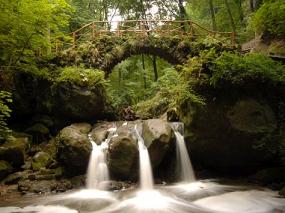
The Mullerthal, Luxembourg’s Little Switzerland, is one of the Grand Duchy’s most enchanting natural regions: a densely forested landscape of bizarre sandstone rock formations, deep mossy gorges, crystal-clear streams, and ancient castle ruins that offers some of the finest hiking in the Benelux countries. Named for its resemblance to the Swiss Jura, Mullerthal is a compact hiking paradise criss-crossed by the Mullerthal Trail, a 112km network of paths through the geological wonderland of the Luxembourg Sandstone formation, passing medieval castles including Beaufort and Larochette, and the dramatic Schéissendëmpel waterfall.
In This Article
Quick Facts: Mullerthal, Luxembourg
- Best time to visit: April-October for hiking; May-June for wildflowers; autumn for spectacular colours in the beech forests; the rock formations are especially atmospheric in morning mist
- Top attraction: The Mullerthal Trail (112km, divided into three loops, Route 1, 2, and 3 of roughly 37km each); the Schéissendëmpel waterfall; the Huel Lee cave and rock labyrinth; Beaufort Castle
- How to get there: ~30 minutes from Luxembourg City by car; bus services connect the main Mullerthal villages (Echternach, Beaufort, Berdorf) from Luxembourg City
- Entry fee: Free access to the trails and rock formations; castle entry fees apply where applicable
- Best for: Hikers, nature photographers, and anyone seeking an off-the-beaten-path European hiking destination
The Mullerthal Region or how it is often called Luxembourg’s Little Switzerland is the part of Luxembourg located in the north-east part at the borders with Germany. It is small but very nice place where you can get remarkable experiences.
Luxembourg’s Little Switzerland is located in the canton of Echternach, which covers 7% of the whole area of Luxembourg. This part of Luxembourg is very popular, especially for campers sliding down from nearby Belgium, Germany, France and Holland. The area is also very popular among European bikers who come to “ventilate” here and take proper outdoor atmosphere.
Suer River forms here a natural border between Luxembourg and Germany. Widely popular activity is renting a canoe and rafting. Along the river you can easily find a number of well-equipped campsites. However, in the summer months, some of them can be quite busy. So it is better to make a reservation in advance.
You can walk through the sandstone forest labyrinth or visit the oldest Luxembourg’s city Echternach. Visitors can come out to the highest peak of this undoubtedly interesting canton, situated near the town of Beaufort and reaching an altitude of 414m.
View The Mullerthal – Luxembourg’s Little Switzerland in a larger map
The Mullerthal Trail Network
The Mullerthal Trail is the region’s premier hiking route, a 112-kilometre network divided into three loops, each approximately 37 kilometres in length. Route 1, the Rock Trail, passes the most dramatic geological formations including the Huel Lee cave, a sandstone labyrinth with natural pillars and overhangs creating a maze-like landscape. Route 2, the Valley Trail, follows the Black Ernz river through deep forested valleys past the Schéissendëmpel waterfall, the region’s highest at 10 metres. Route 3, the Plateau Trail, explores the elevated plateau with views across the countryside and passes the medieval castle ruins at Beaufort. Each route is well-marked with distinctive white-and-orange waymarks and suitable for hikers with moderate fitness levels. Trail maps are available at the Echternach tourist office.
Echternach and the Abbey of St. Willibrord
The town of Echternach serves as the main gateway to the Mullerthal region and is itself one of Luxembourg’s most historic destinations. The Abbey of St. Willibrord, founded in 698 AD by the Anglo-Saxon missionary, has been a centre of religious and cultural life for over 1,300 years. The current building, rebuilt in the 18th century in Baroque style, houses a basilica with an impressive crypt containing the saint’s tomb. The abbey museum displays a collection of Merovingian manuscripts alongside liturgical objects and archaeological finds. The Dancing Procession of Echternach, held annually on Whit Tuesday, is recognised by UNESCO as Intangible Cultural heritage, drawing thousands of participants who perform a traditional dance through the town’s streets in honour of St. Willibrord.
The region offers excellent opportunities for canoeing on the Sauer River and rock climbing on the sandstone formations around Berdorf.
Have you hiked Mullerthal or discovered Luxembourg’s wild side? Share your Little Switzerland adventures in the comments! 🌿
Explore all our Luxembourg travel guides, from Luxembourg City to the Ardennes.
Explore More
If you enjoyed this article, you might also like:
