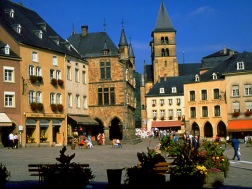
Echternach is Luxembourg’s oldest city, a storybook medieval town tucked into the lush Müllerthal Valley right on the German border. Founded in 698 AD around its magnificent Benedictine abbey, Echternach blends ancient history with a vibrant cultural scene, floral-lined streets, and access to some of Luxembourg’s most enchanting hiking trails. It’s the perfect day trip from Luxembourg City or a peaceful base for exploring the country’s eastern region.
In This Article
Quick Facts: Echternach
- Best time to visit: May–October (the town is famous for its floral decorations in summer); Whit Tuesday for the UNESCO-recognised Dancing Procession
- Top attraction: The Abbey of Echternach and its basilica, founded in 698 by St. Willibrord
- How to get there: ~35 minutes from Luxembourg City by car; bus lines 110/111 from Luxembourg City Gare (~50 min)
- Entry fee (abbey): Free to enter the basilica; museum €3
- Best for: History lovers, hikers, and those seeking an authentic Luxembourgish town
Echternach is the oldest city of Luxembourg, located at the north-east of Luxembourg, on the border with Germany. Echternach has about 5,000 of permanent population. The historical center is very attractive and you can find there lots of floral decorations. One of the most original buildings is the Abbey of Echternach, which was founded in the year of 698. During the certain time, the traditional porcelain production was made in the basilica. Currently, the monastery complex of the cathedral is open to the public and offers an extraordinary tour through choral decorations.
View Echternach – the oldest city of Luxembourg in a larger map
What To See in Echternach
- Abbey of Echternach & basilica of St. Willibrord: The heart of the city for over 1,300 years. The current baroque basilica dates from the 18th century, but the crypt and some foundations go back to the 11th century. The abbey museum houses one of Europe’s finest collections of Merovingian manuscripts and illuminated codices.
- Dancing Procession (Sprangpressessioun): Every Whit Tuesday, thousands of pilgrims and spectators line the streets for this unique UNESCO Intangible Cultural heritage event, a ritual dance-procession paying homage to St. Willibrord that dates back to the 16th century.
- Market Square (Place du Marché): The heart of town, surrounded by pastel-coloured historic buildings, cafés, and the Gothic Town Hall. Arrive on a Thursday morning for the weekly market.
- Roman Villa: Just outside town lie the excavated remains of one of the largest Roman villas north of the Alps, complete with preserved mosaics and underfloor heating systems.
- Müllerthal Trail: Echternach is the gateway to Luxembourg’s “Little Switzerland”, with 112km of signed hiking paths through bizarre rock formations, mossy gorges, and ancient forests.
The Abbey of Echternach in Detail
The Abbey of Echternach was established in 698 AD by St. Willibrord, who became the patron saint of Luxembourg. The abbey grew into an important cultural and religious centre in the Carolingian Empire, with its scriptorium producing illuminated manuscripts that are now among the treasures of European libraries. The basilica’s crypt from the 11th century is the oldest surviving structure, featuring Romanesque arches and massive stone pillars that have supported the building for nearly a thousand years. The main church, rebuilt in the 18th century after a devastating fire, features a light-filled Baroque interior with a painted ceiling, marble altars, and an organ built in 1775. The abbey museum displays archaeological finds including fragments of 8th-century stone carvings and ceramic vessels used by the early monks.
The Dancing Procession and Roman Villa
The Dancing Procession of Echternach is one of Europe’s most unusual religious traditions, recognised by UNESCO as Intangible Cultural heritage. Every Whit Tuesday, thousands of participants dressed in white gather in the town square and perform a slow, rhythmic dance procession through the streets toward the basilica. The dance consists of steps moving three forward and two back, performed in rows of up to eight people holding linked white handkerchiefs. The tradition dates back to at least the 16th century and is accompanied by traditional brass band music. Just outside Echternach lie the excavated remains of a Roman villa among the largest discovered north of the Alps, covering over 4,000 square metres with preserved floor mosaics featuring geometric patterns and marine scenes.
Have you visited Echternach or explored Luxembourg’s Müllerthal region? I’d love to hear about your discoveries in the comments, especially if you’ve seen the Dancing Procession! 🏰
Explore all our Luxembourg travel guides, from Luxembourg City to the Ardennes.
Explore More
If you enjoyed this article, you might also like:
