What separates a good ski resort from one you return to every season? It is not the snow. Good snow is common. It is not the lifts. Fast lifts are standard. It is the thirty seconds of absolute silence halfway up the mountain, dangling above the treeline, when the world shrinks to the width of a chair and the depth of the snow beneath you. These ten resorts deliver that silence. Each one has a reason to come back.
In This Article
1. Val d’Isère, France
Linked with Tignes to form the Espace Killy: 300 km of pistes, a glacier guaranteeing snow from October to May, and La Face de Bellevarde, the 1992 Olympic downhill, a black run dropping 960 metres in under 3 km. The off-piste in the Le Fornet sector, guide required, is world-class. Book through ESF or Oxygène at roughly €400 per day, split between four to six people. The village is mostly 1960s-1980s but strict Savoyard building codes keep it coherent. Après at La Folie Douce from 3pm, DJ-led, champagne sprayed into the crowd, the final run down at 4.30pm a test of skiing ability and blood-alcohol management.
2. St Anton am Arlberg, Austria
The birthplace of modern alpine skiing, the first ski club was founded here in 1901. The Valluga North face, a 55-degree couloir dropping 1,200 metres, is a bucket-list line requiring a guide. The Arlberg pass links St Anton, Lech, Zürs, and Warth into 305 km of marked pistes and 200 km of off-piste. Après-ski at the MooserWirt and Krazy Kanguruh starts at 3pm. Dancing on tables in ski boots is not a myth.
3. Val Thorens, France
At 2,300 metres, the highest ski resort in Europe. Snow from late November to early May. Part of the Three Valleys, 600 km of pistes, the largest linked area in the world. Purpose-built and not pretty, but the skiing is so consistently good that aesthetics stop mattering. Budget accommodation exists here more than in Courchevel. The Peclet glacier stays open through summer.
4. Verbier, Switzerland
The 4 Vallées pass covers 410 km. Verbier is about the off-piste: the Bec des Rosses, a 50-degree face, is the Freeride World Tour finale venue. The town is expensive, a fondue runs roughly €35. The mountain restaurants are worth it. Chez Dany at Clambin, run by the same family since 1969, serves rösti and grilled meat at 1,900 metres. Verbier attracts experts. Beginners should look elsewhere.
5. Cortina d’Ampezzo, Italy
The Dolomites are different, jagged limestone spires, pink at sunset. Cortina co-hosts the 2026 Winter Olympics. The hidden Valley run, 12 km of red through a gorge ending at a frozen waterfall, requires a horse-drawn sleigh ride back to the lifts. Lunch is two hours: canederli in broth, a bottle of Lagrein, no hurry whatsoever. Italian skiing has priorities. The Dolomiti Superski pass covers 1,200 km across 12 valleys.
6. Chamonix, France
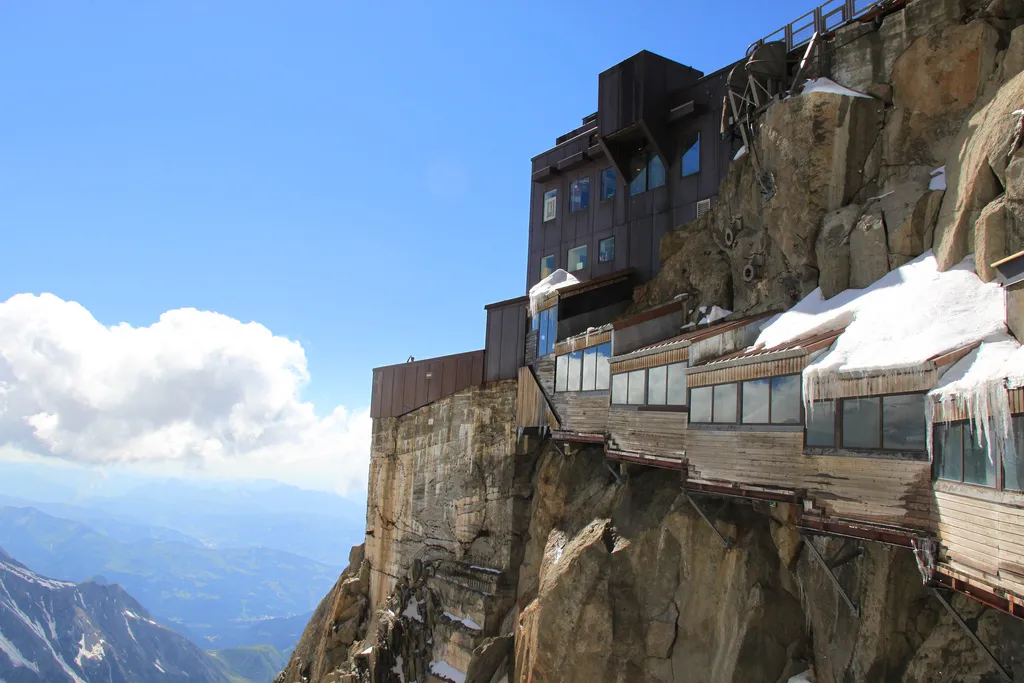
Not a single resort but five areas beneath Mont Blanc. The Vallée Blanche, 20 km of off-piste glacier from the Aiguille du Midi at 3,842 m, is the most famous ski run in the world. You need a guide, a harness, and crevasse rescue equipment. The cable car ride alone, 2,800 vertical metres in 20 minutes, is worth the trip. Chamonix is a real town of 8,900 residents. It has a butcher, a boulangerie, and a hardware store.
7. Zermatt, Switzerland
The Matterhorn dominates every view. The ski area crosses into Italy, ski to Cervinia for pizza and ski back in the afternoon. The highest lift reaches 3,899 metres. Zermatt is car-free and eye-wateringly expensive: a coffee on the mountain is CHF 7.50. Budget accordingly. The summer glacier skiing is some of the best in Europe.
8. Kitzbühel, Austria
The Streif, the most terrifying downhill on the World Cup circuit, is a public run when not in use for racing. Stand at the top of the Mausefalle, an 85% gradient drop that compresses racers at 3G. The rest of the resort is intermediate-friendly, well-groomed, and backed by Austria’s most charming medieval ski town. The Hahnenkamm weekend in January is beer, cowbells, and sheer Austrian euphoria.
9. Méribel, France
The heart of the Three Valleys, prettier than its purpose-built neighbours thanks to strict wood-and-stone building codes dating from its founding in 1938. The intermediate cruising is unmatched. The DC Area 43 snowpark is one of the best in France. Méribel is the ideal base for exploring the full 3 Vallées. The après is lively but less manic than Val d’Isère.
10. Åre, Sweden
The outlier: smaller at 89 km of pistes, lower at 1,420 m, but with a Nordic approach. Night skiing under floodlights from 3pm to 7.30pm. Frozen lake tours on snowmobiles. A sauna culture that treats an ice plunge as the natural conclusion to a day on the mountain. Åre hosted the 2019 World Championships and has world-class infrastructure without the attitude. The season runs December to late April.
Which European ski resort would you return to tomorrow if you could, and which run do you think about in summer?
Explore all our Europe travel guides, discover the best of the continent.
Explore More
If you enjoyed this article, you might also like:
- Powder Ski? Choose Chamonix in France! – View all posts in Ski Resorts
- 7 Of The Best French Ski Resorts For 2013 – View all posts in Ski Resorts
- Skiing holidays in Austria – a real paradise for skiers – View all posts in Ski Resorts
