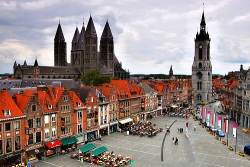
Cathedral bells ring across the ancient cobblestones of Tournai before the sun fully clears the rooftops. This small Belgian city, second only to Tongeren in age, carries a history etched into every stone of its UNESCO-listed Notre-Dame Cathedral. Five towers rise against the sky, a Romanesque masterpiece that has dominated the skyline for over eight centuries. Walking along the Scheldt riverbank, you feel the weight of time in the air, from the Grand Place to the medieval belfry.
Just 7 km from the French border, 85 kilometres southwest of Brussels, on the River Scheldt is the second oldest city of Belgium, Tournai (Doornik). From Brussels, there is a very good connection by train – you can be on the train station in less than two hours, which is just a short walk from the historic center of Tournai.
The City of Tournai has a rich history, the Celts settled here already in 1st century BC. The first Christian church was built here by the Franks in 431. In the 6th century it was the seat of a bishop, later incorporated into the West-Frankish kingdom. In the 13th century the city belonged to the French kings, and just in the 16th century it became the part of the Netherlands. Only in 1830 the city became a part for Belgium.
Tournai is one of the most important cultural sites in Belgium and it is the 2nd oldest city in Belgium – after Tongeren. The city is designated by UNESCO as a World heritage Site.
What to see in Tournai?
You can start at the heart of city – in Grand Place, which consists of Renaissance and Baroque houses with 72-meter high watch tower – Beffroi – built in the 1200. If you look from the tower across the square, you can see the Romanesque church from the late 12th century Cathédrale St. Quentin. In the middle of the square stands the memorial to Christine de Lalaing d Epinoy – heroine who defended the city during the Spanish siege. Not far from the square there are five huge towers of Cathedral of Notre Dame (Cathedral of the Virgin Mary) that you can see from all parts of the city. Cathédrale Notre Dame is one of the finest Romanesque buildings in Belgium.
Another place of interest is the 13th-century Scheldt bridge (Pont-des-Trous). You can also visit the numerous museums such as museum of tapestries, or ethnographic museum documenting life in the 17th century.
Interesting tourist destinations near Tournai are Brussels or Bokrijk – Museum in the nature
View Tournai – 2nd oldest town of Belgium in a larger map
The Rood Screen and Treasure of Notre-Dame Cathedral
Beyond the five soaring towers that define the Tournai skyline, the interior of Notre-Dame Cathedral holds artistic treasures that demand close attention. The most striking is the rood screen, a masterpiece of Renaissance sculpture carved from black Tournai marble. This magnificent partition, completed in 1572, separates the nave from the choir and depicts biblical scenes with remarkable detail and emotional intensity. The screen survived the iconoclastic fury of the Protestant Reformation that destroyed so many similar works across the Low Countries, making it one of the finest surviving examples of its kind in Europe.
The cathedral treasury, housed in the former chapter house, contains an extraordinary collection of religious art spanning nearly a millennium. Among the most precious items is the Shrine of Our Lady of Tournai, a gilded silver reliquary from the 13th century adorned with enamel plaques and precious stones. The treasury also holds richly embroidered vestments, illuminated manuscripts, and intricate goldsmith work donated by nobles and bishops over the centuries. A 12th-century Tournai Bible, weighing over 15 kilograms and written on vellum, sits in a climate-controlled case. Allow at least an hour to appreciate these objects properly. Guided tours in English run on Saturday mornings and provide historical context that transforms the cathedral from a beautiful building into a layered story of faith, politics, and artistry.
The Grand Place and Belfry
Tournai’s Grand Place ranks among the most charming market squares in Belgium, a spacious cobblestone plaza surrounded by guild houses with stepped gables and ornate facades dating from the 17th and 18th centuries. The square comes alive on Saturday mornings when the weekly market spills across the paving stones, filling the air with the scent of fresh bread, roasted chicken, and local cheeses. Flower stalls add splashes of colour against the muted brick tones. Cafes with outdoor terraces line the western edge, offering front-row seats for people-watching over a plate of escavèche, the local speciality of marinated fish in jelly.
Rising above the square is the Belfry of Tournai, the oldest belfry in Belgium and a UNESCO World heritage site. Built between 1188 and 1218, this 72-metre tower served as a watchtower, treasury, and prison over the centuries before becoming the symbol of civic independence. The climb of 256 stone steps rewards you with a panoramic view that stretches across the Scheldt valley to the Flemish countryside beyond. Inside, a small museum displays the original bells, medieval locks, and the iron cage that once held prisoners. Combined with the cathedral and the Grand Place, Tournai’s historic core offers a complete day of discovery that many visitors overlook in favour of larger Belgian cities.
Have you ever explored a small Belgian town with a big history? 🏰
Explore all our Belgium travel guides, from Bruges canals to Brussels Grand Place.
Explore More
If you enjoyed this article, you might also like:
