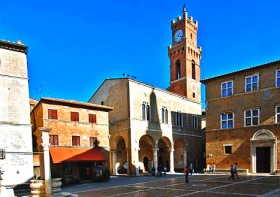
Pope Pius II dreamed of a perfect city, and on this sunbaked Tuscan hilltop, he built it. The trapezoidal Piazza Pio II unfolds like a stage set, framed by the cathedral, the papal palace, and the town hall in flawless Renaissance proportion. Beyond the belvedere, the Val d Orcia rolls away in waves of wheat and cypress, a landscape so deliberately beautiful it seems designed by the same hand that sketched the town. Wandering Pienza is like walking inside a fresco. Every doorway, every window, every angled street leads the eye toward harmony. This is humanism carved in travertine and tufa.
Pienza is a lovely town, whose small chamber center had been almost totally rebuilt by Pope Pius II in the 15th century. In 1405 in Corsignanu, as Pienza was called at that time, was born Aeneas Sylvius Piccolomini. He later became a leading humanist and philosopher. In 1458 he became pope Pius II, and a year later he decided to change the face and the name of his birthplace.
Florentine architect and sculptor Bernardo Rossellino was assigned to a cathedral project, the papal palace and town hall (all completed within three years from 1459 to 1462). The grandiose plan to build the model Renaissance city was never fully realized. Some ideas of how the town could look can be seen at Palazzo Piccolomini, the former papal palace which served until 1968.
In This Article
The Architecture and Urban Design of Pienza
The genius of Pienza lies in its harmonious proportions and the careful relationship between buildings and public space. Rossellino designed the trapezoidal Piazza Pio II as an architectural stage, with the cathedral forming the backdrop and the Palazzo Piccolomini and Palazzo Comunale flanking the sides. The paving pattern draws the eye toward the cathedral facade, creating a sense of depth and perspective that was revolutionary for its time. The cathedral itself blends Gothic and Renaissance elements, with a facade that echoes the triumphal arch motif. Inside, five chapels contain altarpieces by prominent Sienese and Florentine artists, including works by Giovanni di Paolo and Sano di Pietro. The Piccolomini Palace features a three-tiered loggia at the rear, offering panoramic views across the Val d Orcia. This loggia was inspired by the Roman Colosseum and represents one of the earliest examples of a domestic Renaissance facade designed to harmonize with its landscape setting.
Beyond the main square, Pienza retains its medieval street plan with narrow alleyways and hidden courtyards. The town walls, rebuilt by Rossellino, incorporate defensive bastions that also serve as elevated walkways with sweeping views. The local honey-colored travertine stone unifies the town appearance and connects it visually to the surrounding countryside. Many historic buildings now house small museums, artisan workshops, and family-run trattorias where visitors can sample local pecorino cheese and Brunello wine.
The Val d Orcia and Surrounding Landscape
The Val d Orcia is a UNESCO World heritage landscape of rolling hills, cypress-lined roads, and medieval hill towns that has inspired painters and photographers for centuries. The valley stretches south of Pienza toward Montalcino and Montepulciano, two of Italy most celebrated wine-producing towns. The iconic cypress trees that punctuate the hillsides were planted as windbreaks and boundary markers, but they have become symbols of the Tuscan landscape. The winding SP146 road offers the classic driving route through the valley, with pull-off viewpoints at every turn. Photographers often arrive at dawn when the soft light casts long shadows across the wheat fields and morning mist settles in the valleys.
The area produces Brunello di Montalcino and Nobile di Montepulciano wines. Wine-tasting tours are available at numerous estates, many offering olive oil sampling and farm-to-table dining. Hiking and cycling routes crisscross the valley, connecting Pienza with nearby villages such as Monticchiello, San Quirico d Orcia, and Castiglione d Orcia. The landscape changes dramatically with the seasons, from the green wheat shoots of spring to the golden harvest of summer and the misty quiet of autumn.
Planning Your Visit to Pienza
Pienza is easily reached by car from Florence or Siena, with the drive through the Val d Orcia being an attraction in itself. Parking is available just outside the historic center. The best time to visit is spring or autumn when temperatures are mild and tourist crowds are smaller. Summer brings intense heat but the longest daylight hours for photography. Winter has its own charm, with the surrounding hills dusted with snow and the town quiet and peaceful. Local accommodation ranges from countryside agriturismos to boutique hotels within the historic center. Dining options focus on Tuscan classics, with pici pasta, wild boar ragout, and grilled meats featuring prominently on menus.
Pienza is home to 3,000 inhabitants. It is famous for its cheese production, which you can see everywhere in the town. The cheeses are aged here for several years, stored underground, and made with different flavors.
View Pienza the model of the Renaissance town in the heart of Tuscany, Italy in a larger map
Pienza and the Val d Orcia
Pienza was rebuilt in the 15th century by Pope Pius II as an ideal Renaissance town. The main square, Piazza Pio II, features the cathedral, the Piccolomini Palace, and the town hall. The cathedral interior contains works by Florentine artists. The Val d Orcia, a UNESCO World heritage landscape, stretches south of Pienza with rolling hills, cypress trees, and medieval villages. The area produces Brunello di Montalcino and Nobile di Montepulciano wines.
What is the most perfectly planned town you have ever wandered through 🏛️
Explore all our Italy travel guides, from the Dolomites to Sicily.
Explore More
If you enjoyed this article, you might also like:

This brings back wonderful memories. I spent a summer near Pienza back in 2016 and it left a lasting impression. Your description captures the magic perfectly — especially the atmosphere at golden hour.