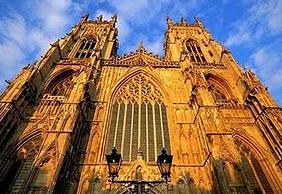
The Shambles narrows to a lane so tight you can almost touch the overhanging timber-framed buildings on both sides at once. The ancient streets of York still follow the Roman grid laid out nearly two thousand years ago, and the medieval city walls encircle a center rich with history at every turn. Clifford Tower looms on its grassy mound, and the magnificent York Minster rises above the rooftops, its stained glass windows casting colored light across the stone floor.
York Minster and the Roman and Viking heritage
York Minster, the largest Gothic cathedral in Northern Europe, dominates the city skyline with its three soaring towers, the central tower rising to 72 metres. The current building was constructed between 1220 and 1472, replacing earlier churches that had stood on the site since the 7th century. The Great East Window, completed in 1408 by Master Glazier John Thornton, is the largest expanse of medieval stained glass in the world, standing 24 metres tall and depicting scenes from the Book of Genesis and the Book of Revelation across 117 individual panels. The Undercroft Museum reveals the layered history of the site, displaying Roman remains from the original fortress of Eboracum, which the Romans founded in 71 AD on the banks of the River Ouse. It quickly became one of the most important cities in Roman Britain. The Yorkshire Museum, set in the beautiful Museum Gardens, houses the spectacular Middleham Jewel, a 15th-century gold pendant set with a large sapphire, and the Gilling Sword, a 9th-century Viking blade discovered in a field near York. The Jorvik Viking Centre, built on the actual excavation site of a Viking settlement, recreates the sights, sounds, and smells of 10th-century Jorvik with amazing authenticity, using archaeological evidence from the famous Coppergate excavations of 1976 to 1981, which recovered over 40,000 objects including coins, jewellery, tools, and household items. The name York itself derives from the Viking word Jorvik, following their capture of the city in 886 AD, and even beyond the Viking era, York position on the key trade route between London and Edinburgh ensured its continued importance as a major transport hub. The arrival of the railways in the 1800s brought a revival in the city fortunes after a period of relative decline, transforming the city into the thriving destination it remains today.
The Shambles, City Walls, and Attractions
The Shambles is York most famous medieval street, mentioned in the Domesday Book of 1086 and recognised as one of the best-preserved medieval shopping streets in all of Europe. The timber-framed buildings lean towards each other at the top, creating a narrow canyon that limits direct sunlight and preserves the medieval atmosphere. Many of the buildings still have the original stone shelves where butchers displayed their meat, along with hooks for hanging carcasses and stone gutters for drainage. Today, the Shambles is lined with independent shops, Harry Potter themed boutiques, quaint tea rooms, and traditional sweet shops that draw millions of visitors each year. The snickelways are narrow, winding medieval alleyways that contain an array of unique shops and food places perfect for spending an afternoon exploring. Other major tourist attractions include Clifford Tower, the remains of York Castle sitting on its grassy mound, and the city walls, which extend for 3.4 kilometres and are the most complete circuit of medieval city walls in England, with four main gatehouses called bars. A complete walk of the walls takes approximately two hours. Museums and galleries abound, including the Yorkshire Museum, the Jorvik Viking Centre, the National Railway Museum housing the world-famous Mallard locomotive that set the steam speed record in 1938, and the York Art Gallery with its collection of ceramics and paintings. Evening entertainment is well catered for at the Theatre Royal, the Grand Opera House, and the Joseph Rowntree Theatre. York has accommodation for all budgets, from basic rooms at the city university to the luxurious Royal York Hotel, comparable with the finest London hotels. The dining options are equally varied, from budget cafes and traditional pubs serving classic British fare to fine dining restaurants offering modern British cuisine. Many visitors to England never venture beyond London, but those who make the journey north to York will be rewarded with a city that offers all the historic charm England can provide together with excellent modern tourist facilities.
Which historic street in England makes you feel like you traveled back in time? 🕰️
Explore all our United Kingdom travel guides, from London landmarks to the Scottish Highlands.
Explore More
If you enjoyed this article, you might also like:
- Severn Bore – surfing on the river Severn in England, United Kingdom – United Kingdom
- Siccar Point rocky promontory in Scotland, United Kingdom – United Kingdom
- Riding High! – Convents, Cathedrals, Monasteries and More | UK – United Kingdom
