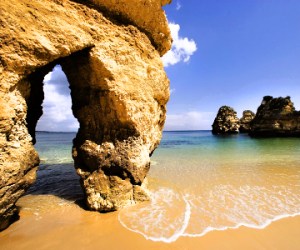
Portugal is the romance of Europe’s western edge, a country of dramatic Atlantic coastlines, golden limestone beaches, medieval hilltop castles, and the melancholic strains of fado music drifting through the narrow alleyways of Lisbon’s Alfama district at midnight. Hemmed in on one side by Spain and on the other by the vast, empty Atlantic, Portugal has always looked outward, to Africa, Brazil, India, and beyond, and this maritime heritage (the Age of Discoveries was launched from Portuguese ports) has left the country with a culture that feels simultaneously deeply traditional and worldly. From the terraced vineyards of the Douro Valley to the fairy-tale palaces of Sintra, from the surf-battered cliffs of the Algarve to the volcanic black sand beaches of the Azores, Portugal delivers astonishing diversity in a country that can be driven end-to-end in 8 hours, and does so at prices that remain among the most competitive in Western Europe.
Quick Facts: Portugal Travel Guide
- Best time to visit Portugal: March–June and September–October for the best weather and manageable crowds across most of the country; July–August is peak season on the Algarve (hot, busy, and expensive, book well ahead); winter is mild in Lisbon and the Algarve (14–18°C) but can be wet; the Douro Valley in September for the grape harvest is magical
- Top attractions: Lisbon’s Belém Tower, Jerónimos Monastery, and the atmospheric Alfama district; the fairy-tale palaces of Sintra (Pena Palace, Quinta da Regaleira, and the Moorish Castle); the Douro Valley wine region; Porto’s Ribeira district and the Livraria Lello bookshop; the beaches and sea caves of the Algarve; and the volcanic crater lakes of the Azores
- How to get to Portugal: Lisbon Portela Airport (LIS) is the main intercontinental hub; Porto (OPO) and Faro (FAO) are well-connected across Europe within budget and full-service airlines; excellent highways (many tolled) connect the country north to south; the train from Lisbon to Porto takes ~3 hours (Alfa Pendular high-speed)
- Currency: Euro (€)
- Language: Portuguese, English is widely spoken in tourist areas; Spanish is understood but replying in Spanish (rather than English) can be perceived as presumptuous, many Portuguese prefer English over Spanish
- Best for: Couples and romantics, food and wine lovers (especially seafood and port), surfers (some of Europe’s best breaks), history enthusiasts, and anyone seeking a more affordable Western European experience
Portugal’s Must-Visit Regions
- Lisbon and the Lisbon Coast: Europe’s sunniest capital city is built on seven hills overlooking the Tagus River, a seductive blend of pastel-coloured buildings, azulejo-tiled facades, and the mournful melodies of fado. Key stops: Belém (the Age of Discoveries in stone), the Alfama (get lost in the alleys), and the Time Out Market. Day trip: Sintra, a mountain of Romantic palaces, mystical gardens, and UNESCO-listed fantasy. Read our Pena Palace guide →
- Porto and the Douro Valley: Porto is Lisbon’s grittier, more atmospheric northern sibling, a city of steep cobbled streets, port wine lodges across the Douro River in Vila Nova de Gaia, and one of the most beautiful railway stations in the world (São Bento). The Douro Valley, a UNESCO World heritage landscape of terraced vineyards climbing dramatically from the river, is one of Europe’s most beautiful wine regions, best explored by boat or the scenic Douro railway line.
- The Algarve: Portugal’s southern coastline is famous for a reason, golden limestone cliffs, turquoise Atlantic water, and a string of beautiful beaches from the dramatic Ponta da Piedade caves near Lagos to the long sandy stretches of the eastern Algarve. Read our Ponta da Piedade guide → The western Algarve (Sagres, the Costa Vicentina) is wilder and popular with surfers.
- Madeira and the Azores: Portugal’s Atlantic islands are worlds unto themselves, Madeira, the floating garden with its impossibly lush Laurisilva forest and levada trails; and the Azores, a remote archipelago of volcanic crater lakes, hot springs, and whale watching. Read our Laurisilva Forest guide →
Portugal is one of the countries with a long and rich history. In 1986 Portugal joined the European Community and now it is a member of Europe, however it is considered as one of the poorest countries in EU.
Portugal is the westernmost country in Europe, lies at the Iberian Peninsula in the subtropical zone. North and center of the country is very mountainous, forested and there are a number of rivers. This area is used mainly for mountain tourism. Generally, the northern climate is mild in winter and rains a lot here which keep the temperature almost the same throughout the year. For the Alentejo region, forming the middle part of Portugal, is characterized by hot, dry summers alternating with quiet winter. But the most popular tourist destination in Portugal is the south – Algarve region. Arab monuments are located here from the time of colonization. This part offers stunning scenery, beautiful beaches and warm climate. The country has the islands of the Azores and Madeira, which lies in the Atlantic west coast. Lisbon is the capital city, located on the west coast at the mouth of the River Tagus. Thanks to its location it is a major Portuguese port.
View Portugal – romance on west coast in a larger map
What’s your corner of Portugal, Lisbon’s fado-filled nights, Porto’s wine cellars, the Algarve’s golden beaches, or the wild Azores? Share your Portuguese discoveries in the comments! 🇵🇹
Explore all our Portugal travel guides, from the Douro to the Algarve and beyond.
Explore More
If you enjoyed this article, you might also like:
- Mata Nacional do Buçaco – protected area in Portugal – Nature
- Vasco da Gama Bridge – the longest bridge in Europe | Portugal – Portugal
- Austria – Country of a Thousand Faces – All Countries
