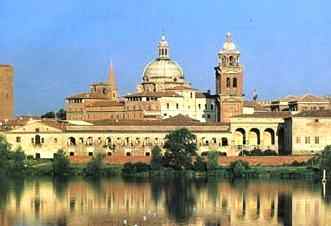
Màntova (Mantua) is one of Italy’s greatest artistic and cultural centres, a Renaissance jewel in the Lombardy region, surrounded on three sides by artificial lakes created in the 12th century, whose magnificent Palazzo Ducale (the largest palatial complex in Italy after the Vatican), Andrea Mantegna’s revolutionary frescoes, and deep connections to the musical heritage of Claudio Monteverdi make it one of the most rewarding art cities in northern Italy. The Gonzaga family ruled Mantua for nearly 400 years (1328-1707), transforming it into one of the most brilliant courts of Renaissance Europe, and the Palazzo Ducale, with its 500 rooms, its frescoed corridors, and Mantegna’s breathtaking Camera degli Sposi, is their enduring monument.
In This Article
Quick Facts: Mantua, Italy
- Best time to visit: Year-round; spring and autumn for the most pleasant temperatures; September for the Festivaletteratura, one of Italy’s most prestigious literary festivals
- How to get there: ~45 minutes from Verona by train; ~1.5 hours from Bologna; ~2 hours from Milan; Mantua’s centre is a 15-minute walk from the station
- Top attraction: Palazzo Ducale, especially the Camera degli Sposi (Bridal Chamber), where Mantegna’s 1465-1474 fresco cycle, including the famous illusionistic oculus in the ceiling (the first di sotto in sù perspective ceiling painting of the Renaissance), is one of the pivotal works of Western art
The Gonzaga Legacy and Palazzo Ducale
Mantua’s historic power and influence under the Gonzaga family made it one of the main artistic, cultural, and musical hubs of Northern Italy. The Palazzo Ducale complex is the centrepiece of this legacy, encompassing a collection of buildings, courtyards, and gardens gathered around the Palazzo del Capitano, the Magna Domus, and the Castle of St. George. Walking through the 500 rooms of the palace is a journey through Renaissance art and architecture, with each chamber revealing new treasures. The Camera degli Sposi is the undisputed highlight, where Mantegna’s frescoes cover every wall and ceiling. The illusionistic oculus painted on the ceiling creates the effect of an open sky, with cherubs and courtiers leaning over a painted balustrade – a technique that revolutionised perspective in painting.
The Gonzaga court attracted some of the finest artists and thinkers of the Renaissance. Beyond Mantegna, the city’s artistic heritage includes works by Leon Battista Alberti, who designed the basilica of Sant’Andrea, and Giulio Romano, who created the remarkable Palazzo Te. Mantua’s musical legacy is equally significant; Claudio Monteverdi, one of the founders of opera, worked here and premiered several of his groundbreaking works at the Gonzaga court. The city’s role in the development of opera cannot be overstated, and music festivals throughout the year celebrate this rich heritage.
Architectural Treasures and City Layout
Mantua is surrounded by three artificial lakes created during the 12th century: Lago Superiore, Lago di Mezzo, and Lago Inferiore. A fourth lake, Lago Pajolo, once completed a defensive water ring but dried up at the end of the 18th century. These lakes give the city its unique character, creating the impression of an island rising from the water. The historic centre is remarkably well preserved, with narrow medieval streets opening onto grand Renaissance piazzas. The Rotonda di San Lorenzo, a 12th-century round church, stands in the heart of the city and is one of the oldest buildings in Mantua. The Duomo, rebuilt in the 16th century, features a striking Baroque interior, while the basilica of Sant’Andrea houses the revered Holy Nail relic.
Beyond the major monuments, Mantua rewards casual exploration. The Palazzo Te, built between 1525 and 1535 as a suburban retreat for the Gonzaga, features Giulio Romano’s famous frescoes in the Sala dei Giganti, where the walls appear to collapse around the viewer. The Bibiena Theatre, an intimate 18th-century theatre, is renowned for its perfect acoustics and ornate interior. The Torre della Gabbia (Cage Tower) and the Palazzo della Ragione with its Torre dell’Orologio (Clock Tower) add to the medieval texture of the city. Art lovers should also visit the Church of San Sebastiano and Palazzo Valenti Gonzaga, both containing important fresco cycles.
Cultural Events and Local Cuisine
Mantua hosts several outstanding cultural events throughout the year. The Festivaletteratura in September is one of Italy’s most prestigious literary festivals, bringing together authors, poets, and thinkers from around the world for readings, discussions, and performances across the city. The Mantua Music Festival celebrates the city’s operatic heritage with concerts in historic venues. The local cuisine reflects Mantua’s position between Lombardy and Emilia-Romagna, featuring pumpkin-filled tortelli, horse meat stew (stracotto di cavallo), and the famous sbrisolona cake, a crumbly almond dessert. The city’s three lakes provide freshwater fish, and the surrounding countryside produces excellent wines including Lambrusco and Trebbiano.
Practical information: Mantua’s compact centre is easily explored on foot, with most attractions within a 20-minute walk of each other. The train station is a 15-minute walk from Piazza Sordello, the main square. For a unique perspective, consider a boat tour on the lakes that surround the city. The best time for photography is late afternoon when the warm light illuminates the brick and stone buildings. Mantua is less crowded than better-known Italian art cities, making it possible to enjoy the Palazzo Ducale and other sites without the long queues found in Florence or Venice.
View Mantova – centre of the art and education, Italy in a larger map
Have you gazed up at Mantegna’s oculus in the Palazzo Ducale or discovered Mantua’s Renaissance treasures? Share your Lombard art discoveries in the comments! 🎨
Explore all our Italy travel guides, from the Dolomites to Sicily.
Explore More
If you enjoyed this article, you might also like:
