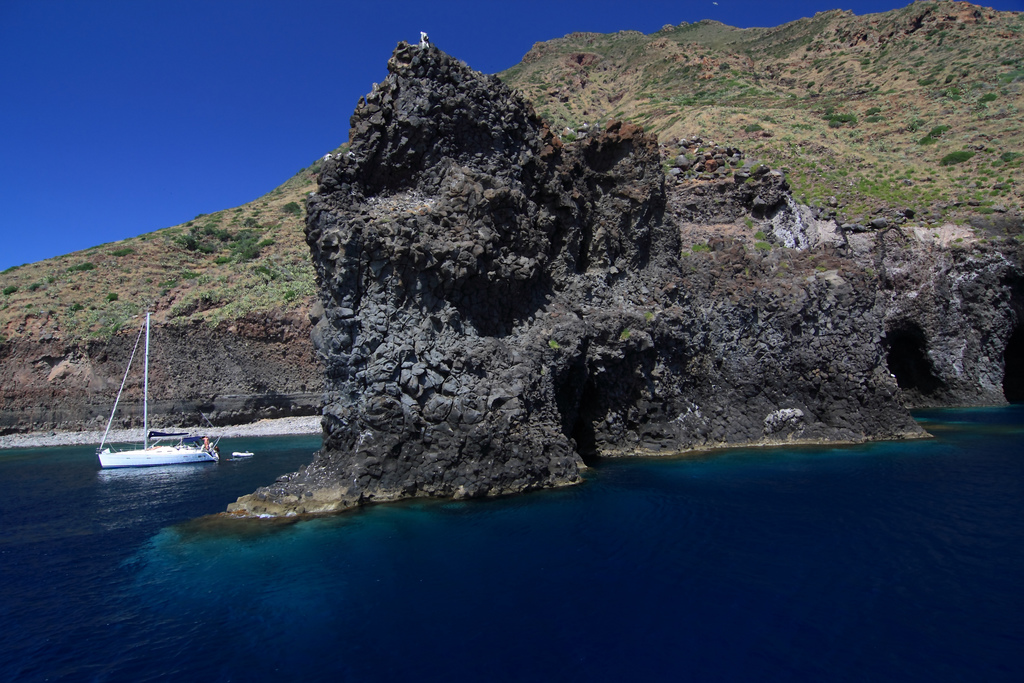
Filicudi is the third smallest of the seven Aeolian Islands and the least visited after Alicudi. The permanent population hovers around 250 people. There is one bank, one pharmacy, one school with a single teacher, and a handful of restaurants that close for lunch. The island has no airport, no ferry from the mainland, and no nightlife worth the name. Filicudi is as far from the chaos of the Italian coast as you can get while still being in Italy.
In This Article
Getting to Filicudi: A Journey Off the Beaten Path
Reaching Filicudi requires a bit of planning, which is precisely why it has retained its authentic character. Hydrofoils and ferries depart from the port of Milazzo in northeastern Sicily, with the journey taking approximately two hours. Services are more frequent during the summer months, with at least two connections daily, while winter schedules are reduced to just a few per week. The island has no airport, and the only roads are narrow, winding lanes best navigated on foot, by scooter, or by the island’s few taxis. The main port at Pecorini Mare is where visitors arrive, greeted by whitewashed houses cascading down the hillside and the sight of fishing boats bobbing in the turquoise harbour. There is a palpable sense of stepping back in time as soon as you set foot on the quay.
Hiking to the Summit of Monte Fossa Felci
The most rewarding activity on Filicudi is the hike to the summit of Monte Fossa Felci, the island’s highest point at 773 metres. The trail starts from the village of Valdichiesa and winds through Mediterranean scrub, past ancient dry-stone terraces, and up onto the volcanic ridge. The climb takes around two hours and is moderately challenging, but the panoramic view from the top is nothing short of spectacular. On a clear day, you can see the entire Aeolian archipelago spread out before you, with the cone of Stromboli puffing smoke on the northern horizon. The trail passes an extinct volcanic crater and several lookout points that offer excellent photo opportunities. Wear sturdy shoes and carry at least a litre of water per person, as there are no facilities along the route.
Wild Swimming, Local Cuisine, and Where to Stay
Filicudi’s coastline is punctuated with hidden coves and pebble beaches accessible only by foot or by boat. The Grotta del Bue Marino, a sea cave on the northern coast, is a popular destination for swimming excursions. Local restaurants serve freshly caught fish, capers grown on the island’s famous terraces, and pasta alla norma made with local aubergines. Accommodation consists mostly of small bed-and-breakfasts and holiday rentals in Pecorini Mare and Valdichiesa, with no large hotels to be found anywhere on the island. The best time to visit is between May and September, when the sea is warm enough for swimming and all the restaurants are open. July and August are the busiest months, but even then, Filicudi feels blissfully uncrowded compared to its more famous neighbours.
Getting to Filicudi
The only way to reach Filicudi is by hydrofoil or ferry from Lipari or Milazzo on Sicily. The hydrofoil from Lipari takes about 45 minutes and costs roughly €25 one-way as of 2026. From Milazzo the journey is about two hours. In summer there are two or three departures daily. In winter the service reduces to one. If the sea is rough the hydrofoil does not run. The island has no real harbour: the ferry docks at the small pier at Pecorini Mare, and a second pier at Valdichiesa serves the eastern side of the island. Cars are uncommon. Most transport is by scooter or on foot.
The Coastline and the Sea
Filicudi’s coastline is steep and jagged, the result of volcanic activity that ended roughly 30,000 years ago. The sea around the island is protected as part of the Aeolian Islands Marine Reserve. The water clarity is exceptional. Snorkelling from the rocks at Capo Graziano, on the southern coast, reveals a submerged archaeological site: the remains of a Bronze Age village that was submerged by rising sea levels around 3,500 years ago. The Grotta del Bue Marino, a sea cave on the eastern side, is accessible by boat from the port. The dive boats run from June through September. The cost is €35-50 per person for a half-day trip.
Walking the Island
A single road crosses the island from Pecorini to Valdichiesa, roughly 7 km end to end. The walking trails are better. The path from Pecorini to Monte Fossa Felci, the highest point at 773 metres, takes about two hours. The summit is a collapsed volcanic crater covered in Mediterranean scrub, with views of Salina, Lipari, and on a clear day, Mount Etna to the south. The trail from Valdichiesa to the prehistoric village at Capo Graziano is a 45-minute walk through terraced olive groves that have been cultivated for centuries. The village site dates to 1,700 BCE. The huts are circular stone foundations, low to the ground, and the pottery fragments still visible among the stones are the reason the site was excavated in the 1950s.
What is the most remote island you have ever visited, and did the silence feel like isolation or peace?
Looking for more European travel inspiration? Check out our other guides and start planning your next European adventure!
Explore all our Italy travel guides, from the Dolomites to Sicily.
Explore More
If you enjoyed this article, you might also like:
