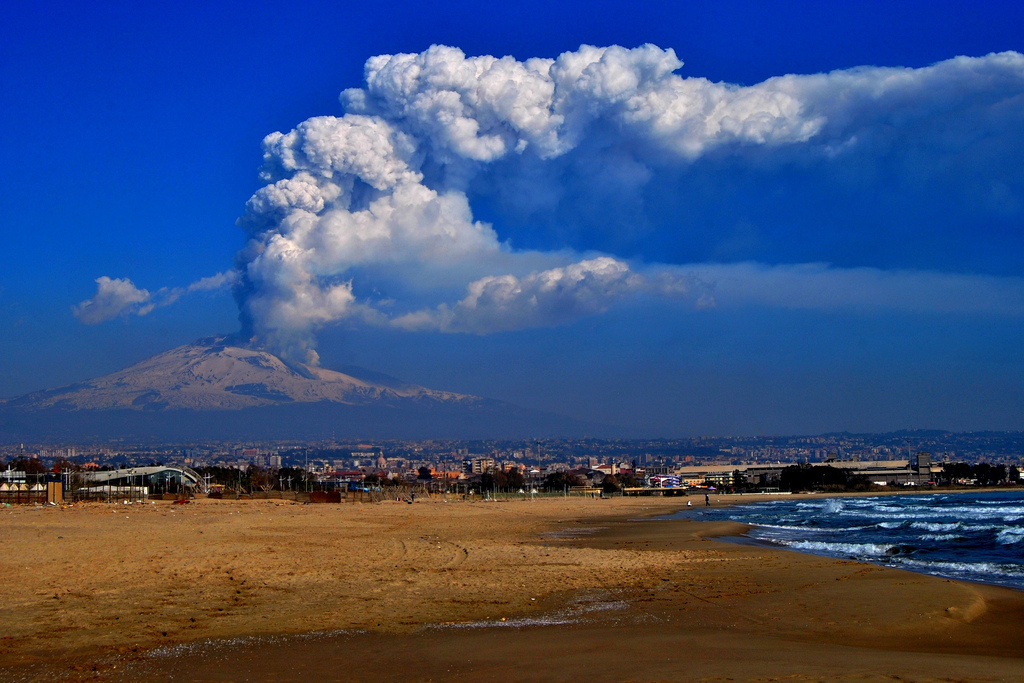
Mount Etna is the largest active volcano in Europe and the most frequently erupting volcano on Earth. It has been erupting for at least 500,000 years. In 2021 alone it erupted more than 50 times. The locals call it Mungibeddu in Sicilian, and they have learned to live with a mountain that could, at any moment, turn the sky orange and cover their cars in ash. Etna is not a threat that looms over Catania. It is a neighbour that occasionally makes a mess.
In This Article
The Volcanic Activity That Shapes Sicily
Mount Etna is one of the most active volcanoes on the planet, with eruptions recorded as far back as 1500 BCE. Its activity ranges from gentle lava flows that creep slowly down the flanks to spectacular paroxysmal eruptions that send fountains of lava hundreds of metres into the air. The volcano stands approximately 3,357 metres tall, though its height fluctuates with each significant eruption as craters collapse and new cones form. Four distinct summit craters dominate the peak: Bocca Nuova, Voragine, Northeast Crater, and Southeast Crater. Each eruption reshapes the landscape, adding new layers of basalt and scoria that make Etna one of the world’s most dynamic geological laboratories. Scientists monitor the volcano constantly, and eruptions rarely pose danger to nearby settlements.
Exploring Etna’s Unique Landscapes
Visitors can explore Etna’s varied terrain through a network of guided tours and hiking trails. The lower slopes are covered in fertile volcanic soil that supports vineyards, olive groves, and orchards, producing renowned wines like Nerello Mascalese. Higher up, the vegetation thins to hardy shrubs and alpine plants adapted to the volcanic environment. Around 2,000 metres, the landscape transforms into a dark, lunar expanse of solidified lava flows, cinder cones, and steam vents. Guided jeep tours typically take you to around 2,900 metres, from where a short hike reaches the summit craters. Winter skiing is possible on Etna’s slopes, with facilities at Rifugio Sapienza and Piano Provenzana. The volcano is a UNESCO World heritage Site, recognised for its exceptional geological and ecological value.
Safety Tips and Best Times to Visit
The best months for visiting Etna are between April and November, when the weather is milder and hiking conditions are most favourable. Early summer offers the clearest views, while autumn provides cooler temperatures and fewer crowds. Sturdy hiking boots, warm clothing, and sunglasses are essential, as conditions at altitude can change rapidly. Always book with a licensed guide, as venturing too close to active craters without local knowledge is dangerous. Check the official Etna activity alerts before travelling, and avoid areas closed due to heightened volcanic activity. Entry to the lower park is free, but guided tours to the summit cost between 50 and 80 euros per person depending on the route and duration. Allow a full day for a comprehensive visit.
The Eruptions That Changed History
The most destructive eruption in Etna’s recorded history occurred in 1669, when lava flowed for 45 days and reached the city of Catania, destroying about 15,000 homes. The walls of the Ursino Castle, built directly on the coast, were lapped by lava but held. The castle still stands today, surrounded by lava rock. More recently, the 2002-2003 eruption forced the closure of the Etna cable car and sent ash clouds that stopped flights at Catania Fontanarossa Airport for days. The 2021 eruptions, a series of spectacular paroxysms from the Southeast Crater, produced fountains of lava 1,500 metres high. The ash fell on Catania, 30 km away, coating cars and gardens in fine grey powder.
How to Visit Etna
The main access point is the Sapienza Refuge at 1,900 metres on the southern slope, reachable by car from Catania in about an hour. From the refuge the cable car rises to 2,500 metres. From there, a bus or a guided hike continues to 2,900 metres. Above that point visitors must be accompanied by a certified mountain guide. A guided tour to the summit craters: the Central Crater at 3,323 metres, the Southeast Crater, the Bocca Nuova: costs roughly €70-100 per person and takes 5-6 hours. The guide provides helmets and torches. The terrain is steep black sand, basalt boulders, and patches of ice that persist year-round at altitude. The temperature at the summit is 10-15 degrees colder than at sea level. A jacket is not optional.
The Wine of Etna
The volcanic soil of Etna’s lower slopes produces some of Sicily’s most distinctive wines. The Nerello Mascalese grape, grown on terraced vineyards between 600 and 1,000 metres, yields red wines that wine critics compare to fine Barolo or Burgundy. The Contrade system: Etna’s version of Burgundian crus: names vineyards by their lava flow. The 2002 flow, the 1981 flow, the 1865 flow. Each flow contributes different minerals to the soil. A bottle of Etna Rosso DOC from a good producer costs €20-35 as of 2026. The wineries around Randazzo and Castiglione di Sicilia offer tastings from May to October. Book ahead. The good ones fill up.
Did you stand on Etna’s black slopes and feel the heat through the soles of your boots, or did you watch from the safety of the refuge and wonder what it would be like to see the lava?
Looking for more European travel inspiration? Check out our other guides and start planning your next European adventure!
Explore all our Italy travel guides, from the Dolomites to Sicily.
Explore More
If you enjoyed this article, you might also like:
