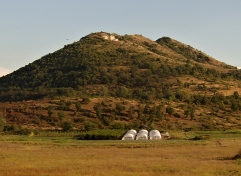
Rupite is one of Bulgaria’s most enigmatic destinations, an extinct volcano crater in the shadow of the Kozhuh Mountain, where steaming mineral springs, otherworldly rock formations, and the spiritual legacy of the controversial mystic Baba Vanga converge into a landscape unlike anywhere else in Europe. Located near the Greek and North Macedonian borders, Rupite combines fascinating geology, healing thermal waters, and a deep connection to Bulgarian folklore and recent history.
In This Article
Quick Facts: Rupite, Bulgaria
- Best time to visit Rupite: April-October; the thermal springs are pleasant year-round; summers can be very hot
- Top attractions: Baba Vanga’s Church of St. Petka, the volcanic crater, thermal mineral springs, and Kozhuh Mountain
- How to get to Rupite: ~2 hours from Sofia by car (via the A3 motorway to Petrich); nearest town is Petrich (10km); limited public transport, taxi from Petrich recommended
- Entry fee: Free to visit the crater area and springs; small fee for the church complex
- Best for: Spiritual seekers, geology enthusiasts, and those interested in Balkan mysticism and off-the-beaten-path destinations
The Baba Vanga Connection
Rupite is inseparable from the legacy of Baba Vanga (1911-1996), Bulgaria’s famous blind mystic, clairvoyant, and herbalist who chose this spot as her home in the later decades of her life. The Church of St. Petka of Bulgaria, built with Baba Vanga’s own funds in 1994, is one of the most unusual Orthodox churches in the Balkans: its iconography was painted by the controversial artist Svetlin Rusev in a stark, hyper-realistic style that divided both the church hierarchy and public opinion. Baba Vanga is buried nearby, and thousands of pilgrims visit annually seeking spiritual connection at the site she believed was charged with extraordinary energy.
Vanga, who lost her sight at the age of twelve during a severe storm, became one of the most famous clairvoyants of the 20th century. She is said to have predicted the breakup of the Soviet Union, the Kursk submarine disaster, and the September 11 attacks in the United States. Her advices to manage even the Bulgarian communists. According to legend, at the age of six years, she met an angel, who gave her the choice between the eyes and clairvoyance. She chose clairvoyance and later she became famous for healing of the people. She advised a total of 7000 predicted events from which 80 percent were correct. In the area of the church you can find her grave.
Geology, Natural Wonders, and Planning Your Visit
- Extinct volcano: Kozhuh Mountain is the remnant of a Pliocene-era volcano that last erupted approximately one million years ago. The surrounding landscape of red and ochre rock, volcanic plugs, and steaming vents creates a visually striking, almost Martian environment.
- Thermal springs: Multiple hot mineral springs bubble up at temperatures of 71-78°C, rich in bicarbonate, sulphate, sodium, and fluoride. The water is believed to have therapeutic properties for musculoskeletal and skin conditions.
- Unique biodiversity: The warm microclimate and mineral-rich soil support species rarely found elsewhere in Bulgaria, including the Southern Dwarf Iris and several endemic insects. The area is a protected natural landmark and part of the Natura 2000 network.
Near the town of Rupite, in southern Bulgaria, there is an extinct volcano crater. In the area, there are several thermal springs that form lakes, in which tourists swim. It was right here where a famous clairvoyant Baba Vanga lived.
Rupite includes a small mountainous protected area in the part Blagoevgrad Province, about 10-12 kilometres northeast of Petrich. The best way to reach Rupite is by car, as public transport in the region is limited. From Sofia, take the A3 Struma motorway south towards the Greek border, exiting at Petrich. The final stretch of road from Petrich to Rupite passes through agricultural land with increasingly dramatic views of the volcanic landscape ahead. Plan to spend two to three hours exploring the crater area, visiting the church, and soaking in the atmospheric setting. For a fuller experience, combine your trip with a visit to the nearby town of Melnik (Bulgaria’s smallest town and a renowned wine region) and the Rozhen Monastery, both within an hour’s drive of Rupite.
View Rupite – extinct volcano in Bulgaria in a larger map
Have you visited Rupite, the church of Baba Vanga, or explored Bulgaria’s off-the-beaten-path destinations? Share your experiences and thoughts on this remarkable place in the comments! 🌋
Explore all our Bulgaria travel guides, from the Black Sea to the Rila Mountains.
Explore More
If you enjoyed this article, you might also like:
