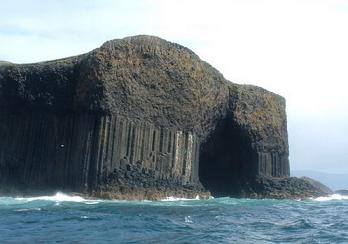
Fingal’s Cave on the uninhabited Hebridean island of Staffa is one of Scotland’s most extraordinary geological wonders, a vast sea cave formed entirely from hexagonal basalt columns, whose natural acoustics produce an eerie cathedral-like resonance that inspired Mendelssohn’s Hebrides Overture and captivated writers from Sir Walter Scott to Jules Verne. Accessible only by boat from the Isle of Mull, this cathedral of nature remains one of the most atmospheric and awe-inspiring destinations in the British Isles.
In This Article
Geology and Formation of the Cave
The hexagonal basalt columns of Fingal’s Cave were created approximately 60 million years ago during the Paleogene period, when a massive lava flow cooled slowly and contracted into the characteristic polygonal shapes that give the cave its unique appearance. The same geological formation can be seen at the Giant’s Causeway in Northern Ireland, which lies directly across the sea, and this connection has given rise to the legendary tale that the Irish giant Fionn mac Cumhaill built the causeway as stepping stones to Scotland. The columns form a natural arched roof over the sea cave, with the ocean surging and echoing within, creating what the Gaelic name An Uaimh Bhinn calls the melodious cave.
The cave is 72 metres deep and 20 metres high at its entrance, gradually narrowing as it extends into the cliff. The columns are predominantly hexagonal but also include pentagonal and heptagonal forms, and their precise geometric arrangement fascinates geologists and visitors alike. Fingal’s Cave was discovered by the English naturalist Sir Joseph Banks in 1772 during his expedition to Iceland, though it had been known to local Gaelic-speaking communities for centuries before that. Celtic legend has always surrounded the cave, and the name Fingal comes from a legendary Scottish hero.
Visiting Staffa and the Cave
In 1829, Felix Mendelssohn visited Staffa and was so moved by the cave’s atmosphere and the sound of the waves echoing against the basalt columns that he composed the concert overture The Hebrides, also known as Fingal’s Cave, which remains one of classical music’s most evocative depictions of nature. Visiting requires planning, as boat tours operate from Fionnphort on the Isle of Mull and from the nearby island of Iona between April and October. The journey takes about 45 minutes each way, costing approximately 35 to 40 pounds per person.
Landing on Staffa involves stepping from the boat onto the rocky shore, and a paved causeway along the cliff face leads to the cave entrance. The island also hosts a colony of puffins in spring and summer, making the boat trip a combined wildlife and geological excursion. Due to the exposed nature of the crossing and the landing, the tour is not suitable for those with mobility issues, and weather cancellations are possible even in summer. The cave is 69 metres long and 7 to 13 metres wide, and the entry is as high as a five-floor house, creating a truly dramatic entrance that leaves every visitor in awe of nature’s power.
Wildlife on the Island of Staffa
Staffa is not only a geological wonder but also an important wildlife sanctuary. The island’s cliffs provide nesting sites for thousands of seabirds, including the iconic Atlantic puffin, which returns to Staffa each spring to breed. Puffins can be seen from May to July, and visitors during this period are almost guaranteed to see these charismatic birds with their brightly coloured beaks bobbing on the water or flying low over the waves. Other seabirds nesting on the island include guillemots, razorbills, and fulmars, which crowd the narrow ledges of the basalt cliffs.
The waters around Staffa are rich in marine life, and boat tours frequently encounter harbour porpoises, common dolphins, and seals. Grey seals can often be seen lounging on the rocks at the base of the cliffs, their curious heads occasionally bobbing up near the boat. Minke whales are also spotted in the area during the summer months. The combination of geological wonder, seabird colonies, and marine wildlife makes a boat trip to Staffa an unforgettable experience that appeals to nature lovers of all kinds. The best time for wildlife viewing is from May to August, when the seabirds are nesting and the weather is most favourable for boat crossings from Mull.
View Fingal’s Cave – natural wonder in Scotland United Kingdom in a larger map
Have you visited Staffa and heard the music of Fingal’s Cave? Share your Hebridean adventures in the comments! 🏴🇹🇬
Explore all our United Kingdom travel guides, from London landmarks to the Scottish Highlands.
Explore More
If you enjoyed this article, you might also like:
