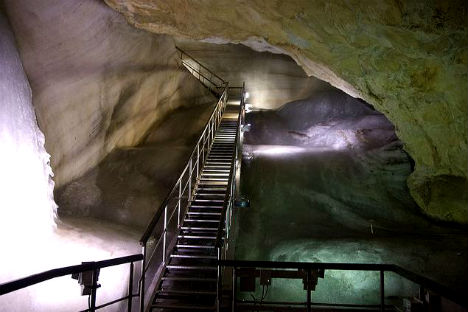
Dobšinská Ice Cave is not just the largest ice cave in Slovakia. It is the first cave in Europe to have electric lighting, switched on in 1887, just a year after its public opening, and a full decade before most European cities had streetlights. The cave sits on the northern slope of limestone hill Duča in the Stratenská Highlands, part of the Slovak Paradise National Park, and its entrance at 970 metres above sea level was known locally as the “cold hole” long before anyone ventured inside. A mining engineer named Eugen Ruffínyi, along with two friends, first explored the depths in June 1870 and what they found was extraordinary: a pocket-like cavity 18 metres wide and 70 metres deep where cold winter air sinks in, freezes the leaking water, and has built up ice formations over 25 metres thick at the floor, with a total ice volume of approximately 145,000 cubic metres. Between 1893 and 1946, the public could actually skate here year-round, inside a mountain.
\n\n
Quick Facts: Dobšinská Ice Cave
\n
- \n
- Best time to visit: May to October (open season); the ice formations are most impressive in late summer after the winter ice has had time to settle and the contrast between the outdoor heat and the -1°C cave temperature is at its most dramatic
- Tour details: Guided tours only, lasting approximately 30 minutes; the public section covers 475 metres of the cave’s total 1,388-metre length. Photography requires an additional fee and eating or drinking is strictly prohibited inside
- UNESCO status: Inscribed on the UNESCO World heritage List in 2000 as part of the Caves of Aggtelek Karst and Slovak Karst transboundary site, shared with Hungary
- Getting there: The cave is near the mining town of Dobšiná, approximately 60 km from Košice in eastern Slovakia. A car is essential as public transport to the cave entrance is limited
\n
\n
\n
\n
\n\n
Dobšinská Ice Cave is the largest ice cave in the Slovak Republic and one of the most important and beautiful ice caves in the world. It is located in Stratenská Highlands, on the northern slope of a limestone hill Duča, near the mining town of Dobšiná. The cave is a part of the Slovak Paradise National Park (Slovenský raj).
\n

\nPhoto published with a kind permission of its author va.lentijn
\n
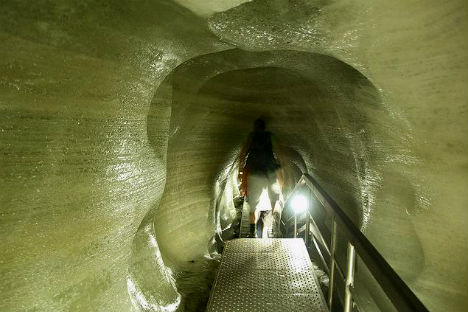
The entrance to the cave is situated at an altitude of 970 meters above sea level and used to be known as a “cold hole”. The first visitor was a mining engineer and amateur speleologist Eugen Ruffínyi with his friends Gustáv Lang and Andrej Mega. They explored the cave in June 1870. A year later it was opened to the public and in 1887 became the first cave in Europe with electric lighting. The total length of the cave is 1388 m, from which only 475 m long section is available for the public. In the years 1893 – 1946 the public skating was allowed here during the whole year.
\n
\nPhoto published with a kind permission of its author va.lentijn
\n
Underground spaces were created and formed by chemical and mechanical action of water of the river Hnilec. Dobšinská ice caves were originally connected with Stratenská caves. But after the collapse of the cave ceiling, the cave system has been divided and closed the air circulation. The cave got a shape of a pocket-like large cavity. It is 18 meters wide and 70 meters deep with a single hole on the surface. This resulted in the establishment of local microclimatic conditions and ice caves. In winter a cold air penetrates into the cave, which cools its walls and leaking water and freezes, creating ice formations (stalactites, stalagmites, icefalls, pillar and floor ice). The thickness of ice reaches up to 25 meters at the floor, its volume is approximately 145,000 cubic meters. The average annual temperature of the cave is -1 °C while the humidity reaches 96-99%.
\n
\nPhoto published with a kind permission of its author va.lentijn
\n
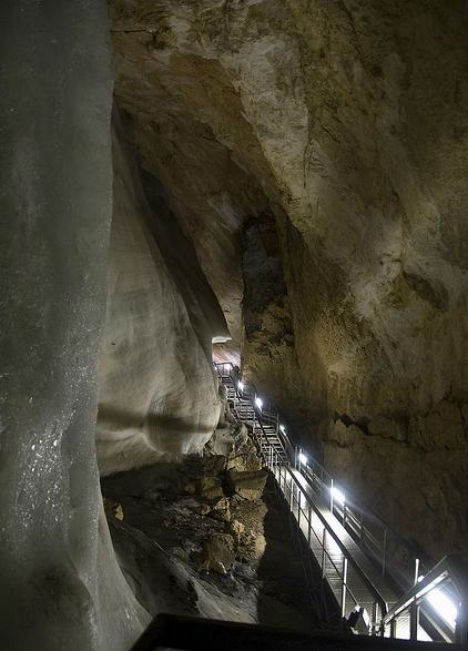
Glaciation is only in the part of the cave entrance, where it gets cold from outside. Rear and bottom areas are ice-free, but with many weathered stalactite formations. The cave consists of several separate parts – Small Hall, Large Hall, collapsing dome, Ruffínyi’s corridor, and other. The largest area is the Great Hall – 72 metres long, 42 metres wide and 10 metres high. The largest ice column is named the Well (Studňa).
\n
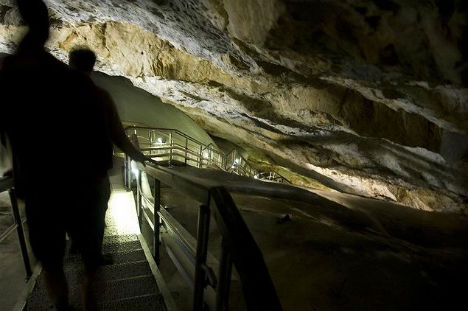
The tour through Dobšinská Ice Cave lasts 30 minutes. It is open from May to October. Eating or drinking is prohibited here, you can use a camera for additional fee. Entry is permitted only with a guide.
\n
Dobšinská Ice Cave is a home of several species of bats, and in 2000, the cave has been inscribed on the UNESCO World heritage List.
\n
\nPhoto published with a kind permission of its author va.lentijn
\n
View Dobšinská Ice Cave – the largest ice cave in Slovakia in a larger map
\n\n
What Makes the Ice Unique
\n
The underground spaces were created by the chemical and mechanical action of water from the river Hnilec. Originally, Dobšinská was connected to the Stratenská cave system. A collapse of the cave ceiling divided the system and closed the air circulation, turning the cavity into a pocket-like trap. In winter, cold air pours in and cools the walls. Leaking water freezes into stalactites, stalagmites, icefalls, and pillar ice. The Great Hall measures 72 metres long, 42 metres wide and 10 metres high, and the largest ice column, named the Well (Studňa), dominates the space. The average annual temperature inside stays at -1°C and humidity reaches 96-99%, conditions that have preserved the glaciation for centuries. The rear and bottom areas remain ice-free but display weathered stalactite formations from an earlier geological era.
\n\n
Bats and Biodiversity
\n
The cave is home to several species of bats that hibernate in the ice-free rear sections during winter. The unique microclimate supports a specialised ecosystem of cave-dwelling invertebrates adapted to the constant cold. The surrounding Slovak Paradise National Park offers some of the best hiking in Slovakia, with ladders, chains, and footbridges navigating the gorges and waterfalls that make this region famous.
\n\n
Have you stood inside Europe’s first electrically lit cave or walked the ice fields of Dobšinská? Share your underground adventure in the comments! 🌙
\n\n
Explore all our Slovakia travel guides, from the High Tatras to Bratislava charm.
Explore More
If you enjoyed this article, you might also like:
