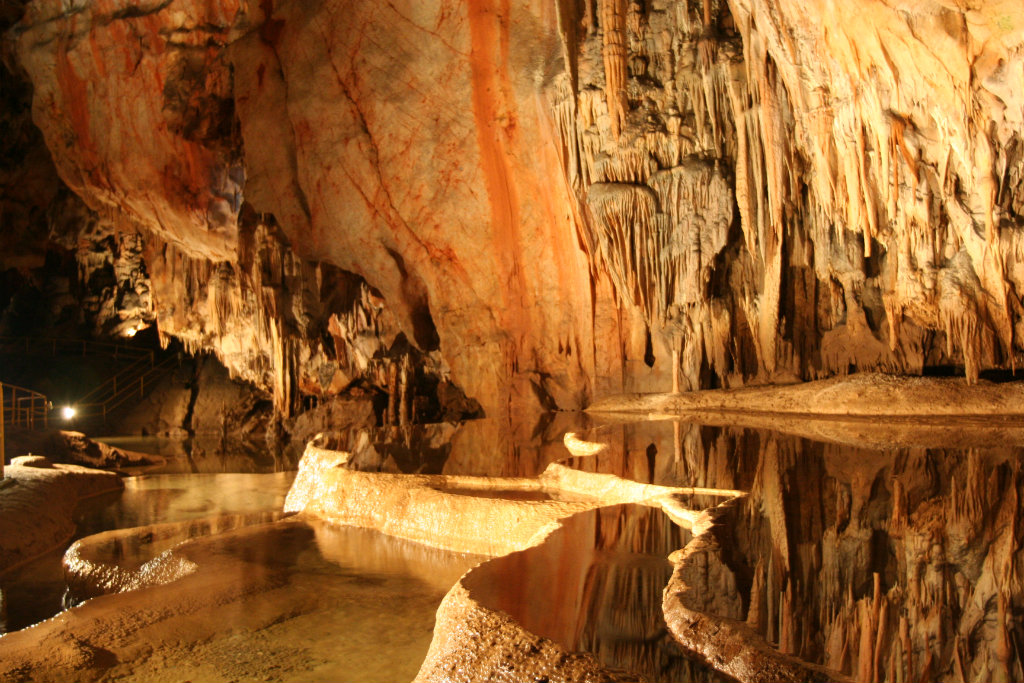
Domica Cave is the largest cave in Slovakia and one of the crown jewels of the UNESCO-listed Caves of Aggtelek Karst and Slovak Karst World heritage site, a vast underground system on the Slovak-Hungarian border featuring magnificent flowstone formations, pagoda-like stalagmites, and a navigable underground river that visitors can explore by boat. Discovered in 1926 and opened to the public in 1932, Domica is a 5,000-metre-long labyrinth of chambers and passages (of which 1,200 metres are accessible on guided tours) that forms a single hydrological system with the Baradla Cave on the Hungarian side, together, one of the largest cave systems in Central Europe.
In This Article
Quick Facts: Domica Cave, Slovakia
- Best time to visit: May–September (extended opening hours); the boat ride on the underground river (Styx) operates when water levels allow, typically spring and early summer
- Tour length: ~60 minutes; 1,200 metres of walkways including a 150-metre boat ride on the underground river
- How to get there: ~1.5 hours from Košice by car; the cave is near the village of Kečovo in the Rožňava district; accessible by bus/train to Rožňava + taxi or bus to Kečovo
- Entry fee: ~€10 (adult)
- UNESCO status: Part of the transboundary “Caves of Aggtelek Karst and Slovak Karst” UNESCO World heritage site (inscribed 1995, extended 2000)
Domica is the biggest and most beautiful cave in the Slovak Karst in southern Slovakia. Domica is situated near Plešivec village in Rožňava district, 2 km from the state boundary with Hungary. It is a part of the cave complex that continues into the cave Baradla (Aggtelek) in Hungary. It was discovered in 1926 by Ján Majko and it is opened to the public since 1932. There is also boat trip included during the visit.
Photo licensed under the Creative Commons, created by Jojo
Domica cave is a part of Caves of Aggtelek Karst and Slovak Karst and is included in the UNESCO World heritage list since 1995.
The full admission price long tour (tour with boat ride) is €7 (2010). Air temperature ranges from 10.2 to 11.4°C and relative humidity from 95 to 98 %.
Domica is one of the 12 caves opened to the public.
The list of all caves in Slovakia:
- Belianska Cave
- Bystrianska Cave
- Demänovská Cave of Liberty
- Demänovská Ice Cave
- Dobšinská Ice Cave
- Domica
- Driny Cave
- Gombasecká Cave
- Harmanecká Cave
- Jasovská Cave
- Ochtinská Aragonite Cave
- Važecká Cave
View Domica cave – the biggest cave in Slovakia in a larger map
Navigating the Underground Boat Ride on the Styx River
The boat ride along the subterranean Styx River is the highlight of any Domica Cave tour. Visitors board a small electric boat that glides silently across the dark mirror-like surface of the underground waterway, passing beneath low-hanging flowstone formations and through chambers where the ceiling reflects in the still water below. The boat journey covers approximately 150 metres of navigable passage and operates when water levels permit, typically from spring through early summer when snowmelt and rainfall keep the river high enough. The experience is intimate and atmospheric: the only sounds are the gentle hum of the electric motor, the drip of water filtering through the limestone above, and the guide explaining the cave’s history in the dim light of strategically placed lamps. This combination of walking and boating makes Domica unique among Slovak caves and a must-see for visitors interested in underground landscapes.
Geological Marvels and Flowstone Formations
The cave system at Domica is renowned for its extraordinary variety of speleothems, the mineral deposits that form inside limestone caves. Unlike many caves where stalactites and stalagmites dominate, Domica is particularly famous for its pagoda-like stalagmites, which resemble tiered oriental towers rising from the cave floor. These unusual formations are created by slow, intermittent water flow that deposits layers of calcite in overlapping terraces. The cave also contains impressive flowstone formations known as cascades, where dissolved calcium carbonate has solidified into what looks like frozen waterfalls of stone. Rich red, ochre, and cream colouration in many formations comes from iron oxide and other mineral impurities in the water. These spectacular geological features led to Domica’s inclusion in the UNESCO World heritage list in 1995, as part of the transboundary Caves of Aggtelek Karst and Slovak Karst site, one of the first cross-border UNESCO designations in the world.
Have you explored Domica Cave or discovered Slovakia’s UNESCO underground heritage? Share your cave experiences in the comments! 🕳️
Explore all our Slovakia travel guides, from the High Tatras to Bratislava charm.
Explore More
If you enjoyed this article, you might also like:
