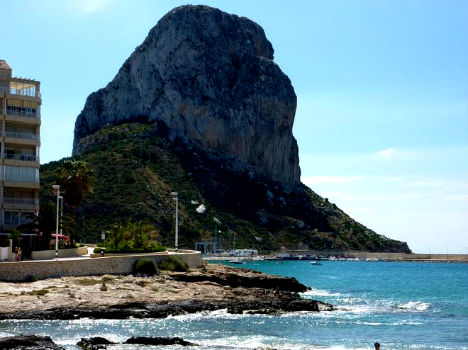
Penyal d’Ifac (Peñón de Ifach) is the smallest Natural Park in Europe, the 332-metre-high limestone monolith rising dramatically from the Mediterranean at Calpe on Spain’s Costa Blanca that is, despite its tiny 45-hectare size, one of the most biodiverse protected areas in Spain, home to over 300 plant species including several endemics found nowhere else on Earth. The hike to the summit is challenging (the final section involves chains and steep rock) but rewards with one of the great coastal panoramas of the Spanish Mediterranean, sweeping views from the skyscrapers of Benidorm to the north, across the turquoise bay of Calpe, and out to the Balearic Islands on the clearest days.
In This Article
Quick Facts: Peñón de Ifach
- Best time to visit: Year-round; the summit is accessible daily but visitor numbers are limited to 300 per day, book a free reservation online at least a week in advance (this is strictly enforced); the hike is best in the morning before the midday heat; you must present ID matching your reservation
- How to get there: Calpe is ~1 hour from Alicante Airport by car; the trailhead is at the base of the rock, walking distance from Calpe town centre
- Hike difficulty: Moderate to challenging, the first section is a wide path, but the upper section involves scrambling on steep rock with chains for support; good footwear essential; not suitable for vertigo sufferers or young children
- Size: 45 hectares, officially the smallest Natural Park in Europe by area
Peñón de Ifach is a rock formation and protected Natural Park situated above the bay of Calpe, in Valencia region. It is also a symbol of this seaside town and also of the whole Costa Blanca. In earlier times, this rock was, thanks to the excellent strategic location, used as a watchtower. Currently, the Peñón de Ifach is a great refuge for many plants and bird species. Unfortunately, due to the large number of tourists an access to this exceptional rock is limited. There is a marked trail leading to the top of the mountain, where you can get in 40 minutes. Peñón de Ifach in offering magnificent views of the surroundings, so it is worth visiting. During nice weather it is even possible to see the island of Ibiza from here.

Photo by admin
In 1987, the rock was declared a nature reserve and the smallest protected area in Europe, because it covers an area of 4,5 square kilometers. There is a number of endemic species of plant and animals such as sea gulls and falcons.
Peñón de Ifach is a distinct visual attraction on the Mediterranean coast, reaching a height of 332 metres.
View Penyal D’ifac in Spain in a larger map
The Challenging Hike to the Summit
The trail to the top of Penyal d’Ifac begins as a gentle, wide path winding through Mediterranean scrub before it reaches the tunnel that cuts through the rock and marks the transition to the steeper ascent. Beyond the tunnel, the route becomes significantly more demanding, requiring visitors to scramble over uneven limestone with the aid of metal chains bolted into the cliff face. The final push to the summit is steep and exposed, with sheer drops on either side that reward careful footing with breathtaking views. The entire hike takes approximately 40 minutes to an hour each way, depending on fitness levels. Because the park limits daily visitors to 300 people, the path rarely feels overcrowded, and the experience retains a wilderness feel despite being so close to the busy Costa Blanca resort town of Calpe. It is essential to book a free reservation online in advance, particularly during Easter week and the summer months when slots fill up days ahead. Hikers should bring at least one litre of water per person, wear sturdy footwear with good grip, and start early in the morning to avoid the fierce Mediterranean midday heat.
Unique Biodiversity of Europe’s Smallest Natural Park
Despite covering merely 45 hectares, Penyal d’Ifac hosts an extraordinary concentration of plant and animal life. Botanists have recorded over 300 plant species on the rock, several of which are endemic to this single location and found nowhere else on the planet. The most famous of these is the silene hifacensis, a delicate flowering plant that grows exclusively on the limestone crevices of Penyal d’Ifac. The rock’s position jutting out into the Mediterranean creates a microclimate that supports both coastal and mountain species in close proximity. Birdwatchers flock to the site to observe nesting colonies of yellow-legged gulls, Eleonora’s falcons, and peregrine falcons that use the sheer cliffs as safe breeding grounds. This remarkable biodiversity is precisely why the site was declared a Natural Park in 1987 and remains under strict protection, with access controls that balance public enjoyment with conservation imperatives.
Have you scrambled up Penyal d’Ifac or discovered the Costa Blanca’s most dramatic rock? Share your Spanish hiking adventures in the comments! 🧗
Explore all our Spain travel guides, from Barcelona Gaudí to Andalusia plazas.
Explore More
If you enjoyed this article, you might also like:
