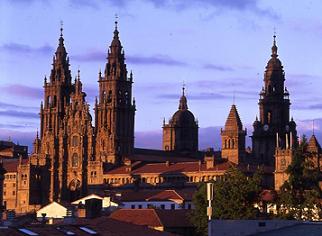
The scent of damp stone and incense lingers along the cobbled lanes that converge on the Plaza del Obradoiro. Pilgrims arrive on foot, their boots worn thin, their eyes fixed on the towering baroque facade of the cathedral. Inside, the botafumeiro swings overhead, trailing clouds of fragrant smoke across the vast nave. The scallop shell, carved into doorways and worn as a badge, marks a journey that has drawn travellers for over a thousand years. This city does not merely show you history; it invites you to walk inside it, to feel the weight of footsteps that came before and the quiet triumph of arriving at last.
The Cathedral of Santiago de Compostela and Its Architectural Treasures
The Cathedral of Santiago de Compostela stands as the crowning achievement of Romanesque architecture in Spain, though its exterior was dramatically remodelled in the Baroque style during the 18th century. The most celebrated feature is the Portico de la Gloria, a triple-arched doorway carved by Master Mateo in 1188 that depicts the Second Coming of Christ surrounded by the 24 Elders of the Apocalypse, their expressions so lifelike that medieval pilgrims reportedly wept at the sight. Over 200 figures populate this masterpiece, each carved from granite with remarkable detail that has survived eight centuries of exposure to the elements. Inside, the main altar rises above the crypt where the relics of Saint James the Apostle rest in a silver urn. The botafumeiro, one of the largest incense censers in the world at 80 kilograms, swings across the transept on major feast days, propelled by eight attendants in red robes who pull the ropes in a coordinated rhythm that has been repeated for centuries. The Cathedral Museum houses an extensive collection of Gothic retables, Flemish tapestries from the 15th and 16th centuries, and a library containing over 80,000 volumes including medieval manuscripts and early printed books. The cathedral interior also features the beautiful Mondragon chapel from the 15th century, the main altar decorated with intricate carvings, and a museum of paintings, retables, reliquaries, and sculptures. The Cloister is a masterpiece of Plateresque architecture with delicate ribbed vaulting and stone tracery that rewards careful observation, while the portico surrounding the cloister contains statues of kings, prophets, and saints that illustrate the rich iconographic programme of the cathedral.
The Way of St James and Pilgrimage Culture
The Way of St James, known as the Camino de Santiago, is not a single route but a network of ancient pilgrimage paths converging on Santiago de Compostela from across Europe. The most famous route, the French Way, stretches approximately 800 kilometres from Saint-Jean-Pied-de-Port in the French Pyrenees across the north of Spain, passing through seven provinces, four autonomous regions, and around 200 villages and towns. Pilgrims carry a scallop shell as the symbol of their journey, and yellow arrows painted on walls, trees, and pavements guide them through farmland, forests, and medieval villages. Along the route, a network of refugios and hostels provides basic accommodation for pilgrims, creating a unique community of travellers from all walks of life who share meals, stories, and the physical challenge of the road. The history of the pilgrimage dates back to medieval times, and along the roads were built hostels, shelters, hospitals, churches, and cathedrals designed to serve the pilgrims, with many towns growing and prospering from the influx of visitors. The pilgrimage has experienced a remarkable revival in recent decades, with over 300,000 people completing the journey each year, motivated by a mix of religious devotion, personal challenge, and cultural curiosity. Spring and autumn offer the most pleasant walking conditions. The historic city centre of Santiago, full of stone streets and surrounding squares, is now a pedestrian zone where most of the sights can be found. The Zona Vieja, or Old Quarter, is particularly lively with students from the important university located here, and is full of bars, restaurants, clubs, and discos. The southern part features Praza de Galicia square, where you will also find the baroque Catedral del Apostol. Art lovers should visit the Centro Galego de Arte Contemporanea for modern art exhibitions and the Museo das Peregrinacions near the cathedral for pilgrimage history. The best time to visit is 25 July, when the celebrations of St James coincide with the National Day of Galicia, filling the streets with music, dancing, and festivities.
Have you ever walked a pilgrimage route, or would you like to try the Camino de Santiago one day? 🚶
Explore all our Spain travel guides, from Barcelona Gaudí to Andalusia plazas.
Explore More
If you enjoyed this article, you might also like:
