Old Harry Rocks – Chalk stacks in Dorset, United Kingdom
Updated June 10, 2026 by europeexplored
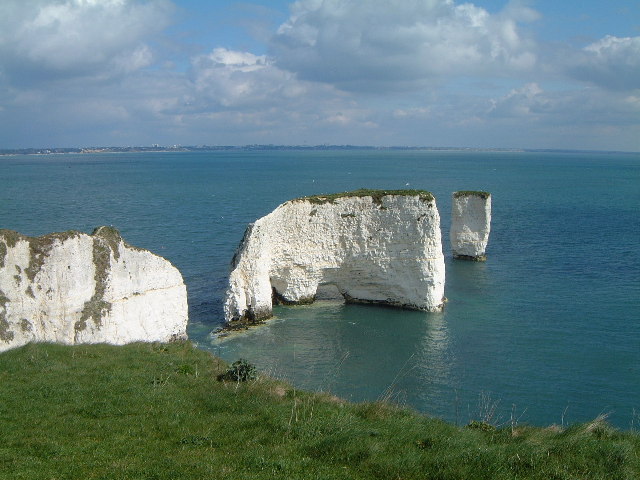
The chalk stacks of Old Harry Rocks rise from the English Channel like white sentinels guarding the Jurassic Coast. From the top of the cliff path at Studland Bay, the view stretches across Poole Harbour to the Purbeck Hills. The sea below crashes against the base of these limestone pillars, slowly wearing them into new shapes with every tide. A short walk from the car park brings you to the edge of the cliff where the full formation comes into view. The headland is part of a longer ridge of chalk that once connected the Isle of Wight to the mainland. Thousands of years of coastal erosion have carved this landscape into what you see today.
The chalk stacks of Old Harry Rocks rise from the English Channel like white sentinels guarding the Jurassic Coast. From the top of the cliff path at Studland Bay, the view stretches across Poole Harbour to the Purbeck Hills. The sea below crashes against the base of these limestone pillars, slowly wearing them into new shapes with every tide. A short walk from the car park brings you to the edge of the cliff where the full formation comes into view. The headland is part of a longer ridge of chalk that once connected the Isle of Wight to the mainland. Thousands of years of coastal erosion have carved this landscape into what you see today.
You will find the Old Harry Rocks along the area that has been dubbed, the Jurassic Coast. Situated just off from the coasts of Purbeck Isle, in an area of the island that has been known for centuries as Handfast Point, the two limestone rock formations can be seen sitting in the surf.
The area where the Old Harry Rocks sits is known as the Jurassic coast. Because of tectonics, the land has folded over and over itself time and time again. As a result, rocks that date back to not just the Jurassic period, but also the Triassic and Cretaceous period can be seen clearly. Amongst these rocks are the fossils of countless dinosaurs from long ago; just waiting to be uncovered.
Old Harry Rocks, UK by John Tomlinson
The area where the Old Harry Rocks can be found is filled with chalk and this particular kind of rock is very resistant to the acidic attacks by saltwater. There was a day when a number of chalk columns stood in the area, but because of erosion by the waves, one by one they have tumbled to the sea. The last rock to fall was back in 1896, it was considered to be the wife of Old Harry. Today, all that is left of her is a stump.
However, to the east, just across the water you will see the very popular Needles that are situated along the coastline of the Isle of Wight. While the distance is quite far if the day is clear enough then you should have no problems seeing the Needles. It is said, that the islands used to be connected by the chalk but over the millennia this bridge has long since eroded away.
Old Harry Rocks, England, UK by Cmcqueen
Before long, it is expected that the Old Harry Rocks too will succumb to erosion. There are many people working together to find a way to protect the rocks and preserve them from the tremendous force of the waves and time.
As local legend has it, the name of the Old Harry Rocks comes from an infamous pirate who hid out in the area. Harry Paye, who was a pirate from Poole, used the area as his hideout and was said to have buried his treasures along the rocky shores of the island. While no treasure has ever been found, the name stuck as a symbol to the history that has made the island what it is today.
Have you ever walked along a coastline that felt like stepping back into deep time? Share your favourite fossil-hunting beach below.
Looking for more British travel inspiration?
The Geology of Old Harry Rocks
The chalk that forms Old Harry Rocks was laid down during the Cretaceous period, approximately 70 million years ago, when much of southern England lay beneath a warm tropical sea. Microscopic marine organisms called coccolithophores built up on the seabed in layers that eventually compressed into the soft white limestone visible today. The same chalk belt runs across the English Channel and reappears in northern France as the cliffs of Etretat. Tectonic forces later folded and uplifted these deposits, creating the ridge that once connected the Isle of Wight to the mainland at Studland. The last ice age reshaped the coastline, and subsequent sea level rise flooded the low-lying areas, leaving the chalk headland exposed to the full force of the English Channel. Wave action exploits the natural joints and fissures in the rock, undercutting the cliffs and forming caves, arches, and eventually the isolated stacks visible today. The process continues, with the famous stack known as Old Harry expected to collapse within the next century as erosion eats away at its base. A nearby stack called Old Harry Wife collapsed in 1896, leaving only a stump visible at low tide.
Walking the South West Coast Path Section
The best way to experience Old Harry Rocks is by walking the South West Coast Path from Studland Bay to the viewpoint at Handfast Point. The trail begins at the National Trust car park near the Studland Beach kiosk, following a gentle uphill gradient through heathland dotted with gorse and heather. The walk covers approximately 2.5 kilometres each way and takes about 45 minutes at a leisurely pace, making it accessible to most fitness levels. Along the way, interpretive panels explain the geology, wildlife, and maritime history of the area. The path offers continuous views of the Purbeck coastline, with Ballard Point and Swanage visible to the south. In spring, the cliffsides are carpeted with thrift, sea campion, and wild thyme. Birdwatchers should watch for peregrine falcons that nest on the cliff faces, as well as fulmars and cormorants gliding on the updrafts. The trail continues beyond the viewpoint toward Swanage, offering a longer 10-kilometre hike for those with more time and energy. The descending sun casts long shadows across the chalk faces in the late afternoon, creating ideal lighting conditions for photography.
Nearby Attractions on the Jurassic Coast
Old Harry Rocks forms part of the Jurassic Coast World heritage Site, which stretches 153 kilometres from Orcombe Point in Devon to Studland Bay in Dorset. The coastline represents 185 million years of Earth history in a continuous sequence of rock formations. Within a 30-minute drive of Old Harry Rocks, visitors can explore the ghost village of Tyneham, abandoned during World War II and never reoccupied; the natural arch of Durdle Door, one of the most photographed geological features in Britain; and the fossil-rich beaches of Charmouth and Lyme Regis, where amateur palaeontologists regularly find ammonites and belemnites. The village of Corfe Castle, dominated by the dramatic ruins of a Norman fortress, is a 20-minute drive inland. The Purbeck Mineral and Mining Museum near Swanage tells the story of the local ball clay industry that operated beneath these hills for centuries. For a full day of exploration, the Jurassic Coast bus service, the X54, connects the major sites between Poole and Weymouth, running hourly during summer months.
Have you ever walked along a coastline that felt like stepping back into deep time? Share your favourite fossil-hunting beach below.
Explore all our United Kingdom travel guides, from London landmarks to the Scottish Highlands.
Explore More
If you enjoyed this article, you might also like:
