Padova – where the beauty meets spirituality in Italy
Updated June 10, 2026 by europeexplored
Padova does not compete with Venice or Verona for attention. It does not need to. This ancient city holds some of the most important artistic and scientific treasures in Italy. The Scrovegni Chapel contains a cycle of frescoes by Giotto that changed the course of Western painting, and people travel from across the world to stand in its blue vaulted interior. The basilica of Saint Anthony draws pilgrims who come to pray at the tomb of the beloved Franciscan saint. The University of Padova, founded in 1222, counts Galileo among its former professors and its anatomical theatre is the oldest surviving in Europe.
\n\n
Padova does not compete with Venice or Verona for attention. It does not need to. This ancient city holds some of the most important artistic and scientific treasures in Italy. The Scrovegni Chapel contains a cycle of frescoes by Giotto that changed the course of Western painting, and people travel from across the world to stand in its blue vaulted interior. The basilica of Saint Anthony draws pilgrims who come to pray at the tomb of the beloved Franciscan saint. The University of Padova, founded in 1222, counts Galileo among its former professors and its anatomical theatre is the oldest surviving in Europe.
\n\n
The city of Padova is located in the northern part of Italy along the banks of the Bacchiglione River. Situated only 40 kilometers from the famous Italian city of Venice, Padova has been a very popular tourist destination for centuries.
\n
The once walled city of Padova was surrounded by the many branches of the Bacchiglione River. With canals throughout the city, there are many old bridges scattered around the now bustling metropolitan region. Today there are more than 1.6 million people living in the Padova metropolitan area.
\n
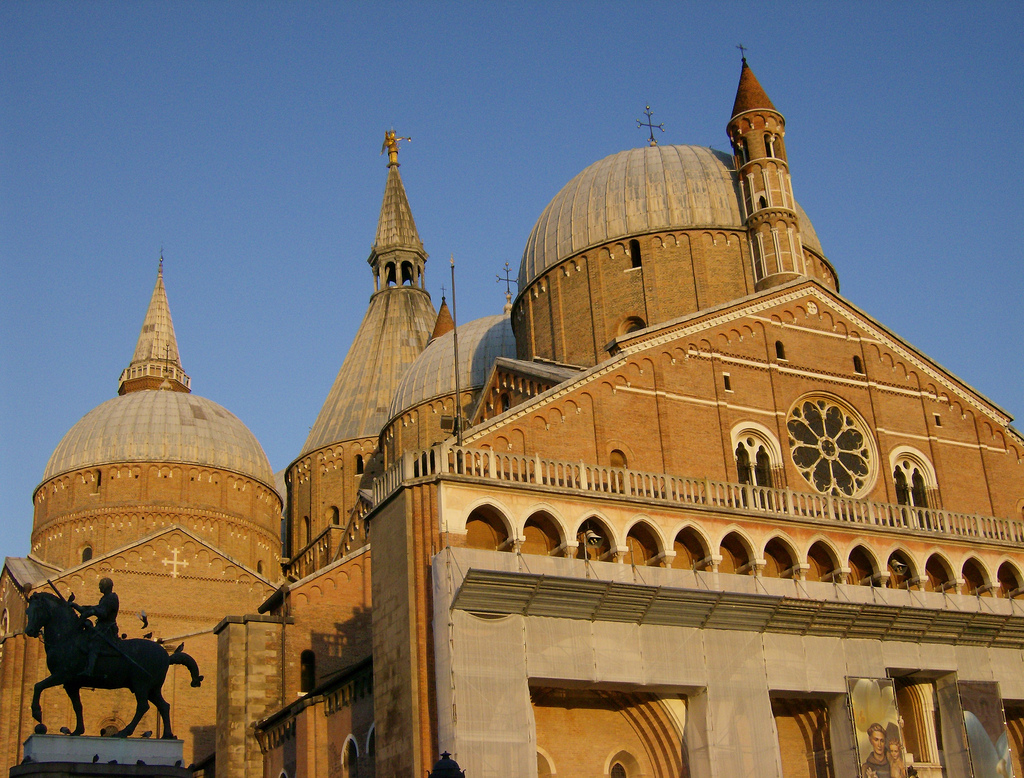
\nbasilica of Saint Anthony of Padua, Italy by Schnu99i
\n
Many people who have studied English literature have read The Taming of the Shrew by William Shakespeare. The city of Padova was the setting of this very famous play.
\n
It is said that Padova is one of the oldest cities in northernmost part of Italy. According to historical records and artifacts uncovered in the area, it has been determined that the city of Padova was founded by Prince Anteno of the Trojans back in 1183 B.C. A sarcophagus which was uncovered back in 1274 belonged to the prince.
\n
By 45 B.C., the city of Padova became part of the Roman Empire and was well-known throughout the empire for their horse breeding. In front of the basilica di Sant’Antonio da Padova you will even find the famous Donatello statue of Erasmo da Narni which features a General astride a magnificent steed.
\n
\nPrato della Valle, Padova, Italy by Fabio Macòr
\n
The city is also home to the University of Padua which was founded more than 820 years ago. Galileo Galilee is one of the most famous lecturers to have stood in the halls of the university. There are also a number of other historically important structures and monuments which can be found throughout Padova. The city is even home to the Palazzo della Ragione which is said to have the largest unsupported roof in the whole of Europe.\n
\n
Have you ever stood inside a room covered in frescoes and felt completely transported to another time?
\n
Looking for more Italian travel inspiration?
\n\n
The Scrovegni Chapel Fresco Cycle
\n
The Scrovegni Chapel, completed in 1305, contains one of the most influential cycles of frescoes in Western art history. Giotto painted the entire interior, covering the walls and ceiling with 39 scenes arranged in three registers that tell the story of the life of the Virgin Mary, the life of Christ, and the Passion, Crucifixion, and Resurrection. The chapel was commissioned by Enrico Scrovegni as a private family chapel and act of penance for his father usury. The deep blue background, created with lapis lazuli pigment imported from Afghanistan, gives the interior an otherworldly quality. The frescoes broke decisively with the flat Byzantine style that preceded them, introducing naturalistic figures with emotional expressions, three-dimensional space, and convincing narrative composition. The most famous scene, the Kiss of Judas, captures the moment of betrayal with extraordinary psychological tension. Entry requires advance booking due to strict climate control measures that limit visitors to 25 people per 15-minute slot. Tickets cost 13 euros and include access to the adjoining Museo degli Eremitani. The 15-minute wait before entry is spent in a climate-controlled anteroom where a video explains the history and significance of the frescoes.
\n
Prato della Valle and the University
\n
Prato della Valle is one of the largest squares in Europe, covering 90,000 square metres with a central elliptical island surrounded by a canal lined with 78 statues of famous Paduans. The square was originally a marshy area outside the city walls until it was drained and transformed in the late 18th century. Today it hosts the weekly Saturday market, a Christmas market, and open-air concerts. The basilica of Saint Anthony, known locally as Il Santo, dominates the southern end of the square. The basilica combines Romanesque, Gothic, and Byzantine architectural elements with its eight domes and two bell towers. The interior contains the tomb of Saint Anthony, a marble saint that is covered with votive offerings left by pilgrims. The University of Padova, founded in 1222, is the second oldest university in Italy and one of the oldest in the world. Its Palazzo del Bo houses the oldest anatomical theatre in the world, built in 1594, where medical students once watched dissections from tiered wooden galleries. Galileo Galilei taught mathematics here from 1592 to 1610, and the university maintains his original lectern.
\n\n
Have you ever stood inside a room covered in frescoes and felt completely transported to another time?
\n
Explore all our Italy travel guides, from the Dolomites to Sicily.
\n\n
Padova Food and Local Specialties
\n
Padova has its own distinctive culinary traditions that are often overlooked by visitors rushing between Venice and Verona. The local cuisine reflects the agricultural wealth of the Veneto plain, with rice, polenta, and fresh vegetables forming the base of many dishes. Bigoli in salsa, a thick spaghetti served with anchovy and onion sauce, is a local classic. Risi e bisi, a creamy rice and pea dish, appears on menus in spring when the local peas are at their sweetest. The historic Caffe Pedrocchi, founded in 1831, is a landmark of Padova cafe culture with its neoclassical architecture and green facade. The Euganean Hills produce the Colli Euganei DOC wines, including the sparkling Fior d’Arancio. A wine tasting tour of the regional wineries is an excellent complement to a cultural visit to the city.
\n\n
Explore all our Italy travel guides, from the Dolomites to Sicily.
Explore More
If you enjoyed this article, you might also like:
