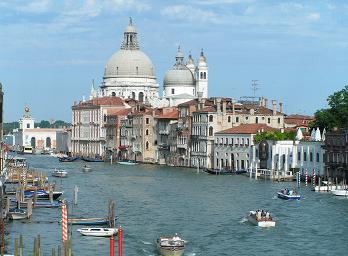
Canal Grande – the most beautiful street in the world | Italy

June 10, 2026 by europeexplored No Comments

The Canal Grande curves through Venice in a reverse-S shape for 3.8 km, from the Santa Lucia railway station to the Bacino di San Marco. It is the city’s main thoroughfare and its most theatrical stage. The canal is lined with 170 palaces built between the 13th and 18th centuries. No road runs alongside it. The only way to experience it is by water. The vaporetto, the water bus, is the practical choice. The gondola is the romantic one. Both reveal a city that built its wealth on the water rather than against it.

The Palaces: A Timeline of Venetian Power

The palaces along the Canal Grande trace the evolution of Venetian architecture. Ca’ Foscari, built in 1453 for the Doge Francesco Foscari, is the most important example of Venetian Gothic architecture, the ground floor warehouse opening onto the canal through four pointed arches. Ca’ d’Oro, built between 1428 and 1430, originally had gold leaf applied to the stone tracery, hence the name “House of Gold.” Palazzo Grassi, built in 1772, is the last palace built on the canal before the Venetian Republic fell to Napoleon in 1797. Ca’ Rezzonico, built in 1667 and completed in 1756, holds the Museum of 18th Century Venice, with a ballroom ceiling frescoed by Giovanni Battista Tiepolo in 1757. The facade of Palazzo Venier dei Leoni, unfinished at just one storey, houses the Peggy Guggenheim Collection, 20th century art including works by Pollock, Picasso, and Dali.

The Bridges: Four Crossings in 3.8 km

Only four bridges cross the Canal Grande. The Rialto Bridge, built between 1588 and 1591 by Antonio da Ponte, is the oldest and the most famous. The single stone arch spans 48 metres and the enclosed walkway is lined with 24 shops. The Ponte dell’Accademia, built in 1854 and rebuilt in 1985, connects the Accademia Gallery with the Dorsoduro district. The Ponte degli Scalzi, built in 1934 in white Istrian stone, connects the railway station with the Cannaregio district. The Ponte della Costituzione, the fourth and newest, was designed by Santiago Calatrava and opened in 2008. It is made of steel and glass and is the most controversial bridge in Venice, criticised for its slippery surface in wet weather and lack of wheelchair access without detours.

The Vaporetto: The Number 1 Line

The vaporetto line number 1 runs the full length of the Canal Grande, stopping at all 18 landing stages between Piazzale Roma and San Marco. The journey takes 45 minutes and costs 9.50 euros for a single ticket valid for 75 minutes. The water bus runs from 5am to midnight, with night service on a reduced schedule. The best seats are outside at the front or back of the boat, where nothing blocks the view of the palaces sliding past. The ticket price includes luggage for airport transfers. A 24-hour travel card costs 25 euros and covers all vaporetto lines across the city.

What is the single best view on the Canal Grande and did you see it from a gondola, a vaporetto, or a window at sunset?


Looking for more Italian travel inspiration? Check out our other guides to Italy and start planning your next European adventure!

A major symbol and the main thoroughfare of the Italian Venice is certainly Canal Grande. The waterway, which is actually the former riverbed of the River Brenta, is almost 4 km long and passes through the ancient heart of the city. It is probably the most beautiful traffic artery in the world.

This meandering water channel is the deepest of all the channels and divides Venice into two parts. In some places it is up to 80 meters wide and there are just three bridges crossing it: the Ponte degli Scalzi, the Ponte di Rialto and the Ponte dell’Accademia. You can sail through this canal by a historical sailing regattas or water taxi but you may save a lot of money if you use a water bus lines, which are called a “vaporetto”.

During the boat tour through Canal Grande you can admire the beautiful Venetian palaces built in the Gothic, Baroque and Renaissance style. During the Venetian glory, many monumental churches were built among the palaces. If you go from Piazzale Roma or from the train station to San Marco, the first church you will see will be Chiesa degli Scalzi. It was built in 1656 by Baldassare Longhenem. The same architect built the church of Santa Maria della Salute and several prestigious palaces around the Grand Canal.

Just a few steps away you can see the church of San Geremia, with the relics of St. Lucy, martyr of the 4th century. On the opposite bank rises Fondaco dei Turchi, where Turkish buyers centre was situated in the years 1621 – 1838. Now it houses the Venice Museum of Natural History. Neighbouring simple building deposit del Megi dates from the 15th century and served as the emergency breadbasket, in case there would be famine or siege.

One of the most beautiful palaces in the Canal Grande is the Palazzo Vendramin-Callergi designed by an Italian architect of the early-Renaissance Mauro Codussi. Today it houses a casino. Two additional magnificent palaces standing nearby, Ca’Pesaro, which houses a museum of modern art and Ca’d’Oro, which today serves as a space for a museum of medieval art. At the opposite side you can see the neo-Gothic Pescheria, fish market, which together with the contours of the Ponte di Rialto bridge marks the entrance to the ancient heart of Venice.

After the bridge you can see Palazzo Loredan and Palazzo Farsetti, where is now Venice city hall. In the past, the palace was occupied by Antonio Canova, the sculptor who was the representative of classicism. A little further you enjoy building Palazzo Benzon, which was inhabited by Countess Benzon in the 19th century. E.g. British poet Lord Byron belonged to the most important guests who often stayed here for the night. The poet lived a bit further in the palace of Mocenigo family for two years. He didn’t live here alone, but with a dog, wolf and monkey. Among his frequent guests was the Cogne Margherita, one of his many mistresses, who tried to kill him once he left her.

Further you can see another palace Ca’Rezzonico where is now a public museum dedicated to 18th century Venice. When you pass the bridge Ponte dell’Accademia you will see Palazzo Barbaro from 15th century, which was bought in 1885 by the Curtis family from Boston (USA). Just opposite the palace there is Palazzo Barbarigo distinguished by its mosaics of Murano glass applied in 1886. The palace is owned by the proprietors of one of the glass factories.

Another interesting building on the banks of the Canal Grande is Palazzo Venier dei Leoni that has never been completed. In its immediate vicinity there is Palazzo Dario, considered as one of the most beautiful palaces lining the waterway. However despite its beauty, none of the locals would not want to have it as it is considered to be cursed.

Another great building that is owned by a glass company is Palazzo Salviati with a mosaic facade. Further you can see the Church of Santa Maria del Giglio and Palazzo Gritti which is known as one of the best Venetian hotels. The hotel is located just beside basilica di Santa Maria della Salute which is one of the most impressive buildings in Venice and a place where history meets the present. This is an unusual scene for organizing summer concerts, literary readings and other activities. Just a few meters further, you will enjoy the look at the Doge’s Palace and Piazza San Marco.

Do you know any other street that is so amazing? Please let us know by commenting below.

Explore More

If you enjoyed this article, you might also like:

Tags: , , , , , , , , , , , , , , , , , , , , , , ,

Categories: Italy, Sights

Leave a Reply

Your email address will not be published. Required fields are marked *