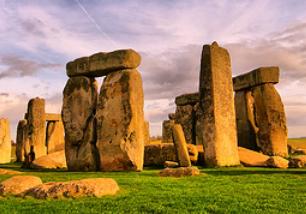
Stonehenge is the most famous prehistoric monument in the world, a haunting circle of colossal sarsen stones and bluestones rising from the Salisbury Plain in Wiltshire, England, whose purpose, construction methods, and precise astronomical alignments have fascinated and mystified humanity for over 5,000 years. A UNESCO World heritage site and Britain’s most iconic ancient landmark, Stonehenge continues to inspire awe, pilgrimage, and heated archaeological debate, a silent stone testament to the ingenuity and spiritual vision of Neolithic and Bronze Age peoples.
In This Article
The Building of Stonehenge: A Neolithic Engineering Feat
Stonehenge was not built in a single phase but evolved over more than 1,400 years, from approximately 3,000 BC to 1,600 BC. The earliest structure was a circular ditch and bank enclosure, known as a henge, with 56 pits (the Aubrey Holes) that may have held wooden posts or bluestones. Around 2,500 BC, the builders undertook the most dramatic phase of construction: the transportation and erection of the enormous sarsen stones. Each sarsen stands up to 9 metres tall and weighs approximately 25 tonnes. They were brought from the Marlborough Downs, about 25 kilometres to the north, and shaped with precision using stone hammers. The lintels that cap the uprights were fitted with mortise-and-tenon joints, a woodworking technique applied to stone that reveals the sophisticated engineering knowledge of the builders. The smaller bluestones, weighing up to 4 tonnes each, were transported from the Preseli Hills in Wales, a distance of 240 kilometres. Recent archaeological experiments suggest they may have been moved by a combination of river, sea, and overland routes, though the exact method remains one of prehistory’s greatest puzzles. The sheer scale of this undertaking, achieved without metal tools or the wheel, is staggering.
Purpose and Meaning: What Stonehenge Tells Us
Archaeologists have proposed multiple theories for Stonehenge’s purpose, and the evidence suggests it served several functions across different periods. The alignment of the monument’s axis with the midsummer sunrise and midwinter sunset points clearly points to an astronomical or calendrical function, allowing the builders to mark the solstices and track the seasons. Cremated human remains of over 150 individuals have been found in and around the Aubrey Holes, indicating that Stonehenge was a burial ground for an elite class, possibly a ruling dynasty or a priestly caste. Recent research has also suggested that Stonehenge may have been a centre of healing, as many of the buried individuals show signs of illness or injury, and the bluestones were believed in antiquity to have magical properties. The monument is part of a much larger ceremonial landscape that includes Woodhenge, the massive henge at Durrington Walls (the largest in Britain), and the Cursus, a 3-kilometre-long processional earthwork. These sites together suggest that Salisbury Plain was a sacred landscape of extraordinary importance to Neolithic people, a place of ceremony, burial, and astronomical observation that drew communities from across the British Isles.
Visiting Stonehenge: Practical Advice
Stonehenge is managed by English heritage and attracts over 1.5 million visitors annually. Tickets must be booked in advance, as daily capacity is limited to protect the monument and manage crowds. Standard adult admission costs approximately 25 pounds and includes access to the stone circle (from a roped path), the new visitor centre with its excellent exhibition of Neolithic artifacts, and a shuttle bus that runs from the centre to the stones. For a more atmospheric experience, book the Stone Circle Access visit, available early morning or late evening outside normal hours, which allows you to walk among the stones themselves. The best times to visit are early morning or late afternoon, when the coach parties have departed and the low sun casts dramatic shadows across the stones. The summer solstice (June 21) and winter solstice (December 21) offer managed open access to the stones free of charge, drawing thousands of pagans, druids, and curious visitors to witness the sunrise alignments. Salisbury, the nearest city, offers rail connections to London Waterloo in approximately 90 minutes, and buses run from Salisbury station to Stonehenge throughout the day. The nearby town of Amesbury has accommodation options and pubs serving traditional English food.
Have you visited Stonehenge or explored Britain’s ancient sites? Share your experiences and theories in the comments! 🗿
Explore all our United Kingdom travel guides, from London landmarks to the Scottish Highlands.
Explore More
If you enjoyed this article, you might also like:
- Siccar Point rocky promontory in Scotland, United Kingdom – United Kingdom
- South Bank – a significant arts and entertainment district of London | United Kingdom – United Kingdom
- A Weekend in Cool Brighton – United Kingdom
