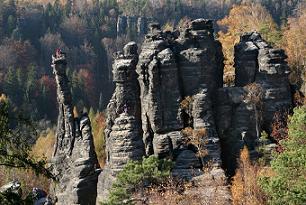
České Švýcarsko (Bohemian Switzerland) National Park is one of the most photogenic landscapes in the Czech Republic, a fantasy realm of towering sandstone rock pillars, deep mossy gorges, and the iconic Pravčická brána, the largest natural sandstone arch in Europe, whose film-set appearance (it featured in The Chronicles of Narnia) draws hikers and photographers to northern Bohemia. Together with the adjacent Saxon Switzerland National Park on the German side, Bohemian Switzerland forms one of the most spectacular sandstone landscapes on the continent, a climber’s paradise threaded with well-marked hiking trails, including the famous Gabrielina stezka (Gabriela’s Trail) through the Kamenice River canyon, part of which is traversed by gondola boat.
In This Article
Quick Facts: Bohemian Switzerland National Park
- Best time to visit: May-October for hiking; September for the most beautiful light and autumn colours; the Pravčická brána arch is at its most dramatic in morning light
- How to get there: ~1.5 hours from Prague by car; ~2 hours by train from Prague to Děčín + local bus to Hřensko (the gateway village); easily combined with a trip to Dresden (30 min)
- Top attraction: Pravčická brána, Europe’s largest natural sandstone arch (16m high, 27m span); the nearby Sokolí hnízdo (Falcon’s Nest) chateau now houses a museum and restaurant
- Entry fee: Park access is free; Pravčická brána viewing platform ~€4
Hiking Trails and Natural Wonders
The national park offers an extensive network of hiking trails suitable for all fitness levels. The most popular route leads from Hřensko up to the Pravčická brána arch, passing through dense forest and emerging onto the sandstone plateau where the arch commands panoramic views over the Elbe Valley. For those seeking a longer adventure, the Gabrielina Trail winds through the Kamenice Gorge, where wooden walkways hug the cliff walls and a gondola boat ferries visitors across the emerald-green river. The gorge is at its most atmospheric in the early morning when mist rises from the water and sunlight filters through the narrow canyon above. Winter hiking is possible on lower elevation trails, and snowshoeing offers a different perspective on the park’s landscape.
Another must-see is the Wild Gorge (Divoká soutěska), where visitors take a guided boat trip through rapids and past towering rock walls. The boatmen share local legends and point out unusual rock formations shaped by centuries of erosion. The combination of boat rides and hiking makes this one of the most memorable experiences in the park. Photographers should spend at least a full day here, as the changing light transforms the sandstone into shades of gold and amber.
Climbing Paradise and Rock Formations
Bohemian Switzerland is renowned as one of Europe’s premier sandstone climbing destinations. The park features hundreds of climbing routes across dozens of rock formations, ranging from beginner-friendly slabs to advanced overhangs. The soft sandstone requires special climbing techniques and traditional protection rather than modern bolts. Local climbing clubs offer guided excursions for beginners and experienced climbers, ensuring safety while respecting the fragile environment. The most famous climbing areas include the Křídelní stěna (Wing Wall), the Rudolfův kámen, and the Jehla (Needle), each offering unique challenges and spectacular views.
Climbing regulations are strictly enforced to protect the delicate sandstone. Climbers must use soft shoes, avoid chalk that stains the rock, and follow designated routes. The climbing season runs from April to October, with spring and autumn offering the most comfortable temperatures. Beyond rock climbing, the park attracts boulderers who test their skills on massive fallen blocks scattered throughout the forest. The combination of technical climbing and stunning scenery makes Bohemian Switzerland a bucket-list destination for climbing enthusiasts from across Europe.
Wildlife, Conservation, and Nearby Attractions
The park protects a rich diversity of wildlife adapted to the sandstone ecosystem. Red deer, wild boar, and roe deer roam the forests, while peregrine falcons nest on high cliff ledges. The elusive European wildcat has been spotted in remote areas, and the streams are home to otters and native crayfish. Birdwatchers can spot black storks, eagle owls, and several woodpecker species. Conservation efforts focus on protecting fragile sandstone formations from erosion and maintaining the natural water regime of the Kamenice and Elbe rivers. Visitors should stay on marked trails and avoid disturbing wildlife, particularly during breeding season from March to July.
Beyond the park boundaries, the region offers several attractions. The town of Děčín features a beautiful château overlooking the Elbe. The nearby Tisa Wall (Tiské stěny) is another spectacular sandstone labyrinth popular with hikers. The local cuisine features game dishes, wild mushroom soups, and excellent Czech beer. Many visitors combine a trip to Bohemian Switzerland with a visit to Dresden, just 30 minutes across the German border, making this one of the most rewarding natural destinations in Central Europe.
View České Švýcarsko National Park – climbers’ paradise in Czech republic in a larger map
Have you hiked to the Pravčická brána arch or discovered Bohemian Switzerland’s rock formations? Share your Czech sandstone adventures in the comments! 🏔️
Explore all our Czech Republic travel guides, from Prague spires to Moravian wine country.
Explore More
If you enjoyed this article, you might also like:
- Karlovy Vary – biggest spa town in the Czech Republic – Czech Republic
- The town of Telč – well-preserved Renaissance and Baroque houses in the Czech Republic – Czech Republic
- Top 15 sights to see in Prague – Czech Republic – Czech Republic

České Švýcarsko is absolutely stunning. We spent three days hiking the sandstone trails and every viewpoint was more spectacular than the last. The Pravčická brána arch is incredible — largest natural sandstone arch in Europe. Well worth the hike up. If you are a climber this is paradise, but even casual walkers will find plenty of gentle trails through the woods.