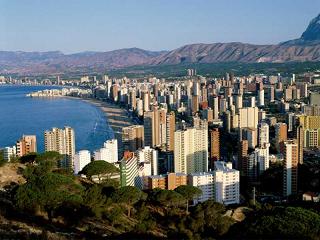
Benidorm is Spain’s most famous, and most controversial, resort city: a skyline of towering skyscrapers rising from the Costa Blanca like a Mediterranean Manhattan, with more high-rise buildings per capita than any city in Europe. Love it or hate it, Benidorm is a phenomenon: two sweeping golden beaches, a year-round microclimate, and a tourism model that packs over 4 million visitors annually into a compact coastal strip that has become one of the most recognisable holiday landscapes in the world.
In This Article
The Beaches of Benidorm
Benidorm’s two main beaches are the foundation of its tourism success. Levante Beach, stretching 2 kilometres along the eastern side of the rocky promontory, is the livelier of the two, lined with hotels, bars, and water sports operators. The golden sand is fine and well maintained, earning Blue Flag status year after year. Sunbeds and parasols are available for hire, and the calm Mediterranean waters are ideal for swimming, paddleboarding, and kayaking. Poniente Beach, on the western side, is slightly longer at 3 kilometres and has a more family-friendly atmosphere. The promenade here is wider and more relaxed, with palm trees providing natural shade along parts of the walkway. Both beaches benefit from Benidorm’s remarkable microclimate, which produces over 300 sunny days per year and keeps winter temperatures comfortably above 15 degrees Celsius. The strip of land between the two beaches, known as El Castell, is a rocky headland topped with the remains of a medieval watchtower and a scenic viewpoint that provides a perfect photo opportunity of both bays. Evening strolls along the promenades are a cherished local ritual, with the lights of the skyscrapers reflecting off the calm waters of the Mediterranean.
Beyond the Skyscrapers
Benidorm’s old town, the original fishing village that predates the tourist boom, is a charming maze of whitewashed houses, narrow cobbled streets, and traditional tapas bars perched on a rocky promontory between the two main beaches. The Balcón del Mediterráneo offers spectacular views of both bays and the mountainous interior. The city’s unusual vertical architecture was a deliberate urban planning decision in the 1950s. Rather than spreading low-rise hotels along the coast, the model followed by most Spanish resorts, Benidorm’s planners opted for concentrated high-rises to preserve surrounding natural space. The result is a uniquely compact resort with a smaller environmental footprint per tourist than many sprawling low-rise alternatives. Nearby, the Serra Gelada Natural Park offers excellent coastal hiking with dramatic clifftop trails overlooking the Mediterranean. The inland mountain villages of Guadalest and Altea provide a complete contrast to Benidorm’s urban energy, with traditional whitewashed houses perched on dramatic hilltops just 20 minutes away. The old town is also home to the Church of Santo Jaime and Santa Ana, a 18th-century building that stands as a reminder of Benidorm’s pre-tourism past, along with several small plazas where locals gather for evening tapas.
Day Trips and Activities in the Costa Blanca
While Benidorm’s beaches and nightlife are the main draws for most visitors, the surrounding Costa Blanca region offers numerous attractions worth exploring. The inland town of Guadalest, frequently described as one of Spain’s most beautiful villages, is built into a dramatic rock formation and features a medieval castle, a bell tower carved from solid rock, and several quirky museums. The coastal town of Altea, with its whitewashed old town and blue-domed church, is a more tranquil alternative to Benidorm’s energy. For theme park enthusiasts, Terra Mítica and Aqualandia offer family-friendly entertainment within easy reach. The Serra Gelada Natural Park, a protected marine and terrestrial area adjacent to Benidorm, provides hiking trails with breathtaking coastal views and opportunities for birdwatching. Boat trips from Benidorm’s harbour offer a different perspective on the coastline, with some excursions including stops at secluded coves for swimming and snorkelling. The region’s excellent public transport connections make all of these day trips easily accessible without a car. The Benidorm tram line connects directly to Alicante city centre and the airport, making it convenient for visitors to explore the wider Costa Blanca region without needing to rent a vehicle.
Quick Facts: Benidorm, Spain
- Best time to visit: May–June and September–October for warm weather without peak crowds; winter temperatures rarely drop below 15°C, popular with long-stay retirees
- Top attractions: Levante Beach, Poniente Beach, the Balcón del Mediterráneo viewpoint, and Benidorm’s old town (El Casco Antiguo)
- How to get there: ~45 minutes from Alicante Airport (ALC) by car or bus; regular tram connections from Alicante city
- Beaches: Two Blue Flag beaches, Levante (2km, lively) and Poniente (3km, family-friendly)
- Best for: Sun-seekers, families, nightlife, and budget-conscious travellers
View Benidorm – Spanish Manhattan in Costa Blanca in a larger map
Is Benidorm your kind of Spanish holiday or do you prefer quieter Costa Blanca gems? Share your Benidorm experiences and alternative recommendations in the comments! 🏖️
Explore all our Spain travel guides, from Barcelona Gaudí to Andalusia plazas.
Explore More
If you enjoyed this article, you might also like:
