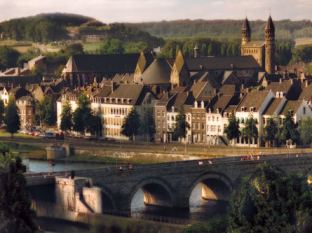
Maastricht is one of the Netherlands’ most distinctive cities, a vibrant university town whose medieval heart of cobbled streets, Roman ruins, and Gothic churches has more in common with Flanders or Wallonia than with the canal-ringed cities of Holland. Sitting at the southernmost tip of the Netherlands, wedged between Belgium and Germany, Maastricht’s cosmopolitan, Burgundian character, outdoor cafés, fine dining, and a European sensibility, makes it feel uniquely un-Dutch, and its historic centre and excellent museums make it one of the country’s most rewarding short-break destinations.
In This Article
Quick Facts: Maastricht, Netherlands
- Best time to visit: Spring and summer for café terraces on the Vrijthof; March for the TEFAF art fair; December for the Christmas market
- Top attractions: The Vrijthof square, the basilica of Saint Servatius, the Helpoort (oldest city gate in the Netherlands, 1229), and the St. Pietersberg Caves
- How to get there: ~2.5 hours from Amsterdam by train; ~1 hour from Brussels; ~1 hour from Cologne
- Don’t miss: The Boekhandel Dominicanen, a stunning bookshop in a converted 13th-century Dominican church, regularly voted the most beautiful bookshop in the world
historic Landmarks in Maastricht
The Vrijthof is Maastricht’s central square and the heart of the city’s social life. Flanked by the imposing basilica of Saint Servatius and the Gothic Sint Janskerk, this large open square hosts outdoor concerts, festivals, and the lively café terraces that give Maastricht its distinctive southern European atmosphere. The basilica of Saint Servatius, built between the 10th and 15th centuries, is one of the oldest standing churches in the Netherlands. It houses the relics of Saint Servatius, the first bishop of Maastricht, in a richly decorated golden shrine. The church’s treasury contains an extraordinary collection of liturgical objects, including the jewel-encrusted Cross of Saint Servatius and early medieval manuscripts. climb the 70-metre tower for panoramic views over the city and the surrounding Limburg hills.
Just a few minutes’ walk from the Vrijthof lies the Helpoort, the oldest surviving city gate in the Netherlands, dating from 1229. This imposing stone gate once guarded the southern entrance to the city and now houses a small museum of local history. Nearby, the remains of the Roman walls and the foundations of a 2nd-century Roman bathhouse can be seen, reminders that Maastricht was already a significant settlement when the Romans arrived. The Onze-Lieve-Vrouwebasiliek, a stunning Romanesque church on the banks of the Maas, is another must-see landmark, with its serene cloister and a revered statue of the Star of the Sea. The St. Pietersberg Caves, a vast network of underground limestone quarries dating back to Roman times, offer guided tours through kilometres of tunnels carved by centuries of marl extraction. The cave walls are covered in drawings and inscriptions left by workers and visitors over hundreds of years, including signatures from French soldiers during the Napoleonic era.
The Culinary Scene and European Atmosphere
Maastricht’s location at the crossroads of three countries has shaped a culinary culture that is distinctly more French and Belgian than Dutch. The city boasts a remarkable concentration of Michelin-starred restaurants, including Beluga Loves You and Tout à Fait, alongside countless bistros serving traditional Limburgse vlaai (fruit-filled pie) and local cheeses. The weekly markets on the Markt square, held every Wednesday and Friday, are a feast for the senses: stalls overflow with fresh produce, flowers, bread, and the famous Maastrichtse stroopwafels made fresh on the spot. In spring, the outdoor cafés on the Vrijthof fill with students and visitors enjoying the first warm sun, and the whole city seems to pause for a glass of local beer or a well-made cappuccino.
The city’s international character is reinforced by its role as the birthplace of the Maastricht Treaty, which laid the foundations for a unified Europe in 1992. The signing ceremony took place at the Gouvernement, the provincial government building, which can still be visited. European Fine Art Fair (TEFAF), held annually in March, transforms Maastricht into the global capital of art dealing for ten days, drawing collectors and curators from the world’s greatest museums. Even outside of festival and fair dates, Maastricht’s blend of history, culture, and culinary sophistication makes it one of the Netherlands’ most appealing city breaks, a place where the best of northern and southern European traditions meet in one beautifully preserved medieval setting.
Have you explored Maastricht or discovered the Netherlands beyond Amsterdam? Share your favourite Dutch city discoveries in the comments! 🇳🇱
Explore all our Netherlands travel guides, from Amsterdam canals to tulip fields.
Explore More
If you enjoyed this article, you might also like:
