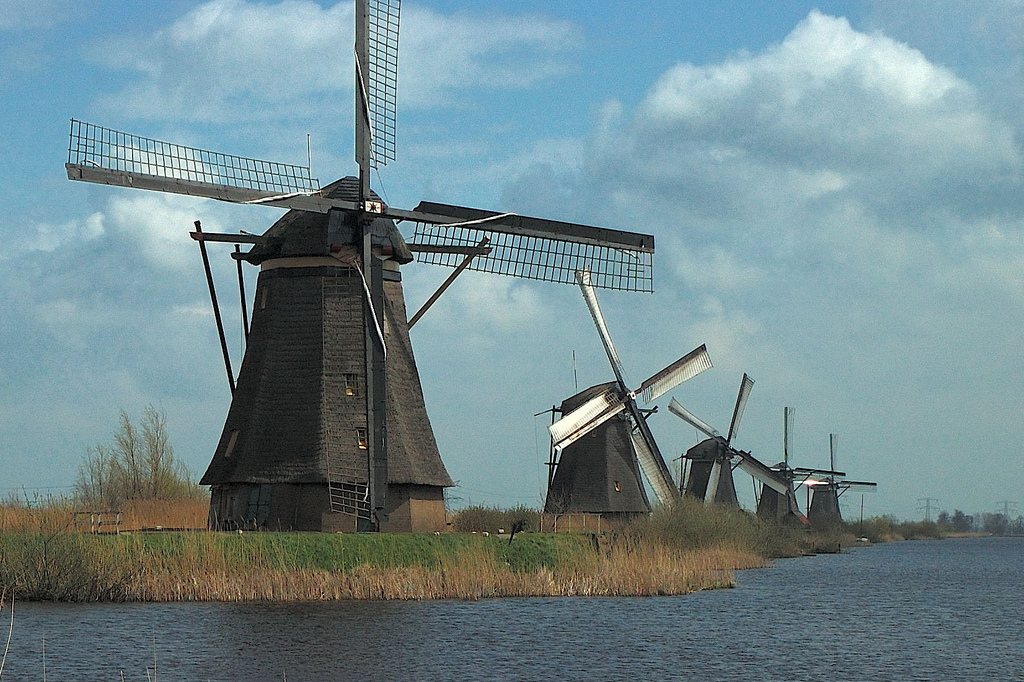
The windmills of Kinderdijk are the most famous Dutch landscape on Earth, 19 beautifully preserved 18th-century windmills lined up along the canals of the Alblasserwaard polder near Rotterdam, forming a UNESCO World heritage site that is the single strongest image of the Netherlands in the global imagination. More than just a photo opportunity, Kinderdijk is a functioning water management system; the windmills, together with pumping stations, dykes, and reservoirs, have been keeping this land (much of it well below sea level) dry for nearly 300 years. The ingenuity of the Dutch water management system, demonstrated in its purest form at Kinderdijk, is a staggering feat of human engineering that has literally shaped the country.
In This Article
Quick Facts: Kinderdijk Windmills
- Best time to visit: Year-round; the windmills are most atmospheric in the golden light of early morning or late afternoon; September for the illumination weeks (Mills in Floodlight, all 19 windmills lit up at night); July-August for the Saturday afternoon mill sails in operation
- How to get there: ~15 minutes from Rotterdam by car; ~1 hour from Amsterdam; Waterbus line 20 from Rotterdam Erasmusbrug to Kinderdijk (~30 min), a scenic approach; the site is also on the popular Rotterdam-Kinderdijk cycling route
- Entry fee: Free to walk or cycle the paths between the mills; ~16 (adult) for entry to the two museum windmills (Molen Nederwaard and Molen Blokweer) and the visitor centre film
- Best for: Photographers, cyclists, families, and anyone wanting to see the quintessential Dutch landscape
A Brief History of Kinderdijk’s Water Management
The story of Kinderdijk begins long before the windmills were built. The Alblasserwaard polder, a low-lying region in the province of South Holland, has always been vulnerable to flooding from the Lek and Noord rivers. As early as the 13th century, Dutch engineers began constructing dykes and drainage canals to protect the land. However, by the 18th century, the natural drainage through sluice gates was no longer sufficient. The solution was an ingenious system of wind-powered water mills that could lift water from the polder into a reservoir, which then drained into the river during low tide.
The construction of the Kinderdijk windmill network began around 1740, with 19 windmills built in two distinct groups: eight mills at the Overwaard pumping station and eight at the Nederwaard pumping station, plus three additional mills at the Nieuw-Lekkerland side. Each mill used a paddle wheel or Archimedes screw to raise water approximately 1.4 metres into a higher canal. This seemingly modest lift, repeated in stages, kept the entire polder dry. The system worked so well that it remained the primary drainage method into the early 20th century, with some windmills maintained in operational condition for emergencies until the 1950s. Today, the windmills are preserved as a working monument, and on designated days visitors can see the massive sails turning and the paddle wheels lifting water, exactly as they did 275 years ago.
Experiencing the Kinderdijk Site Today
The best way to explore Kinderdijk is on foot or by bicycle. A network of paved paths winds through the site, crossing the narrow canals and passing directly beneath the towering windmills. The entire loop is approximately 7 kilometres and takes two to three hours at a leisurely pace, including stops at the museum mills. The paths are flat and accessible, making them suitable for families with children and cyclists of all abilities. Bicycles can be rented at the visitor centre, and electric bikes are available for those who prefer a bit of assistance. Cycling through the polder with windmills stretching across the flat horizon is one of the most iconic Dutch experiences imaginable.
Inside the two museum windmills, visitors can see the living quarters of the millers’ families, complete with period furniture, kitchen equipment, and photographs documenting life in the mills before they were electrified. The narrow staircases and low ceilings give a vivid sense of the cramped conditions in which these families lived, often with eight or more children. The adjacent Wisboom pumping station, a late-19th-century steam-powered facility that eventually replaced the windmills, is also open to visitors and houses an interactive exhibition on Dutch water management history. For those visiting in September, the Mills in Floodlight event is truly magical: all 19 windmills are illuminated with warm lights, creating a perfectly reflected mirror image in the still canal waters. It is a photographer’s dream and one of the most photographed landscapes in the Netherlands.
Have you walked or cycled the Kinderdijk windmill path at sunrise? Share your iconic Dutch landscape photos and experiences in the comments! 🌷
Explore all our Netherlands travel guides, from Amsterdam canals to tulip fields.
Explore More
If you enjoyed this article, you might also like:
