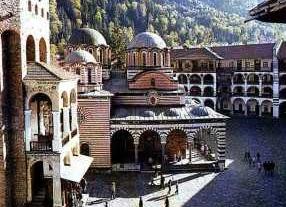
Rila Monastery is Bulgaria’s most sacred and visually spectacular site, a UNESCO World heritage monastery hidden in the deep forests of the Rila Mountains, whose striped black-and-white arcades, golden domes, and vivid frescoes form the spiritual and architectural crown jewel of the Bulgarian Orthodox Church. Founded in the 10th century by the hermit Saint John of Rila, the monastery has been rebuilt and expanded over the centuries into a vast fortified complex of extraordinary beauty, the largest and most famous Eastern Orthodox monastery in the Balkans, and a symbol of Bulgarian national identity that survived five centuries of Ottoman rule.
In This Article
The Monastery Complex: Architecture and Frescoes
The Rila Monastery complex, enclosed within formidable defensive walls that rise to 24 metres in height, feels more like a fortress than a place of contemplation. Entering through the main gate, visitors step into a vast inner courtyard dominated by the Cathedral Church of the Nativity of the Virgin, the centrepiece of the entire complex. The church was built between 1834 and 1837 by master builders from the Bulgarian Revival period, who created a five-domed basilica of extraordinary ambition. The exterior is painted in dramatic alternating bands of black and white, a distinctive scheme that makes the church instantly recognisable. The five domes are covered in gold leaf, and the central dome rises to 24 metres above the courtyard floor.
The interior of the church is covered from floor to ceiling in frescoes painted between 1840 and 1846 by artists led by the masters Zahari Zograf and Dimităr Zograf. The frescoes present a complete visual encyclopedia of Orthodox theology and Bulgarian history, with over 1,200 individual figures depicted across the walls and domes. The scenes include the life of Christ, the Virgin Mary, the apostles, and narrative cycles depicting the founding of the monastery and the miracles of Saint John of Rila. The wooden iconostasis, carved in the late 19th century, is one of the finest examples of Bulgarian woodcarving, its intricate patterns of vines and geometric designs gilded against a dark background. The entire courtyard is surrounded by four-storey galleries of monks’ cells with tiered wooden balconies painted in geometric patterns.
Saint John of Rila and Monastic History
Saint John of Rila, the founder of the monastery and the patron saint of Bulgaria, was born around 876 AD in the village of Skrino near Dupnitsa. After becoming a monk and spending years as a hermit in a cave in the Rila Mountains, he attracted a community of disciples who established the first monastery on the site around 927 AD. His humility and spiritual authority earned him the respect of the Bulgarian tsars, and he is credited with laying the foundations of Bulgarian monasticism. His relics remain in a silver reliquary in the main church.
The monastery’s history is one of repeated cycles of construction, destruction, and renewal. The original wooden buildings were replaced by stone in the 14th century, only to be burned down by Ottoman forces after the Bulgarian rebellion of the 1440s. The devastating fire of 1833 destroyed most of the monastery, leaving only the original Tower of Hrelja, built in 1335, standing as the oldest surviving structure. The rebuilding that followed, completed by 1862, created the monastery as it appears today, one of the supreme achievements of the Bulgarian National Revival. Throughout Ottoman rule, the monastery functioned as a centre of Bulgarian culture and learning, maintaining a library that preserved countless manuscripts and providing refuge to scholars and revolutionaries.
Visiting Rila: The Relics and the Museum
The monastery museum holds one of the most remarkable objects in the Orthodox world: the Rafail’s Cross. This extraordinary wooden cross, measuring 81 by 43 centimetres, was carved by the monk Rafail over 12 years using fine needles and a magnifying glass. The cross depicts 140 biblical scenes with over 1,500 tiny human figures carved in microscopic detail. Rafail went completely blind from the strain of the work, which is considered one of the supreme masterpieces of Bulgarian religious art. The museum also contains icons, manuscripts, and liturgical objects spanning six centuries of Orthodox tradition.
The best time to visit is early morning, before the tour buses arrive from Sofia. The drive from Sofia takes about two hours through the Rila Mountains, following the Rilska River valley through forests of pine and beech. Several hiking trails start from the monastery, including the path to Saint John of Rila’s cave, a three-hour round trip ending at a small chapel built into the rock where the saint lived as a hermit. The monastery offers simple accommodation in the monks’ cells for those who wish to experience the spiritual atmosphere after the day-trippers have departed, and the sound of bells echoing across the mountain valley at sunset lingers long after the visit ends.
View The Rila monastery – the most popular tourist site among all monasteries in Bulgaria in a larger map
Have you walked Rila Monastery’s colonnades or discovered Bulgaria’s mountain monasteries? Share your Bulgarian spiritual and cultural discoveries in the comments! ⛪
Explore all our Bulgaria travel guides, from the Black Sea to the Rila Mountains.
Explore More
If you enjoyed this article, you might also like:
