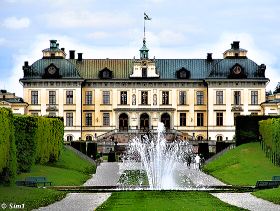
The spires of Drottningholm Palace rise elegantly above the manicured hedges of its French-style gardens, reflected perfectly in the still waters of Lake Mälaren. This is the private residence of the Swedish royal family, a living palace where the King and Queen have made their home since 1981, yet large sections are open to the public throughout the year. Built in the 17th century on the model of a French château, Drottningholm is the best-preserved royal palace in Sweden and a UNESCO World heritage Site, offering visitors a rare glimpse into the daily life and ceremonial traditions of the Swedish monarchy.
The Palace Interiors
The palace contains lavishly decorated state apartments, each room more ornate than the last. The Royal Library, with its floor-to-ceiling bookshelves and gilded detailing, houses the personal collection of the royal family. The Hall of State, used for official ceremonies and banquets, features a magnificent ceiling painting depicting the glory of the Swedish Empire. The palace chapel, still used by the royal family for Sunday services, is a masterpiece of Baroque design with its white and gold interior and the royal pew enclosed by a carved wooden screen. The Chinese Pavilion, a short walk through the park, is a delightful 18th-century pleasure palace inspired by the chinoiserie style that swept through Europe at the time, complete with gilded dragons, pagoda-style roofs, and a dining room where an elaborate mechanical table once rose from the floor.
The Palace Theatre and Gardens
The Drottningholm Palace Theatre is one of the best-preserved 18th-century theatres in Europe, still using its original stage machinery, scenery, and seating. The theatre was built in 1766 and fell into disuse after the death of Gustav III in 1792, only to be rediscovered in the 1920s with its original equipment intact. Today, it hosts regular performances of Baroque and Classical opera during the summer months. The gardens surrounding the palace are divided into three distinct styles. The formal Baroque garden, with its symmetrical parterres, fountains, and clipped hedges, stretches from the palace towards the lake. The English-style park, with its winding paths, ancient oaks, and ornamental ponds, offers a more natural contrast. The sculpture park features works by Swedish and international artists.
Visitor Information
Drottningholm is located on Lovön island, roughly 30 minutes from central Stockholm by public transport. Buses from the T-Centralen metro station run regularly, and ferries from Stockholm City Hall offer a scenic approach across Lake Mälaren during the summer months. The palace is open from May through September, with reduced hours in the shoulder seasons and winter months. Admission to the palace costs approximately 160 Swedish kronor for adults, with combination tickets available for the Chinese Pavilion and the Palace Theatre. The gardens are free to enter and open year-round. The best time to visit is on a sunny summer afternoon when the gardens are at their finest and the theatre is in performance.
Have you visited the Swedish royal family’s private residence at Drottningholm? What part of the palace impressed you most?

Drottningholm Palace (Drottningholms slott) is a private royal residence located on one of the outlying islands of Stockholm (Lovön), right on the shores of Lake Mälaren.
The palace was built by John III of Sweden in 1580 for his queen, Catherine Jagellon. The Queen Dowager Regent Hedwig Eleonora, widow of Charles X Gustav, bought the castle in 1661. She gave the command to rebuild a site in 1662.
until today there are still 30 of the original props and decorations in the unique Baroque theater, built in 1766 in the Palace. The summer is still issued here with operas and theatrical performances. For safety reasons, the interior of the theater was designed with special electric lamps, instead of candles.
The entire complex is strongly inspired by Versailles and the surrounding beautiful park with symmetrical and architectural features are worth the walk. On the way to large garden complex are seen two ponds, canals, bridges, large open grassy areas, trees standing in groups or arranged in an alley, plenty of fountains, the Chinese pavilion dating from 1753 and many statues .. Most of the ancient marble sculptures were purchased by Gustav III in Italy, but here you find the Mannerist sculptures by Adrian de Vries from the Wallenstein Garden in Mala Strana, Prague, which was taken as war booty by the Swedish soldiers in the Thirty Years War.
View Drottningholm Palace – one of Sweden’s Royal Palaces in a larger map
Have you explored the natural wonders and historic treasures described here? Share your favourite European travel memory in the comments below!
Explore all our Sweden travel guides, from Stockholm archipelago to northern Lapland.
Explore More
If you enjoyed this article, you might also like:
