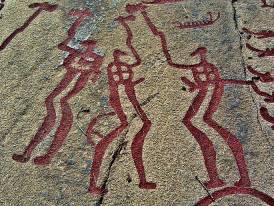
The Tanum rock carvings are one of the world’s most extraordinary prehistoric art sites, a UNESCO World heritage collection of over 1,500 Bronze Age petroglyphs etched into the glacially smoothed granite bedrock of western Sweden. Dating back 3,000 years or more, these remarkable carvings depict warriors, ships, animals, hunting scenes, and mysterious rituals that offer an unparalleled window into the lives and beliefs of Bronze Age Scandinavia.
In This Article
Quick Facts: Tanum Rock Carvings, Sweden
- Best time to visit the Tanum rock carvings: May-September; the carvings are painted with red ochre in summer to enhance visibility; the Vitlycke Museum is open year-round
- Top panels to see: Vitlycke (the largest), Aspeberget, Litsleby, and Fossum, all within a few kilometres of each other
- How to get to Tanum: ~1.5 hours from Gothenburg by car (E6 north); Tanum station is on the Gothenburg-Oslo railway line; buses connect Tanumshede to the rock art sites
- Entry fee: Free to visit the rock panels; Vitlycke Museum entry is free
- Best for: Archaeology enthusiasts, history lovers, families, and anyone captivated by prehistoric Europe
What Makes the Tanum Rock Carvings Special?
Carved between approximately 1800 BC and 500 BC, the Tanum petroglyphs are unusually rich in figurative detail. The most common motifs are ships, over 300 of them, ranging from simple outlines to elaborate vessels with detailed crews and ornamentation. Also depicted are warriors with shields and spears, horses, oxen, deer, hunting scenes, ploughing scenes, ceremonial processions, and enigmatic cup-marks (shallow circular depressions) whose exact purpose remains debated.
UNESCO inscribed the site in 1994, noting its ‘outstanding universal value’ as ‘a unique artistic achievement through their rich and varied motifs’ and ‘an exceptional testimony of many aspects of life in European Bronze Age’.
The carvings were made by hammering or pecking the granite bedrock with a harder stone tool, creating shallow grooves that contrast with the surrounding rock. One of the most striking features is the sheer concentration of petroglyphs within a small area. While similar carvings exist elsewhere in Scandinavia, nowhere else can you find such a dense and varied collection. The motifs reveal a society deeply connected to the sea, with ships appearing in more than two-thirds of all panels. These Bronze Age people were skilled seafarers and traders, part of a network that stretched from Scandinavia to the Mediterranean. The ships are of the Hjortspring type, long and narrow with prominent stem and stern. The presence of warriors and weapons suggests conflict and status were important, while cup marks and ritual scenes point to a complex religious belief system centred on the sun, fertility, and the seasons.
A Guide to the Main Rock Art Sites
- Vitlycke Panel: The most impressive and accessible panel, featuring the famous ‘Lovers’ carving (a embracing couple), a large ship, a warrior with an outsized phallus, and numerous cup marks. Adjacent is the excellent Vitlycke Museum with reconstructions of a Bronze Age farm.
- Aspeberget: A large sloping outcrop with carvings of bulls, ships, and the famous ‘Sun Horse’, a horse pulling a sun disc, a key Bronze Age religious symbol.
- Litsleby: Home to the ‘Spear God’, a 2.3-metre-tall warrior figure, the largest known Bronze Age carving of an individual human figure in Scandinavia.
- Fossum: Features an unusually detailed composition showing over 130 figures in what appears to be a narrative hunting and battle scene, one of the most complex known Bronze Age compositions.
Rock paintings (petroglyphs) is a unique work of art located in Tanum, Sweden, near the borders with Norway. It is the largest flat rock of Nordic Bronze Age petroglyphs in Scandinavia. The paintings are found on several stone blocks. They have a rich and diverse themes. Showing people, animals, weapons, boats and other objects. There is a large number of them. Petroglyphs are in excellent quality and shows the life and faith of people living in the Bronze Age. The paintings were discovered recently (in 1972 by Age Nilsen) and it is expected that the other are still waiting to be discovered.
The area around Tanumshede has been declared a World heritage Site by UNESCO in 1994.
Planning Your Visit to Tanum
The best time to visit the Tanum rock carvings is between May and September, when the panels are painted with red ochre to enhance their visibility. This summer painting tradition, begun in the 1990s, makes the intricate details much easier to see with the naked eye. The Vitlycke Museum is the natural starting point for any visit, with exhibitions explaining the Bronze Age context, the techniques used to create the carvings, and the ongoing research into their meaning. The museum also features a full-scale reconstruction of a Bronze Age farm, complete with livestock, giving visitors a tangible sense of daily life 3,000 years ago. The museum and all main panels are free to enter, making this an exceptionally accessible UNESCO site. All four major panels are within a 5-kilometre radius, connected by marked walking trails and country roads. Allow a full day to visit all of them properly. The landscape itself is worth the journey, with glacially scoured granite outcrops, small lakes, and mixed forest creating a serene setting. Guided tours are available in English during the summer months and are highly recommended for understanding the symbolism of the carvings. The nearest town, Tanumshede, offers accommodation, restaurants, and a tourist information centre with maps and advice.
View The rock carvings in Tanum, Sweden in a larger map
Have you discovered the rock carvings of Tanum or explored Sweden’s prehistoric sites? Share your impressions and favourite panels in the comments below! 🗿
Explore all our Sweden travel guides, from Stockholm archipelago to northern Lapland.
Explore More
If you enjoyed this article, you might also like:
