
The basilica of Saint Francis of Assisi rises from the hillside like a vision of peace, its simple Romanesque facade belying the artistic treasures held within. This is the spiritual heart of the Franciscan order, a UNESCO World heritage Site that draws pilgrims and art lovers from across the globe. Saint Francis, born here in 1181 as Giovanni di Pietro di Bernardone, founded the Franciscan order and transformed the medieval church with his message of poverty, humility, and love for all creation. The basilica that bears his name was built in his honour shortly after his death in 1226 and consecrated just two years later.
In This Article
The Frescoes of Giotto
The basilica of Saint Francis consists of two churches built one above the other. The upper basilica is famous for the cycle of 28 frescoes by Giotto and his workshop, depicting scenes from the life of Saint Francis. These frescoes, completed around 1300, are considered a watershed moment in Western art, marking the transition from the formal, stylised figures of Byzantine painting to a more naturalistic and emotionally engaging style. Giotto’s use of perspective, gesture, and facial expression was revolutionary for its time and influenced generations of painters who followed. The frescoes were badly damaged in the 1997 earthquake that struck Umbria, but careful restoration work has returned them to their former glory, and visitors can now view them in their restored condition.
The Lower basilica and the Sacro Convento
The Lower basilica, built into the hillside, is darker and more intimate, with a low vaulted ceiling decorated with frescoes by Simone Martini and Pietro Lorenzetti. The Chapel of Saint Martin, containing Martini’s exquisite fresco cycle, is one of the highlights. The crypt beneath the Lower basilica contains the stone tomb of Saint Francis, a simple and moving space that is the destination of countless pilgrimages each year. The adjacent Sacro Convento, the monastery attached to the basilica, houses a museum of Franciscan art and a library containing some of the order’s most precious manuscripts. The cloister offers a peaceful space for reflection, with a well at its centre and views across the Umbrian countryside.
Exploring the Town of Assisi
Assisi itself is a beautifully preserved medieval hill town, with narrow cobbled streets, ancient stone buildings, and stunning views over the Umbrian valley. The Roman Temple of Minerva, now incorporated into the church of Santa Maria sopra Minerva, stands in the main square and is a reminder of the town’s ancient origins. The Rocca Maggiore, a 14th-century fortress at the top of the hill, offers panoramic views over the town and the surrounding countryside. The town’s restaurants serve traditional Umbrian cuisine, including truffles, wild boar, and locally produced olive oil and wine. The best time to visit is spring or autumn, when the weather is mild and the crowds of summer pilgrims have thinned. Allow a full day to explore both the basilica and the town.
Have you walked through the frescoed halls of the basilica of Saint Francis and felt the spiritual power of this extraordinary place? What moved you most about Assisi?
Assisi is a town located in the central Italian region of Umbria and one of the most important pilgrimage sites in the country. It is linked with the life of St. Francis, who lived here from 1181 to 1226. The town is considered a historical treasure of Italy.
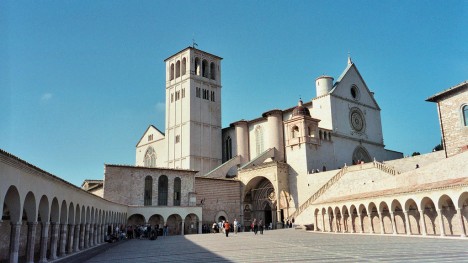
basilica di San Francesco, Assisi, Umbria, Italy by Jim Linwood
The town stretches along one side of Monte Subasio. A typical feature of Assisi are picturesque houses decorated with pink geraniums, narrow winding streets, small squares with fountains, a number of churches and other monuments from pre-Christian times. Visitors to Assisi can enjoy tranquility, comfort and cleanliness.
St. Francis of Assisi was born here in 1181 and later founded the Secular Franciscan Order. But the city has a much longer history. The city was inhabited already in around 1000 BC. From the Roman period there have been preserved several sights: city walls, forum, where is now the Piazza delle Commune, an amphitheater and the Temple of the Goddess Minerva where is now the church of Santa Maria sopra Minerva. From the original temple only the front face with 6 columns have been preserved.
Most sites, however, comes from the Middle Ages, when the city experienced its greatest prosperity, and was several times under papal jurisdiction. Among the most important monuments from this period are:
- basilica of San Francesco d’Assisi (UNESCO World heritage Site) and the Franciscan monastery which were built in 1228 – 1253. The basilica was badly damaged by an earthquake of 26 September 1997 – where four people died inside the church
- Pilgrimage basilica of Santa Maria degli Angeli, built in 1569
- the Cathedral of San Rufino, built in 1140 – 1253
- basilica of Santa Chiara from 1257
- Santo Stefano – one of the oldest churches of Assisi
In Assisi there are much more beautiful religious buildings, which are definitely worth seeing. The main square of the city is already mentioned Piazza delle Commune, which was formerly the Roman Forum. Assisi is dominated by the medieval Castle of Rocca Maggiore, built in 1367 by Cardinal Albornoz. There is also the smaller castle in Assisi which was built much earlier, in the Roman era. However, only small part has been preserved and only three towers are open to the public.
The city offers to the visitors lots of cultural events. Most renowned festival is Calendimaggio, which is held here every year in early May. It presents the medieval way of life where you can see many actors of theater and dancing crews. Since 2000, the town of Assisi, is UNESCO World heritage Site. Today there are living about 27.000 people.
In the city neighbourhood you can reach following destinations:
- Urbino – about 73 km
- San Marino – about 97 km
- Montefiore Conca – about 91 km
- Rocca fortress – about 97 km
- the Leaning tower of Vernazzano – about 45 km
- Orvieto Cathedral – about 57 km
