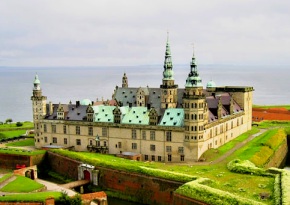

If you take the ferry from Helsingør to Helsinborg, it is hard to miss the fortified castle of Kronborg at the coast. It became famous mainly because its corridors and rooms were used for William Shakespeare tragedy Hamlet. It is known as Elsinor in the play. That is why most tourists are from England.
In This Article
Architecture and Renaissance Design of Kronborg
Kronborg Castle stands as one of the most important Renaissance castles in Northern Europe, a testament to the ambition of King Frederick II. The original fortress, known as Krogen, was built by King Eric of Pomerania in the 1420s as a toll house controlling the narrow strait between Denmark and Sweden. In 1574, Frederick II commissioned the transformation into a magnificent Renaissance palace, hiring Flemish architects and artisans. The result was a four-winged structure with a grand courtyard, ornate gables, copper spires, and sandstone decorations from the Netherlands. The Great Hall, measuring 62 meters in length, was the largest banquet hall in Northern Europe and remains one of the most impressive surviving Renaissance interiors. The chapel, completed in 1582, retains its original wooden decor, altarpiece, and pews, offering a rare glimpse into court religious life during the Renaissance.
The castle strategic position at the narrowest point of the Oresund strait was no accident. Kronborg controlled the vital shipping route between the North Sea and the Baltic, and its cannons enforced the collection of Sound Dues from passing vessels. This toll system provided the Danish crown with enormous revenue for over four centuries. The outer fortifications, expanded in the late 17th century, included advanced defensive earthworks that made Kronborg the strongest fortress in Europe at the time. The ramparts offer exceptional views of the strait and the Swedish coast.
Shakespeare and the Legacy of Elsinore
William Shakespeare never visited Kronborg Castle, yet his decision to set Hamlet in Elsinore made the fortress one of the most famous literary landmarks in the world. Shakespeare likely learned about Kronborg through traveling actors and merchants. The castle became synonymous with the brooding atmosphere of the tragedy, its dark corridors providing a perfect setting for ghostly encounters and political intrigue. The famous stage direction from Hamlet Act I, Scene I reads “Elsinore: A platform before the Castle,” capturing the essence of Kronborg battlements overlooking the sea. Today, the castle hosts annual Shakespeare performances in the courtyard during summer. The HamletScenen festival has been running since 1816, making it one of the oldest continuous Shakespeare performance traditions anywhere.
A statue of Hamlet stands in the castle courtyard, and visitors can tour the casemates where the ghost of Hamlet father is said to walk. The underground passages, which once housed soldiers and prisoners, add to the mysterious atmosphere. Guided tours frequently reference scenes from the play, bringing the literary connection to life.
Visiting Kronborg Castle Today
Kronborg Castle was added to the UNESCO World heritage List in 2000. The castle is open to visitors year-round with guided tours in multiple languages. Highlights include the Great Hall, royal apartments, the chapel, and the casemates where the legendary Danish hero Holger Danske is said to sleep. The castle also houses the Danish Maritime Museum. The best views are from the ferry approaching from Sweden, where the full scale of its fortifications and the elegance of its spires become apparent against the Scandinavian sky.
The castle was originally used to collect duties and was later rebuilt as a Renaissance castle. However it is important to note that Renaissance means something different in Scandinavia than in Italy. Later the castle was used as barracks for two centuries.
Kronborg Castle has been added to UNESCO World heritage Sites list in 2000.
History of Kronborg Castle
- In 1420s the fortress Krogen was built by the Danish king Eric of Pomerania.
- In 1585 was rebuilt by Frederick II into a Renaissance castle and renamed Kronborg.
- In 1629 the castle was totally burned due to a mistake by two workers.
- In 1639 the castle was restored by Christian IV, but the interior never fully regained its former glory.
- From 1688-1690 an advanced line of defence and ramparts were built, making Kronborg the strongest fortress in Europe.
- From 1739 until the 1900s, Kronborg was used as a prison.
View Kronborg Castle in Denmark the place of William Shakespeare famous tragedy Hamlet in a larger map
Explore all our Denmark travel guides, from Copenhagen canals to Viking heritage.
Explore More
If you enjoyed this article, you might also like:
