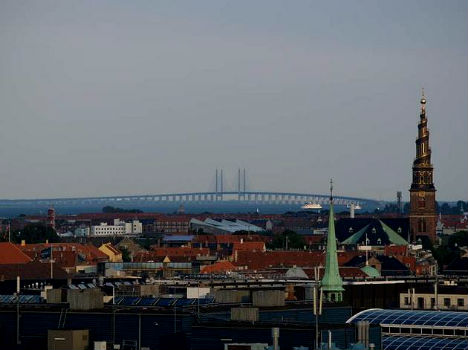
The train emerges from the tunnel beneath the sea and rises onto the Öresund Bridge, where the horizon opens into an endless expanse of silver-grey water and pale Scandinavian sky. eight kilometres of steel and concrete connect Sweden to Denmark, carrying cars and rail passengers across one of the most remarkable engineering feats in Europe. Sea wind whips across the deck as the bridge arcs toward Copenhagen, visible in the distance.
Engineers have constructed (1995 – 2000) Öresund Bridge (Øresundsbron) to establish the connectivity between Sweden and Denmark. Öresund Bridge is the longest railway and highway bridge in European continent and plays a vital role to ensure good communication system. Öresund Bridge makes a link between Danish capital city of Copenhagen and the major Swedish city of Malmö.
Photo licensed under the Creative Commons, created by Hunter-Desportes
European E20 route passes through Öresund Bridge as well, which is important connection between Scandinavia and Central and Western Europe. But not only the bridge is interesting here. Another part of this route is a well-built tunnel under the sea that ensures better navigation and transportation network for the ships. The long tunnel permits fleets of large cargo boats, passenger ships and speed boats steer safely through this extended tunnel.
On Öresund Bridge you will pass the borders but thanks to Schengen Agreement there are usually no passport inspections.
View Öresund Bridge – the longest road and rail bridge in Europe – between Sweden and Denmark in a larger map
The Architect of the bridge is Georg Rotne who designed several important bridges throughout the world. Öresund Bridge is 7,845 meters long and up to 23.5 meters wide and today it serves to more than 17,000 road vehicles every day.
If you visit Sweden or Denmark in the future, you have to make a trip by train or car through this unique bridge and tunnel. It is really very impressive!
View Öresund Bridge – the longest road and rail bridge in Europe – between Sweden and Denmark in a larger map
The Engineering Marvel of the Öresund Bridge
The Öresund Bridge is not simply a bridge. It is a 16-kilometre combination of bridge, artificial island, and tunnel that represents one of the most daring engineering projects in European history. The bridge section stretches nearly 8 kilometres from the Swedish coast to the artificial island of Peberholm, a 4-kilometre-long strip of land created specifically for this project. The bridge carries both a four-lane motorway and a double-track railway on two separate decks, with the rail line tucked beneath the road to minimise wind resistance. The main span, a cable-stayed section measuring 490 metres between pylons, rises 57 metres above the water to allow ships to pass beneath.
The decision to build a tunnel for the final section rather than extending the bridge was driven by an unusual constraint. Copenhagen Airport lies close to the Danish landing point, and tall bridge pylons would have interfered with flight paths. The solution was the Drogden Tunnel, a 4-kilometre immersed tube tunnel built from 20 prefabricated concrete sections, each weighing 55,000 tons, that were floated into position and sunk into a trench on the seabed. Construction began in 1995 and took five years, involving 2,500 workers, 100,000 tonnes of steel, and 1.2 million cubic metres of concrete. The total cost of 30 billion Swedish kronor was recovered through tolls in just over 20 years. The bridge opened in July 2000 and has carried over 100 million vehicles since then, fundamentally changing the connection between Scandinavia and continental Europe.
Crossing the Bridge and the Kastrup Sea Bath
Crossing the Öresund Bridge is an experience in itself, weather you drive or take the train. The train journey from Malmö to Copenhagen Airport takes just 20 minutes, and passengers on the upper deck of the double-decker trains get the best views as the bridge rises above the grey-green waters of the strait. For drivers, the toll at the Lernacken toll plaza in Sweden costs around 55 euros for a standard car one way, with discounts for frequent users and pre-booked tickets. The crossing takes about 10 minutes by car, and the sensation of driving from land onto a bridge that disappears into the sea before emerging onto an island and then into a tunnel is genuinely memorable.
On the Danish side, the Kastrup Sea Bath offers a unique way to experience the Öresund waters. This architectural swimming platform, designed by Bjarke Ingels Group, extends from the Kastrup Strandpark into the sound, creating a circular, shell-shaped pool that fills with naturally filtered seawater. The wooden deck provides space for sunbathing and diving, and the water temperature reaches a comfortable 18 to 20 degrees Celsius in summer. From the sea bath, you can look back at the bridge stretching toward Sweden, creating a perfect photo opportunity that frames the engineering achievement against the natural beauty of the sound. The sea bath is free to use and open 24 hours a day from June through August, with changing rooms and showers available on site.
Would you cross the sea by bridge or by tunnel? 🌉
Explore all our Denmark travel guides, from Copenhagen canals to Viking heritage.
Explore More
If you enjoyed this article, you might also like:
