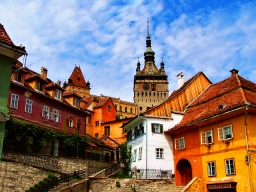
Perched on a hill in the heart of Transylvania, the medieval citadel of Sighișoara looks like a storybook illustration brought to life. Colourful houses line cobbled streets, Gothic spires pierce the skyline, and the entire old town is encircled by fortified walls with nine surviving towers, each one originally defended by a different guild of craftsmen. This is one of the best-preserved medieval towns in Europe and a UNESCO World heritage Site. It is also the birthplace of Vlad the Impaler, better known as Count Dracula, whose father was known as Vlad Dracul, giving the town an enduring connection to one of literature’s most famous characters.
In This Article
The Citadel and Its Towers
The upper town, or citadel, is entered through the Clock Tower, a 64-metre-high structure that dominates the skyline. The tower, built in the 14th century, houses a small history museum and offers panoramic views over the town and the surrounding countryside from its upper balcony. The clock mechanism, dating from the 17th century, still operates and features a parade of wooden figurines that emerge on the hour. The nine surviving towers, each named after the guild that defended them, include the Tailors’ Tower, the Butchers’ Tower, and the Tanners’ Tower. The Scholars’ Stairs, a covered wooden staircase built in 1642, connects the lower town to the citadel and originally had 300 steps, though only 175 survive today.
The Birthplace of Vlad the Impaler
The house where Vlad the Impaler is believed to have been born in 1431 now functions as a restaurant, the Casa Vlad Dracul. The building, with its distinctive Gothic windows and red facade, is one of the most photographed in the town. A small exhibition on the upper floor tells the story of Vlad’s life, his reputation for cruelty, and his transformation into the literary figure of Dracula through Bram Stoker’s 1897 novel. The restaurant serves traditional Romanian cuisine, including mici, grilled minced meat rolls, and sarmale, cabbage rolls stuffed with pork and rice. The connection to Dracula has made Sighișoara a popular destination for fans of Gothic literature, though the town itself is far more charming than frightening.
Exploring the Town and Practical Tips
Sighișoara is easily explored on foot, with the entire historic centre compact enough to visit in a single day. The main square, Piața Cetății, is lined with cafes and restaurants and is the heart of the social life in the old town. The nearby Church on the Hill, a 14th-century Gothic church, contains frescoes and a carved wooden altar worth seeing. Sighișoara is well connected by train to other Transylvanian cities, including Brașov, Cluj-Napoca, and Sibiu, making it an ideal stop on a Romanian road trip. The best time to visit is from May to September, when the weather is warm and the medieval festival in July brings the streets alive with music, dance, and historical re-enactments. Accommodation in the citadel ranges from atmospheric guesthouses to modern hotels, though booking in advance is essential during the summer months.
Have you walked the cobbled streets of Sighișoara and felt the medieval atmosphere of this Transylvanian gem? Did you visit the birthplace of Vlad the Impaler?

Sighisoara is one of the most interesting cities in Romania. If you should choose for your trip just one town, go there. It’s not a big city (approx. 32,000 inhabitants), but it is located on the main railway and most international trains are passing through it. Although Sighisoara at first glance looks like most Romanian cities (dug up, dirty and neglected), a closer look to show you that this is a really beautiful town. Sighisoara is located right in the center of Romania.
The city was founded sometime in the late of 12th century by rich Saxon merchants. Its strategic importance gradually grew and the fortifications were improved. Sighisoara is well known because of Vlad Tepes or Vlad III the Impaler (known as Dracula) was born here around the year of 1430.
Historical center is located on a hill, and it is thoroughly fortified. From the train station it takes for about 15 minutes to get there. At the courtyard there is the landmark of the city – Clock Tower, a 64m high tower built in the 13th century where is now museum. There is also Dracula’s family house, which is now one of the best (and most expensive) local restaurant.
There is a medieval festival in the courtyard and city events.
What else you can see in Sighisoara?
- Sighisoara Citadel – a 12th Century Saxon edifice, is the historic center of the city. Still inhabited, the citadel is listed as a World heritage Site
- Weapon Museum – next to Vlad’s birthplace. Very small, but it contains an interesting selection of medieval weapons (swords, arrows, etc.)
- Covered Staircase – a very old stone staircase with a wooden roof along the whole span. This leads up to the Church on the Hill and the cemetery
- Church on the Hill – contains many frescoes and a crypt. Built on the location of a Roman fort. Located on the side of the hill next to it is one of the Lutheran cemeteries in the city, which contains many tombstones of Germans.
- Bust of Vlad Tepes – Located around the corner from his birthplace, within sight of the Clock Tower
View Sighişoara – one of the most interesting Romanian cities and birthplace of Dracula in a larger map
Have you explored the natural wonders and historic treasures described here? Share your favourite European travel memory in the comments below!
Explore all our Romania travel guides, from Transylvania castles to the Danube Delta.
Explore More
If you enjoyed this article, you might also like:
