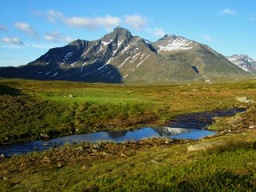
Sarek National Park is the largest area of unspoiled wilderness in Europe, a vast, roadless mountain kingdom in Swedish Lapland where 2,000-metre peaks, massive glaciers, and deeply carved U-shaped valleys create a landscape so rugged and remote that it has been called “Europe’s last wilderness.” Part of the Laponian Area UNESCO World heritage site, Sarek is not for casual tourists: there are no marked trails, no mountain huts, and no facilities, just 200 peaks, 100 glaciers, and some of the most spectacular trekking on the continent for experienced backcountry hikers.
In This Article
Quick Facts: Sarek National Park, Sweden
- Best time to visit: Late June–early September for summer trekking; July–August for 24-hour daylight; March–April for ski touring
- Size: 1,970 km², larger than Greater London, with no roads, no trails, and no mobile phone coverage
- How to get there: ~2 hours from Kiruna by car to the trailhead at Ritsem or Kvikkjokk; both are reachable by bus in summer; the nearest road is the famous Wilderness Road (Vildmarksvägen)
- Experience required: Sarek is for experienced, self-sufficient wilderness trekkers only, you must carry all food, navigate by map and compass, and ford glacial rivers
Trekking Through Sarek Untouched Wilderness
Sarek National Park offers one of the most demanding yet rewarding trekking experiences in Europe. With no marked trails, no bridges across its raging glacial rivers, and no mountain huts, this is true wilderness travel at its most raw. Experienced trekkers typically spend 5 to 10 days traversing the park, navigating by map and compass through a landscape that has remained unchanged for centuries. The classic route runs from Ritsem in the north to Kvikkjokk in the south, crossing the massive Rapadalen valley where the famous Rapaselet delta fans out into Lake Laitaure. This 80-kilometre traverse takes most parties 5 to 7 days and requires fording several glacial rivers fed by the park hundred glaciers. Water temperatures rarely rise above 5°C even in July, making a good pair of wading shoes and trekking poles essential gear. The best months for this crossing are July and August when the snow has cleared from the passes and the 24-hour daylight of the Arctic summer gives you the flexibility to hike at any hour.
Wildlife and Natural Highlights of the Park
Sarek National Park is a sanctuary for some of Europe most iconic wildlife species. The park is home to Europes largest population of brown bears outside Russia, with an estimated 2,000 individuals roaming the valleys and forests. Reindeer herds belonging to the indigenous Sami people graze the high plateaus during the summer months, their bells chiming across the tundra. Wolverines, lynx, and golden eagles all thrive in this protected wilderness, while the Arctic fox, one of Scandinavia most endangered mammals, finds refuge in the higher alpine zones above the treeline. Birdwatchers will find the park a paradise: dotterel, ptarmigan, and the majestic sea eagle all nest here. The flora is equally remarkable, with over 500 species of vascular plants adapted to the harsh sub-Arctic climate. In late July and early August, the valley floors explode with colour as the alpine flowers reach their peak bloom. The contrast between the deep green birch forests of the lower valleys and the stark grey granite of the 2,000-metre peaks is unforgettable.
Practical Tips for Your Sarek Expedition
Planning a trip to Sarek requires careful preparation. The nearest supply points are the villages of Kvikkjokk and Ritsem, both accessible by bus from Jokkmokk or Gallivare during the summer months. Kvikkjokk has a small mountain lodge with basic provisions, a sauna, and boat rental for crossing the delta. Ritsem offers similar facilities and sits at the edge of the massive Lake Akkajaure reservoir. You must carry all food for the duration of your trek, as there are no shops or huts inside the park. A typical daily food weight of 800 grams per person for 7 days means roughly 5.6 kilograms of food per person. Water is abundant from the countless streams and rivers, but always treat it with a filter or purification tablets due to the presence of beaver and other wildlife upstream. A 4-season tent capable of withstanding strong winds is non-negotiable, as weather in Sarek can shift from warm sunshine to freezing rain and gale-force winds within an hour. Pack layers: a base layer, fleece, windproof and waterproof outer shell, and a down jacket for evenings. The mosquitoes can be relentless in July, so a high-quality insect repellent and a head net are essential additions to your pack.
Sarek National Park is Sweden’s second largest national park bordering Padjelanta national park which is located 20 km from Kvikkjokk. It is the largest area of unspoilt countryside in Europe. There are mountains, glaciers, deep valleys, rich flora and fauna. In the park there are no shelters for tourists, hunting and fishing is forbidden.
The national park is popular with hikers and mountaineers, but not suitable for beginners. Sarek National Park has no marked trails, no accommodation possibilities.
Sarek National Park was established in 1909 (in this year the first national parks in Europe have been established) and protects nearly 2000 km2 of wilderness.
Sarek National Park is best reached from Kvikkjokk. Another way is by ship from Ritsema on the north side through the lake Akkajaure. weather you choose any path you will get into absolute wilderness. You will find here more than 100 peaks that are higher than 1,800 meters and over a hundred glaciers.
View Sarek National Park in Sweden – largest area of unspoilt nature in Europe in a larger map
Have you trekked in Sarek or explored Swedish Lapland’s wilderness? Share your Arctic adventures in the comments! 🏔️
Explore all our Sweden travel guides, from Stockholm archipelago to northern Lapland.
Explore More
If you enjoyed this article, you might also like:
