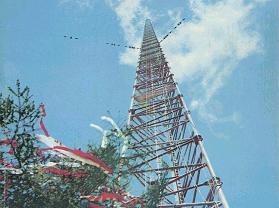
The Warsaw Radio Mast was the tallest structure ever built, a 646.38-metre-high radio transmission mast near Konstantynów in central Poland that, from its completion in 1974 until its dramatic collapse in 1991, was the tallest man-made structure on Earth, taller than the Burj Khalifa would be when it opened 20 years later. The mast was built to transmit Radio Poland’s longwave signal across the country and the Polish diaspora worldwide, its 2-megawatt signal was powerful enough to be received as far away as North America and Australia. The mast’s collapse during maintenance work in August 1991 was an engineering tragedy; today, the tower’s foundation and the small memorial at the site are a pilgrimage destination for engineering enthusiasts and a poignant monument to Cold War-era technological ambition.
In This Article
Quick Facts: Warsaw Radio Mast
- height: 646.38 metres, remained the tallest structure on Earth for 17 years (1974–1991); today dwarfed only by the Burj Khalifa (828m), the Merdeka 118 (679m), and the Tokyo Skytree (634m)
- Location: Near Konstantynów, ~80km west of Warsaw
- Status: Collapsed August 8, 1991; the site is not a tourist attraction but can be visited by those interested in engineering history. The neighbouring guy-wire anchors and the transmitter building are still visible
- Significance: The tallest structure ever built in Europe, a record likely to stand permanently given modern aviation height restrictions and the shift away from longwave radio
Engineering Triumph: Building the World’s Tallest Structure
The Warsaw Radio Mast was an extraordinary feat of Cold War engineering, designed and built by Polish engineers and workers at a time when the Polish People’s Republic was eager to demonstrate its technological capabilities on the world stage. The mast was a guyed steel lattice structure, meaning it was held upright by a system of steel guy wires anchored at multiple levels, rather than being a freestanding tower. This design allowed the mast to achieve its exceptional height while using a relatively modest amount of steel. The mast was erected in sections using a specialised climbing crane, a process that took several years and required extraordinary precision and skill from the construction teams working hundreds of metres above the ground.
The mast’s official name was the Radiofoniczny Ośrodek Nadawczy w Konstantynowie (Radio Broadcasting Centre in Konstantynów), also known as the Warszawska Radiostacja Centralna (WRC) in Gąbin. Its primary function was to transmit the first programme of Polish Radio (PR1) on the longwave frequency of 225 kHz. The transmitter, one of the most powerful in the world, operated at 2 megawatts, enabling its signal to reach Polish communities across Europe, North Africa, and as far away as North America and Australia. For millions of Poles living abroad under communist rule, the sound of Radio Poland’s longwave broadcast was a vital link to their homeland, making the mast not just an engineering landmark but a symbol of national connection.
The Collapse of the Warsaw Radio Mast
On 8 August 1991 at 19:10 local time, during routine maintenance work to replace guy-wire ropes that had deteriorated, the Warsaw Radio Mast suffered a catastrophic structural failure. The upper section of the mast buckled and broke, colliding with the lower section and causing the entire structure to collapse in a matter of seconds. Remarkably, no one was killed or injured in the collapse, as the maintenance crew had been evacuated from the mast moments before the failure. The collapse destroyed a small crane but left the transmitter buildings and substation undamaged.
The cause of the collapse was attributed to corrosion of the guy-wire ropes, design vulnerabilities identified as early as 1984, and the specific dynamics of the maintenance operation that stressed the already weakened structure. Engineers had detected damage from wind-induced vibrations years earlier and proposed building a stronger mast, but the idea was never implemented amid the economic turmoil of Poland’s transition from communism. The collapse marked the end of an era in longwave broadcasting, as satellite and digital technologies were making such colossal transmission towers obsolete.
Visiting the Site and Legacy of the Mast
Today, the site near Konstantynów, about 80 kilometres west of Warsaw, is a quiet field where the mast’s concrete foundations and guy-wire anchor points can still be seen. A small memorial plaque commemorates the structure that once dominated the flat Masovian landscape. The surviving transmitter building stands as a relic of Cold War-era broadcasting. While not a formal tourist attraction, the site attracts engineering enthusiasts, radio amateurs, and history buffs who visit what remains of the tallest structure ever built in Europe.
The legacy of the Warsaw Radio Mast extends beyond its physical remains. For 17 years, it held the record as the tallest man-made structure on Earth, a record that would not be surpassed until the completion of the Burj Khalifa in Dubai in 2010. Even today, it remains the tallest structure ever built in Europe, a record that is unlikely to be broken given modern aviation height restrictions and the declining importance of longwave radio transmission. The mast’s story has been preserved in books, documentaries, and museum exhibits, ensuring that future generations will remember this remarkable chapter in Poland’s engineering history. For those interested in visiting, the mast’s foundation is located in a rural area near the village of Gąbin, accessible by car from Warsaw, and the nearby town of Łowicz offers additional historical attractions worth exploring.
View Warsaw Radio Mast in Poland – tallest structure in Europe that have ever been built in a larger map
Have you visited the site of the Warsaw Radio Mast or have a fascination with Europe’s engineering landmarks? Share your thoughts on Poland’s lost giant in the comments! 📡
Explore all our Poland travel guides, from Kraków square to the Tatra Mountains.
Explore More
If you enjoyed this article, you might also like:
