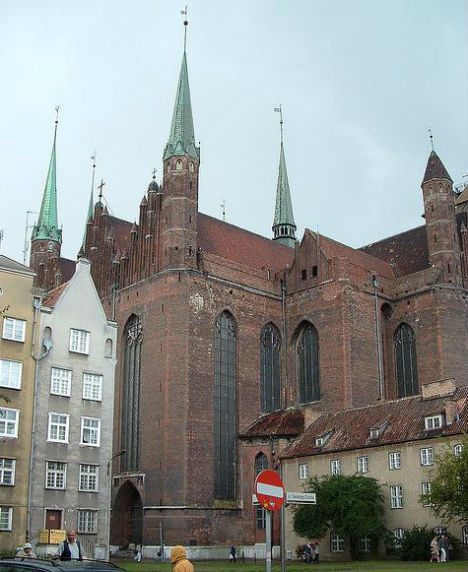
St. Mary’s Church in Gdańsk (Bazylika Mariacka) is the largest brick Gothic church in the world, a colossal 14th-15th-century basilica in the heart of Poland’s most beautiful Baltic city whose soaring nave, 78-metre tower, and capacity of 25,000 worshippers make it one of the most awe-inspiring religious buildings in northern Europe. Built over 159 years (1343-1502) by the wealthy merchants of the Hanseatic League, St. Mary’s was severely damaged in World War II when Gdańsk was reduced to rubble, but was painstakingly rebuilt by Polish conservationists, the restoration is one of the great triumphs of post-war European heritage reconstruction.
In This Article
Quick Facts: St. Mary’s Church, Gdańsk
- Best time to visit: Year-round; the tower climb is most rewarding on clear days (views over Gdańsk, the Motława River, and the Baltic Sea on the horizon); summer afternoons for the astronomical clock procession (noon)
- How to get there: The church dominates the Gdańsk Old Town skyline, a 5-minute walk from the main railway station (Gdańsk Główny)
- Tower climb: 409 steps to the top (82 metres); ~€4 (adult), the panorama of Gdańsk’s reconstructed old town, the shipyard cranes, and the Baltic Sea is one of the best city views in Poland
- Key artwork: The 15th-century astronomical clock by Hans Düringer, a masterpiece of medieval craftsmanship with moving figures, zodiac signs, and a calendar; and the copy of Hans Memling’s Last Judgement triptych (the original is in the National Museum next door)
Architectural Marvels of the Largest Brick Church
One of the greatest landmarks of the Polish city of Gdansk is certainly a medieval brick church of the Virgin Mary. This church of red bricks (indeed almost all the churches in Gdańsk except for Oliwa Cathedral are made of red bricks) boasts world record: it is the largest brick church in the world. Its construction started in 1343, but was completed 150 years later. Now it can hold up to 25,000 worshippers. This truly monstrous Gothic building has the shape of the cross and features a great nave and huge windows along the entire perimeter. The brick construction is not merely a practical choice, but an artistic statement: the warm red tones of the bricks give the church a distinctive appearance that changes with the light throughout the day. You should visit it early in the morning when the sun is still low, it’s worth to wake up early! The church’s dimensions are staggering: 105 metres long, 66 metres wide, and the vaulted ceiling rises 29 metres above the floor. The nave alone is 31 metres wide, making it one of the widest Gothic naves in Europe.
A Turbulent History and Remarkable Reconstruction
Final finishing works were carried out under the guidance of architect Henry Hetzel. From 1529 until 1945 it served to the Protestants. It was destroyed during the World War II and then undergone extensive reconstruction, just like many other monuments in Poland. The interior of the church is furnished with a Gothic, manneristic and baroque furniture. You can see here also several memorial plaques of the leading local families. The post-war reconstruction was a monumental task: the church had been reduced to a burned-out shell, with its roof collapsed and most of its interior destroyed. Polish conservationists spent decades painstakingly restoring the building, using original bricks salvaged from the rubble wherever possible. The reconstruction was finally completed in 1955, and the church was reconsecrated as a Catholic basilica. Today, the building stands as a powerful symbol of Gdańsk’s resilience, much like the city itself.
Art and Treasures Within
The interior of St. Mary’s houses an extraordinary collection of art spanning several centuries. The centrepiece is the magnificent 15th-century astronomical clock, created by Hans Düringer between 1464 and 1470. This complex mechanical masterpiece displays the time, date, phases of the moon, and zodiac signs, and features moving figures that process at noon each day. The church also contains a copy of Hans Memling’s Last Judgement triptych, one of the most important works of early Netherlandish painting; the original is displayed in the National Museum located next to the church. Other notable artworks include the Gothic Pieta from 1420, the 16th-century epitaphs of wealthy Gdańsk merchant families, and the magnificent late-Gothic high altar. The 78-metre tower, accessible via 409 steps, rewards climbers with a panoramic view of Gdańsk’s reconstructed old town, the shipyard cranes at the former Lenin Shipyard, and on clear days, the Baltic Sea stretching to the horizon.

Photo licensed under the Creative Commons, created by Kristian Dela Cour
View St. Mary’s Church in Gdańsk the largest Brick Gothic church in the world Poland in a larger map
Have you climbed St. Mary’s tower or discovered Gdańsk’s brick Gothic skyline? Share your Polish cathedral experiences in the comments! ⛪
Explore all our Poland travel guides, from Kraków square to the Tatra Mountains.
Explore More
If you enjoyed this article, you might also like:
