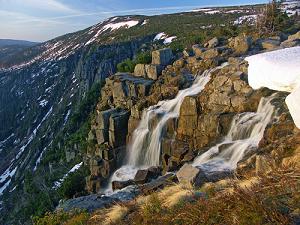
Pančava Waterfall is the highest cascade in the Czech Republic, tumbling 148 metres down a rocky amphitheatre in the heart of the Krkonoše Mountains. Fed by the Pančava stream and surrounded by subarctic tundra vegetation found nowhere else in Central Europe, it\’s a breathtaking sight that rewards those willing to hike into the country\’s highest mountain range.
In This Article
Quick Facts
- Best time to visit: Spring or after heavy rain for the strongest flow; summer for alpine wildflowers
- height: 148 metres (486 feet), falling in multiple cascades
- How to get there: ~2.5 hours from Prague by car to Špindlerův Mlýn, then a 3-hour round-trip hike
- Hiking difficulty: Moderate to challenging, the trail passes through exposed alpine terrain
- Entry fee: Krkonoše National Park is free to access
The Geology and Formation of Pančava Waterfall
Pančava Waterfall is a testament to the powerful forces of glacial erosion that shaped the Krkonoše Mountains during the last Ice Age. The waterfall cascades down the side wall of the Labský důl valley, a classic U-shaped glacial valley carved by the movement of ice sheets thousands of years ago. The water flows from the Pančavská Meadows, a high-altitude plateau at approximately 1,300 metres, and drops 148 metres in a series of cascades to join the Elbe River in the valley below. The waterfall is not a single drop but a complex series of four main cascades, measuring 36, 40, 23, and 20 metres respectively, with smaller steps and rapids in between. The overall slope of the waterfall is 45 degrees, giving it a steep but not vertical profile that allows the water to flow in a series of dramatic leaps and plunges. The rock over which the waterfall flows is granite, the dominant bedrock of the Krkonoše Mountains, which is resistant to erosion and gives the waterfall its permanent, stable character. The flow rate averages 35 litres per second but varies significantly with the seasons, reaching its peak during the spring snowmelt and after heavy summer rainfall. In winter, the waterfall partially freezes, creating spectacular ice formations that attract ice climbers and photographers.
The Unique Arctic-Alpine Ecosystem of the Krkonoše Tundra
The area surrounding Pančava Waterfall is one of the most remarkable natural environments in Central Europe. The high-altitude plateaus of the Krkonoše Mountains, known as the Krkonoše tundra, are home to an Arctic-alpine relic ecosystem that has survived since the last Ice Age. This means that plant and animal species normally found only in the Arctic Circle or the high Alps survive here, isolated on these mountain islands surrounded by temperate lowlands. The Pančavská Meadows, at the top of the waterfall, are covered with subarctic tundra vegetation including cloudberry, a plant that produces edible golden berries and is a relic from the Ice Age. The Krkonoše endemic saxifrage, a small flowering plant found nowhere else on Earth, grows in the rocky crevices near the waterfall. Other rare species include the dwarf willow, the alpine bistort, and the glacier crowfoot. The area is also home to the critically endangered Arctic hare, known here as the Krkonoše mountain hare, which turns white in winter for camouflage. Bird species include the Alpine accentor, the ring ouzel, and the water pipit. This unique ecosystem is protected within the Krkonoše National Park, and visitors are asked to stay on marked trails to avoid damaging the fragile vegetation.
Hiking Routes and Practical Information
The most popular approach to Pančava Waterfall starts from the resort town of Špindlerův Mlýn, the main tourist centre of the Czech Krkonoše Mountains. From the town centre, follow the red-marked trail that ascends through the Labský důl valley, passing the beautiful Labský waterfall along the way. The trail continues to the Labská bouda mountain hut, a historic refuge where hikers can rest and enjoy refreshments. From the hut, a marked detour leads to the viewpoint above Pančava Waterfall. The round trip from Špindlerův Mlýn takes approximately three hours and covers about 8 kilometres with 450 metres of elevation gain, making it a moderate hike suitable for most fitness levels. The trail is well maintained and clearly marked, but sturdy walking shoes are essential as the terrain can be uneven and slippery, especially after rain. An alternative approach is from the town of Pec pod Sněžkou, which offers a longer but equally scenic route through the Obří důl valley. The best time to visit is late spring or early summer, when the snowmelt fills the waterfall with the greatest volume of water, and the alpine meadows are carpeted with wildflowers. Autumn is also beautiful, with the golden colours of the dwarf birch and willow contrasting with the dark green of the spruce forests.
Have you visited Pančava waterfall, the highest waterfall in the Czech republic? I\’d love to hear about your experience and any travel tips in the comments below!
Discover more destinations in our sitemap or explore by destination.
Explore all our Czech Republic travel guides, from Prague spires to Moravian wine country.
Explore More
If you enjoyed this article, you might also like:
- Orlické hory – a mountain ideal for skiing and hiking in the Czech Republic – Czech Republic
- Kutná Hora – historic town in Czech Republic – Czech Republic
- Lužnice – enjoy canoeing on the river in real nature paradise in Czech republic – Czech Republic
